If your time is limited, or if you’re a newcomer to town, we’ve made two short, connectable city walks that will lead you past the highlights of Berlin. Each takes about 45 minutes, without breaks. The sights mentioned along the walk are to be found in the Sightseeing section.
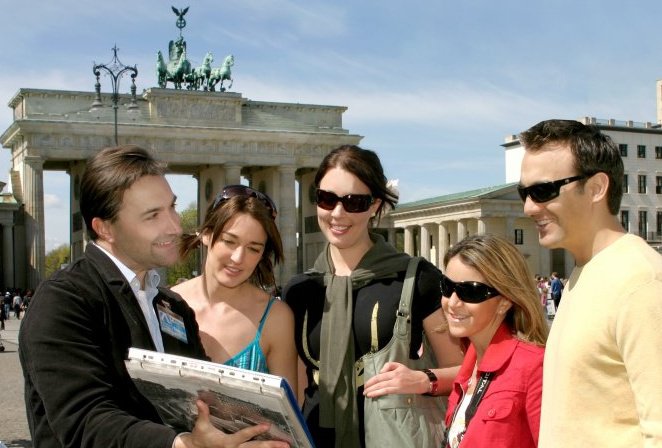
The first walk is a beeline from Alexanderplatz along Karl-Liebknecht-Straße and down Unter den Linden, that takes in many of the most important sights in Berlin. Your camera’s reward at the end of the stroll 'Under the Linden Trees' is the Brandenburger Tor.
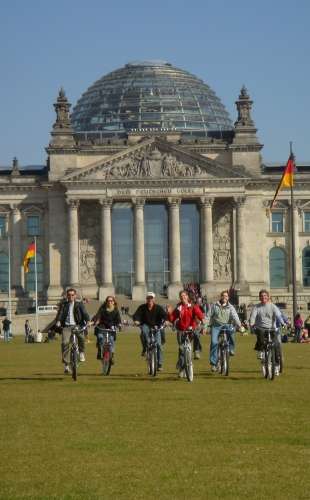
The second walk starts just beyond, and takes you from the heights of the Reichstag’s glass dome to the Cold War’s tense intersection, Checkpoint Charlie.
Alexanderplatz to Brandenburger Tor
From Alexanderplatz walk through the squares bordering Karl-Liebknecht-Straße, passing beneath the Berliner Fernsehturm, and then by the Marienkirche, Neptune Fountain and, to the left, the Rotes Rathaus (city hall). Patiently awaiting you on the near-empty Marx-Engels Forum opposite Spandauer Straße are the statuesque men themselves, Karl Marx and Friedrich Engels. Now take Karl-Liebknecht-Straße, named after the Communist leader slain in 1919, over the Spree River and onto the Museumsinsel. On your left is the much-maligned Palast der Republik (1976), the former East German parliament building. It’s slated for demolition to make room for a rebuilt royal Schloss, which before the East Germans dynamited it in 1950, stretched to the next bridge. Facing the lawns of the Lustgarten are the Berliner Dom and the Altes Museum by Karl Friedrich Schinkel. Cross Schinkel’s Schlossbrücke bridge and note that you can turn right to reach the must-see Pergamon Museum. Ahead is the pastel Deutsches Historisches Museum, once Prussia’s armoury. Only its new wing by I.M. Pei is open at the moment (to reach it, turn right at the next corner). The temple-like building next door, Schinkel’s Neue Wache, was the Royal Guardhouse until Kaiser Wilhelm abdicated in 1918. Today it is Germany’s national war memorial. Booksellers signal your arrival at Humbolt University. Across Unter den Linden is Bebelplatz, where Nazis organised a book-burning in May 1933. The square is surrounded by the Staatsoper, St. Hedwigs Cathedral and the university’s law faculty library. The man taking it all in on horseback is Frederick the Great, who ruled in Berlin from 1740 to 1786. He developed this area and also built Sanssouci in Potsdam. Take a short detour off Unter den Linden at Charlottenstraße to see the Gendarmenmarkt, dubbed Berlin’s most classic square. Take Jägerstraße west to Friedrichstraße, turn right and left again back on Unter den Linden. On the left side of the second long block is the Russian embassy. Cross Wilhelmstraße (where the British embassy is within view) and pass the doormen at Hotel Adlon to reach Pariser Platz and the grand finale, the Brandenburger Tor. To return to Alexanderplatz (or to continue westward to Zoo Bahnhof), board bus N°100 or 200.
Reichstag to Checkpoint Charlie
To reach the Reichstag, the federal parliament building, hop out of bus N°100 at Platz der Republik (or walk from the S-Bahn station Unter den Linden). To visit its dome, allow an hour. From the Reichstag, follow Ebertstraße which runs between it and Brandenburger Tor. You’ll pass crosses and liternature on the fence in memory of those who died trying to escape over the Wall, which ran right along this street, past the Reichstag and Brandenburger Tor - look for the double row of cobblestones on the pavement. The Straße des 17. Juni leads to the Soviet Memorial, and in the distance, to the angel-topped Sieggesäule. Continue south along Ebertstraße past the open plot reserved for the new American embassy, and next, the construction site of Germany’s national Holocaust memorial, the Memorial to the Murdered Jews of Europe. Ahead are the highrises of Potsdamer Platz; in 1989 this area was right up against the Wall and at an dead-end of West Berlin. Continue past Potsdamer Platz along Stresemannstraße. At Niederkirchnerstraße, the cobblestones that mark where the Wall ran make a sharp left - follow their lead. West Berlin’s border ran on the south side of the street. The front steps of the ornate Martin-Gropius-Bau were just a leap away from the Wall (the back entrance had to be used when the Wall still stood). The open-air exhibition next door, the Topography of Terror, is bordered by a remnant of the Wall, nearly pecked out of existence by souvenir hunters. Continue on, passing the Nazi’s massive Air Force Ministry (undamaged in the war and now the Ministry of Finance), to the intersection of Friedrichstraße and Zimmerstraße. Here was Checkpoint Charlie, the only crossing point into East Berlin for Western allies and non-Germans. The Haus am Checkpoint Charlie Museum is to the right. To reach bus N°100 again, take the U-Bahn at Kochstraße two stops to Französische Straße and then walk north to the Unter den Linden bus stop. To get on the S-Bahn system, take the U-Bahn one stop further to Friedrichstraße.
The first walk is a beeline from Alexanderplatz along Karl-Liebknecht-Straße and down Unter den Linden, that takes in many of the most important sights in Berlin. Your camera’s reward at the end of the stroll 'Under the Linden Trees' is the Brandenburger Tor.
The second walk starts just beyond, and takes you from the heights of the Reichstag’s glass dome to the Cold War’s tense intersection, Checkpoint Charlie.
Alexanderplatz to Brandenburger Tor
From Alexanderplatz walk through the squares bordering Karl-Liebknecht-Straße, passing beneath the Berliner Fernsehturm, and then by the Marienkirche, Neptune Fountain and, to the left, the Rotes Rathaus (city hall). Patiently awaiting you on the near-empty Marx-Engels Forum opposite Spandauer Straße are the statuesque men themselves, Karl Marx and Friedrich Engels. Now take Karl-Liebknecht-Straße, named after the Communist leader slain in 1919, over the Spree River and onto the Museumsinsel. On your left is the much-maligned Palast der Republik (1976), the former East German parliament building. It’s slated for demolition to make room for a rebuilt royal Schloss, which before the East Germans dynamited it in 1950, stretched to the next bridge. Facing the lawns of the Lustgarten are the Berliner Dom and the Altes Museum by Karl Friedrich Schinkel. Cross Schinkel’s Schlossbrücke bridge and note that you can turn right to reach the must-see Pergamon Museum. Ahead is the pastel Deutsches Historisches Museum, once Prussia’s armoury. Only its new wing by I.M. Pei is open at the moment (to reach it, turn right at the next corner). The temple-like building next door, Schinkel’s Neue Wache, was the Royal Guardhouse until Kaiser Wilhelm abdicated in 1918. Today it is Germany’s national war memorial. Booksellers signal your arrival at Humbolt University. Across Unter den Linden is Bebelplatz, where Nazis organised a book-burning in May 1933. The square is surrounded by the Staatsoper, St. Hedwigs Cathedral and the university’s law faculty library. The man taking it all in on horseback is Frederick the Great, who ruled in Berlin from 1740 to 1786. He developed this area and also built Sanssouci in Potsdam. Take a short detour off Unter den Linden at Charlottenstraße to see the Gendarmenmarkt, dubbed Berlin’s most classic square. Take Jägerstraße west to Friedrichstraße, turn right and left again back on Unter den Linden. On the left side of the second long block is the Russian embassy. Cross Wilhelmstraße (where the British embassy is within view) and pass the doormen at Hotel Adlon to reach Pariser Platz and the grand finale, the Brandenburger Tor. To return to Alexanderplatz (or to continue westward to Zoo Bahnhof), board bus N°100 or 200.
Reichstag to Checkpoint Charlie
To reach the Reichstag, the federal parliament building, hop out of bus N°100 at Platz der Republik (or walk from the S-Bahn station Unter den Linden). To visit its dome, allow an hour. From the Reichstag, follow Ebertstraße which runs between it and Brandenburger Tor. You’ll pass crosses and liternature on the fence in memory of those who died trying to escape over the Wall, which ran right along this street, past the Reichstag and Brandenburger Tor - look for the double row of cobblestones on the pavement. The Straße des 17. Juni leads to the Soviet Memorial, and in the distance, to the angel-topped Sieggesäule. Continue south along Ebertstraße past the open plot reserved for the new American embassy, and next, the construction site of Germany’s national Holocaust memorial, the Memorial to the Murdered Jews of Europe. Ahead are the highrises of Potsdamer Platz; in 1989 this area was right up against the Wall and at an dead-end of West Berlin. Continue past Potsdamer Platz along Stresemannstraße. At Niederkirchnerstraße, the cobblestones that mark where the Wall ran make a sharp left - follow their lead. West Berlin’s border ran on the south side of the street. The front steps of the ornate Martin-Gropius-Bau were just a leap away from the Wall (the back entrance had to be used when the Wall still stood). The open-air exhibition next door, the Topography of Terror, is bordered by a remnant of the Wall, nearly pecked out of existence by souvenir hunters. Continue on, passing the Nazi’s massive Air Force Ministry (undamaged in the war and now the Ministry of Finance), to the intersection of Friedrichstraße and Zimmerstraße. Here was Checkpoint Charlie, the only crossing point into East Berlin for Western allies and non-Germans. The Haus am Checkpoint Charlie Museum is to the right. To reach bus N°100 again, take the U-Bahn at Kochstraße two stops to Französische Straße and then walk north to the Unter den Linden bus stop. To get on the S-Bahn system, take the U-Bahn one stop further to Friedrichstraße.