Castle

Castle
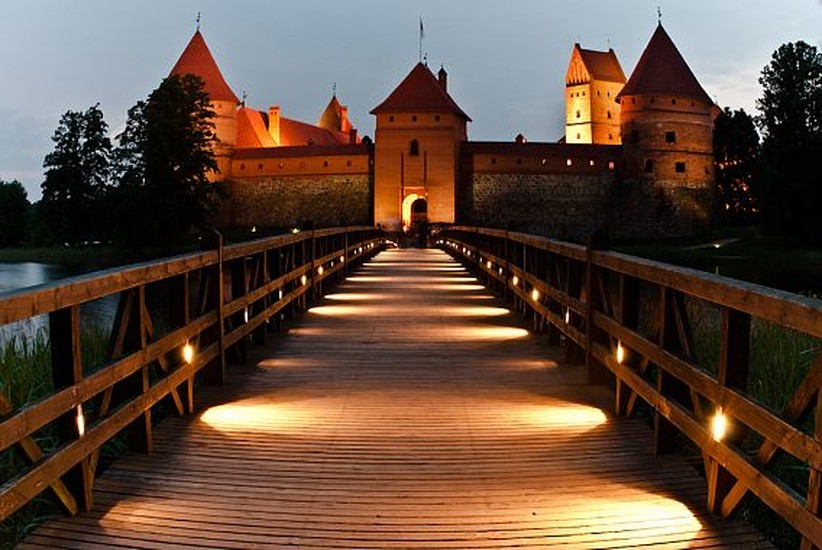
Drawing mild comparisons to the vast, red brick Teutonic fortress in the Polish town of Malbork, Trakai Castle (or Trakai Island Castle as it’s also known) may not be as grand as its Germanic cousin to the west, but what it lacks in stature it more than makes up for in location. Sat splendidly on a diminutive Lake Galvė island in the northern end of the town, construction on this Gothic masterpiece began in the 14th century at the behest of the then ruler of the Grand Duchy of Lithuania Kęstutis, and was completed at the start of the 15th century by his son, Vytautas the Great. Built as part of an expansion programme of the neighbouring Peninsular Castle, its completion came at more or less the same time that its military importance came to an end after the victory of the combined Polish-Lithuanian armies led by Vytautas against the Teutonic Order at the Battle of Grunwald (Lithuanian, Žalgiris) in 1410. Its second life as a residential palace saw it enter a golden age, with the Castle visited and admired by many foreign dignitaries including the Flemish diplomat Guillebert de Lannoy (1386-1462), who mentioned it favourably in his memoirs. The Castle’s demise came with the war with Muscovy in 1655, which saw it seriously damaged and eventually abandoned. Attempts to rebuild it have been ongoing since the 19th century, with the usual wars and border changes complicating each new project as it arose. Ironically it was during the Soviet occupation of Lithuania that the Castle was eventually restored to its former glory, with work beginning soon after the end of WWII. Reached by crossing two footbridges and one island, Trakai Castle is essentially two structures, namely the defensive outer section and the Ducal Palace. Entrance to the island and area around the Castle is free.