Watching football

Poland is a country with a rich football heritage, fanatical supporters and a major European tournament to look forward to hosting. However there have been major problems with corruption in recent years, widespread condemnation of the incompetent administration of the game by the Polish FA and a pretty serious hooligan issue. So while watching a game here is not discouraged, be warned that you may be surprised at the high level of trouble and the low standard of football.

Poland as a national side has finished 3rd in 2 World Cups and the older fans among you will remember the likes of Grzegorz Lato (Golden Boot winner at the West German World Cup of 1974), Kazimierz Deyna and Zbigniew Boniek (one half of the great Juventus midfield pairing with Michel Platini). Poles are big fans but the state of the game in this country in recent years has been depressing. A series of defeats, poor performances and lack of new talent have Poles thankful that they qualify for Euro 2012 by way of being hosts and the draw which placed in a group alongside Russia, Greece and the Czech Republic has seen the Polish group nicknamed the Group of Dreams.

With the national side typically recruiting from the limited number of players plying their trade in foreign leagues, Polish clubs are even worse off. Their standing in European competition, although improved in the 2011/12 season, is poor with their last representatives in the group stage of the Champions League being Widzew Lodz in 1996. Both Legia Warszawa and league champions Wisla Krakow did manage to qualify for the Europa League knockout stages this season and with the investment in new stadia hopes are finally being raised for the future of the game here.

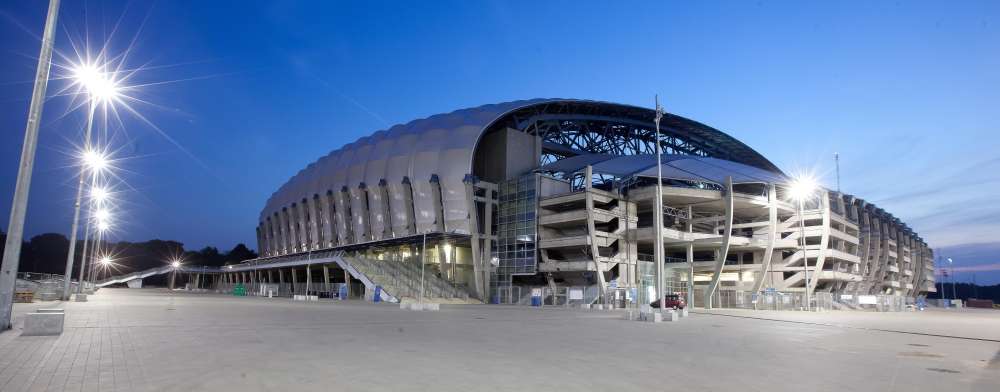
That said, you are probably in the best place in the country to watch football. Because believe it or not Lech Poznan, rather than Wisla Krakow or Legia Warsaw, are Poland’s best supported team. A rich football heritage, enthusiastic and vocal support and of course a modern, supporter friendly stadium, mean that this is one of the best places in the country to watch Polish football.

Lech’s history can be traced to 1922 when, playing in their traditional blue and white strip, they were first founded under the name of Lutnia Dębiec, a name which survived up until after WWII. They are commonly referred to by their nickname of ‘The Railwaymen’ due to their close ties with the Polish State Railway which can be traced back to the mid 1930s. Although the club eventually made it to the top flight in 1957, Lech’s fans would have to be patient for a couple more decades for success.

The man credited with launching Lech into the big time was head coach Jerzy Kopa. Kopa took over in 1976, with Lech at the bottom of the table. Gathering his team of under-performers at a training camp in Błażejewko the boss laid down the law, inspiring his charges to return from their sojourn and somehow cling to their top-flight status. It was this ‘miracle in Błażejewko’ that would serve as the catalyst, and by next season Kopa had transformed the side into title contenders.

Wojciech Łazarek took the hot seat in 1980 and oversaw the beginning of what is generally regarded as a ‘Golden Age’ for Lech. The club won the title in ’83 and ’84 and the Polish cup in ’82, ’84 and ’88. Following this last cup triumph, the blue and whites faced Barcelona in the second round of the Cup Winners’ Cup. Lech took Johann Cruyff’s all star side to the wire, eventually falling on penalties after drawing 1-1 both home and away.

More titles were added in ’90, ’92 and ’93, and Lech looked like they would rule Polish football for years to come. Then it all went wrong. Financial mismanagement had crippled Lech, and a fire sale of players broke up the nucleus of their invincible side. After years of flirting with relegation the axe finally fell in 2000 when the giants of Polish football were relegated following an unbroken stint of 28 years in the top division. It was a spectacular fall from grace, and it very nearly got worse – their first season in the second division saw them within a whisker of another relegation. Lech’s fall had bottomed out and they went on to win promotion the following season, the Polish Cup in 2004, and the league title returned to Poznan in 2010.

One thing to be aware of in Polish football is the peculiar allegiances that exist between supporters of different teams and more importantly the animosity amongst others. When two ‘friends’ are playing each other expect a cheery atmosphere, bbq and beer being provided by the hosts and the distinct lack of uniformed police and security. If, however, enemies are playing each other, don’t be surprised to see baton wielding, armoured police and scenes reminiscent of Braveheart. Complete lunacy. For the record Lech Poznan are good friends with Arka Gdynia and Cracovia while ‘enemies’ would be Slask Wroclaw, Wisla Krakow and Lechia Gdansk.