

Or: How We Learnt to Stop Worrying and Love a City That Runs on Time
So, you've arrived in Tokyo. Perhaps the flight in gave you a glimpse of Mount Fuji through the clouds, a perfect white cone floating above the smog like a postcard that has somehow made it into real life. Then you landed at Narita or Haneda, boarded a train that arrived at the precise second the departure board promised it would, and found yourself standing on a platform surrounded by signs in four scripts, none of which you can read, surrounded by commuters who are walking very fast and apologising to each other for it. Welcome, friend. You are going to be absolutely fine, and absolutely overwhelmed, in roughly equal measure.Tokyo is the largest city on earth, which is a fact your feet will confirm for you within about forty-eight hours. It sprawls across the Kantō Plain in a great urban continent of some thirty-seven million people, divided into wards and neighbourhoods, each with its own character, its own subway exit, and its own particular flavour of extraordinary. We've put together this guide to help you make sense of it all – or at least to help you understand why you can't make sense of it, and to reassure you that this is entirely intentional.
Shinjuku: The City Condensed Into One Ward
We might as well start here, because Shinjuku is in many ways Tokyo at its most Tokyo. On one side of the station – the world's busiest, by some measures, with over two hundred exits – you have the Kabukichō entertainment district: neon-soaked, loud, and unapologetically alive at three in the morning. On the other side you have the Tokyo Metropolitan Government Building and the sleek towers of the business district, all glass and civic seriousness. Shinjuku is a city that has decided it doesn't need to resolve its contradictions. It is simply getting on with things.The streets around the east exit at night are a marvel of organised excess. The Golden Gai is a tiny warren of perhaps two hundred minuscule bars, each holding somewhere between four and twelve people, that has survived every attempt to modernise it and remains one of the most atmospheric drinking destinations in the world. The Omoide Yokochō – Memory Lane – is a clutch of yakitori stalls under the train tracks, all smoke and skewered chicken and the feeling that you have stumbled into a scene that has not changed since 1954, which is more or less accurate.
Do eat here. Do drink here. Do attempt to find your hotel by landmark rather than by address, because Shinjuku's address system will defeat you, and the hotel staff have accepted this entirely and will be waiting for you.
Shibuya: The Crossing and Everything Around It
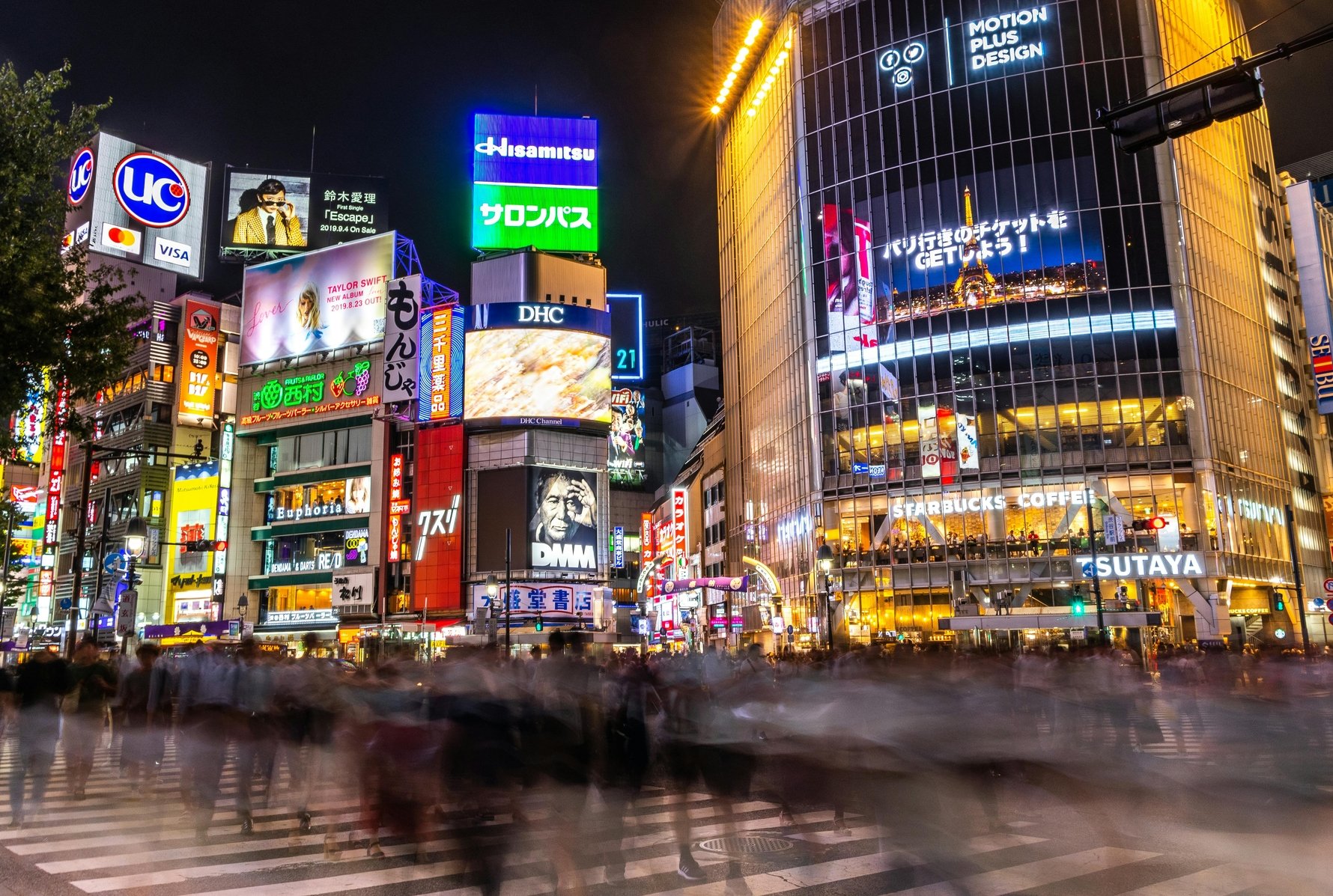
You have seen the photograph. The great pedestrian crossing in front of Shibuya Station, hundreds of people flowing in every direction simultaneously and somehow, miraculously, not colliding. It is one of those images that travels so far before you arrive that seeing it in person feels like meeting someone very famous: simultaneously more real and slightly less surprising than expected. It is, nevertheless, genuinely spectacular. Go at rush hour. Stand on the elevated walkway at the Scramble Square building and watch it below you. Wonder briefly about the mathematics of it.Beyond the crossing, Shibuya is the spiritual home of Tokyo's youth culture – at least one iteration of it, in a city that produces and discards aesthetic movements with remarkable speed. The side streets off Shibuya Centre-gai are full of fashion boutiques, record shops, and restaurants that don't open until eight in the evening and don't fill up until midnight. The area around Daikanyama and Nakameguro, a short walk away along the Meguro River, offers a quieter, more considered version of the same energy: smaller shops, excellent coffee, and canal paths that become one of Tokyo's most famous viewing spots when the cherry blossom arrives.
There is a bronze statue of a dog called Hachikō outside the station. He waited for his deceased owner there every day for nearly ten years. There will be tourists photographing him. You will photograph him too. This is entirely correct.
Harajuku & Omotesandō: Costume and Couture in Close Proximity
A short train ride from Shibuya brings you to what might be the most concentrated stretch of aesthetic contrast in the city. On one side, the wide zelkova-lined boulevard of Omotesandō – sometimes called Tokyo's Champs-Élysées, though it is considerably more interesting – where the world's great luxury brands have commissioned spectacular buildings in which to sell things most people cannot afford. The architecture alone is worth the walk: Herzog & de Meuron's mesh-wrapped Prada building, Tadao Ando's restrained concrete for several others, all jostling for understated supremacy in a street that is doing anything but.On the other side of the station, Takeshita Street offers the full, unapologetic spectacle of Harajuku's street fashion culture. It is narrow, extremely crowded, and lined with shops selling things that defy easy categorisation: clothing in shades unavailable in nature, accessories of uncertain purpose, and crepes filled with combinations of ingredients that belong more to aesthetic theory than to food. The young people who dress here – in styles ranging from fairy-kei to gothic Lolita to things that have not yet been named – are not performing for tourists. They are simply getting on with being exactly who they are, which is both charming and quietly instructive.
Nearby, the Meiji Shrine sits in one of Tokyo's great forested parks, an extraordinary pocket of silence and cedar trees that the city has somehow arranged itself around. The contrast between the shrine's gravel paths and the Harajuku streets ten minutes' walk away is one of those juxtapositions that Tokyo offers constantly and never quite explains.
Asakusa: The Old City and Its Insistent Temple
Asakusa is where Tokyo keeps its history, or at least the version of it that survived the fires of the Second World War and the rather more gradual fire of twentieth-century urban development. The Senso-ji Temple is the city's oldest, dedicated to the bodhisattva Kannon, and it is approached through the Nakamise shopping street – a long corridor of souvenir stalls selling rice crackers, folding fans, lucky charms, and regional confectionery that has been operating in some form for over three centuries. It is commercial, cheerful, and entirely sincere.The temple complex at the end of the approach is genuinely beautiful, particularly in the early morning before the tourist crowds arrive, when elderly visitors come to offer incense and prayer with the unhurried focus of lifelong habit. The great paper lantern in the Kaminarimon gate – the Thunder Gate – is one of Tokyo's most photographed objects, which means you should photograph it quickly and then wander away from the main axis entirely, because the streets behind the temple are quieter, older-feeling, and considerably more interesting.
The neighbourhood around Asakusa still has the flavour of the old shitamachi – the low city, the working city – where craftsmen's workshops, traditional restaurants, and sento public bathhouses operate alongside craft beer bars and boutique hotels with some apparent ease. Tokyo's most famous view of the Skytree, the city's brutally tall broadcasting tower, is obtained from the bridges over the Sumida River here, where the future and the past are arranged in the same frame and have no particular opinion about the matter.
Akihabara: The Electronics District and Its Many Subcultures
Akihabara exists in a state of almost aggressive specificity. It began as a black-market trading post for electronic components after the war and evolved, over several decades, into the global headquarters of anime, manga, and video game culture, with several floors' worth of electronics retail still operating underneath. The main street is lined with multi-storey shops selling everything from industrial components to collectable figurines to items of fan merchandise so niche that their existence implies a depth of devotion one can only admire.This is also the home of the maid café, an establishment where the staff are costumed as maids in an anime-adjacent style and serve coffee and omelette rice while calling you "Master" or "Mistress" with impressive commitment. The first-time visitor is advised to simply accept this and order the curry.
Akihabara is not for everyone. But if you have ever spent time with someone who cares deeply about any of the things sold here – and in a city of thirty-seven million people, the probability is high – then a few hours in its streets will tell you something about that person that you will find genuinely illuminating.
Yanaka: The Neighbourhood That Didn't Burn
Most of Tokyo burned – in the 1923 earthquake, in the firebombing of 1945, and in the various conflagrations in between. Yanaka didn't, or at least didn't burn as thoroughly as the rest, and the result is one of the city's most intact pre-war streetscapes: a hillside neighbourhood of wooden houses, temple graveyards, tofu shops, and cats sitting in the sun with the confident ease of animals who know they are universally adored.The Yanaka Ginza – a short covered shopping street – sells the kind of things that neighbourhood shopping streets used to sell before they all became convenience stores: fresh fish, pickled vegetables, sweet buns, and hardware. The temples and shrines that dot the area are small and neighbourhood-scale and smell of incense and old wood. Cats are everywhere and belong to no one in particular.
Yanaka will not give you the Tokyo of neon and skyscrapers. It will give you something rarer: a sense of what the city was like before it became what it is, and a suggestion that what it was was not without its own considerable beauty.
Tsukiji & Toyosu: Fish, at Scale
The inner wholesale market has moved to Toyosu, but the outer market at Tsukiji – the cluster of restaurants and fishmongers that surrounded the old wholesale operation – remains, and remains excellent. Breakfast here, ideally involving tuna in some form, is one of Tokyo's obligatory experiences. The combination of brisk efficiency, extraordinary freshness, and the mild chaos of tourists and professionals and delivery vehicles all occupying the same narrow lanes simultaneously is invigorating in the way that mornings involving very good fish tend to be.For the full spectacle of the tuna auctions, Toyosu now requires advance registration and considerable early rising. We mention this because it is extraordinary to witness and because the queues at Tsukiji will remind you that many other people have also read about it.
A Few Final Words of Orientation
Tokyo does not reveal itself immediately. It is a city of extraordinary depth that has been arranged, in part, specifically for the purpose of gradual discovery. The vending machines will delight you on day one and become entirely unremarkable by day three, at which point you will be ready for what comes next.You will get lost, despite the best efforts of the subway system, which is both incredibly efficient and slightly terrifying in its complexity until you surrender to it entirely. You will eat something extraordinary in a place that seats eight people and has no English menu and has been serving the same dish for forty years. You will bow slightly when you enter a shop and find, after a day or two, that this feels entirely natural. You will stand at the Scramble Crossing and feel the particular democratic miracle of a very large city moving through its day, and it will occur to you that Tokyo has figured something out about how many people can share a small space with patience and consideration and mutual regard, and that this is not a small thing.
The city is loud and serene, ancient and aggressively contemporary, utterly bewildering and, once you stop requiring it to make sense, perfectly navigable. It will feed you well, lose you cheerfully, and return you to your hotel at the end of each day with the slightly stunned satisfaction of someone who has been shown something remarkable and knows they have not seen half of it yet.
There are thirty-something wards and hundreds of neighbourhoods still waiting.
どうぞよろしく。 – Douzo yoroshiku. We hope you enjoy every bewildering, magnificent moment of it.
Comments