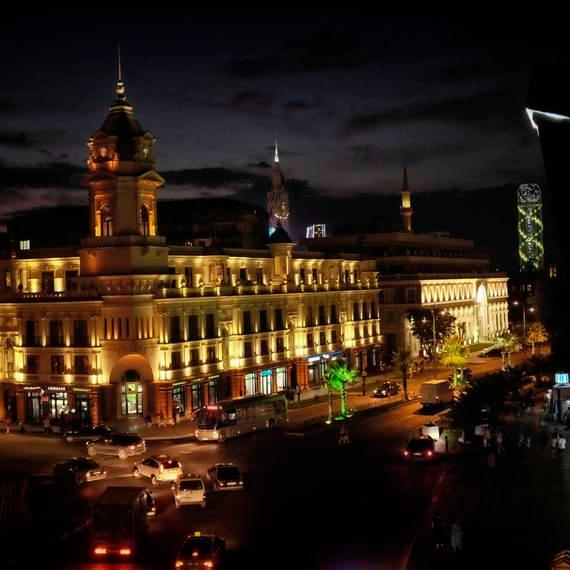
Batumi is a city that has committed to being a resort destination with the kind of enthusiasm that occasionally gets ahead of itself. The capital of the Autonomous Republic of Adjara, on Georgia’s southwestern Black Sea coast, it has spent much of the past two decades constructing towers, promenades and kinetic sculptures at a pace that would be admirable if all the projects had been finished. Some were not. What remains is an odd and not uncharming hybrid: a late 19th-century Russian Imperial port town with Ottoman layers underneath, topped with a modern resort that is part Tbilisi’s more optimistic cousin, part developer’s mood board come to life.
The older city – the part that predates the post-Soviet boom – is genuinely worth your time. Adjara’s history is longer and stranger than the seafront tower blocks might suggest: the region spent three centuries under Ottoman rule before passing to the Russian Empire in 1878, which gives the Old Town a religious and architectural mix you will not find elsewhere in Georgia. Batumi also happens to be 15 kilometres from one of the oldest Roman fortifications in the Caucasus, and within reach of a subtropical national park that receives more rainfall than almost anywhere in the country. Prices were accurate when this was written; check before you visit.
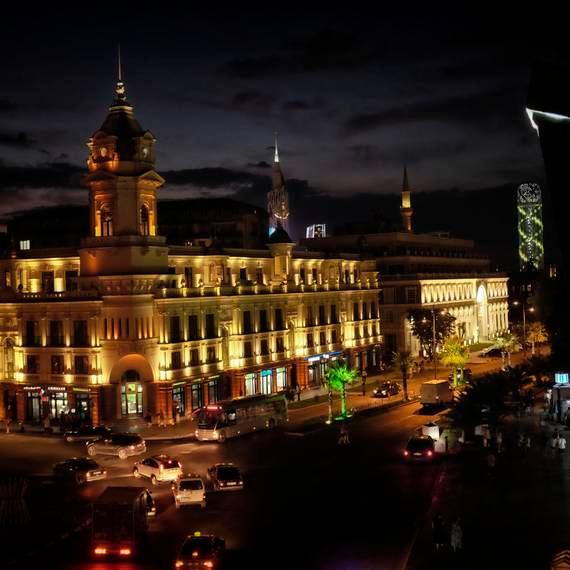
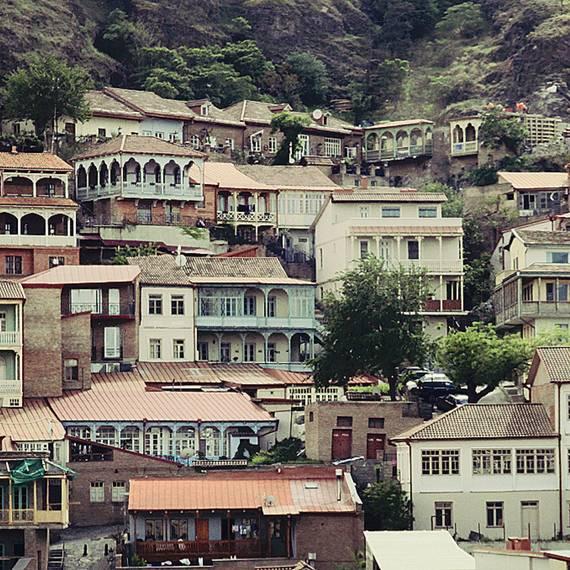
Batumi Old Town covers the compact historic centre that runs inland from the port, and it repays wandering in a way that the seafront boulevard – for all its charms – does not. The neighbourhood’s architectural mix is the result of Adjara’s unusually turbulent history: the region was Ottoman from the early 17th century until 1878, when it was ceded to Russia under the Treaty of San Stefano at the end of the Russo-Turkish War. The Russian period that followed produced most of what you see: neoclassical facades, wrought-iron balconies, the kind of civic buildings that imperial administrations erect to make a point.
What makes the Old Town interesting rather than merely pretty is the density of different faiths within a very small area, which reflects Adjara’s position at the junction of Christian Georgia and the Ottoman world. A Greek Orthodox church whose bell tower was added later because the Ottoman authorities initially forbade the ringing of bells; an active mosque; an Armenian church; a Catholic cathedral. All of them within a short walk of each other, all of them still in use. The Soviets did their best to reduce the stock of religious buildings in the 1920s and 30s, but enough survived to make the point. Adjara remains around 40% Muslim today, the legacy of three centuries of Ottoman rule that no subsequent administration has managed to fully overwrite.
Location: The Old Town runs broadly from the port south to Ilia Chavchavadze Street, and east from the boulevard to Iakob Gogebashvili Street. Piazza Square and Europe Square are the two main focal points.
Best time to visit: Morning, before the heat builds in summer. The Piazza and Europe Square fill up with tourists and organised tours by midday.
Ticket prices: Free to explore. Individual churches have their own customs around dress and behaviour; cover up, and follow whatever signs are posted.
Good to know: Piazza Square, opened in 2010, was designed to evoke an Italian city and contains what is claimed to be the largest marble mosaic in Europe – 88 million individual pieces, which is exactly the kind of statistic that Batumi enjoys deploying. The Church of St Nicholas, the square’s oldest surviving building, has a facade redesigned to fit the new square’s aesthetic. Make of that what you will.
Batumi Boulevard
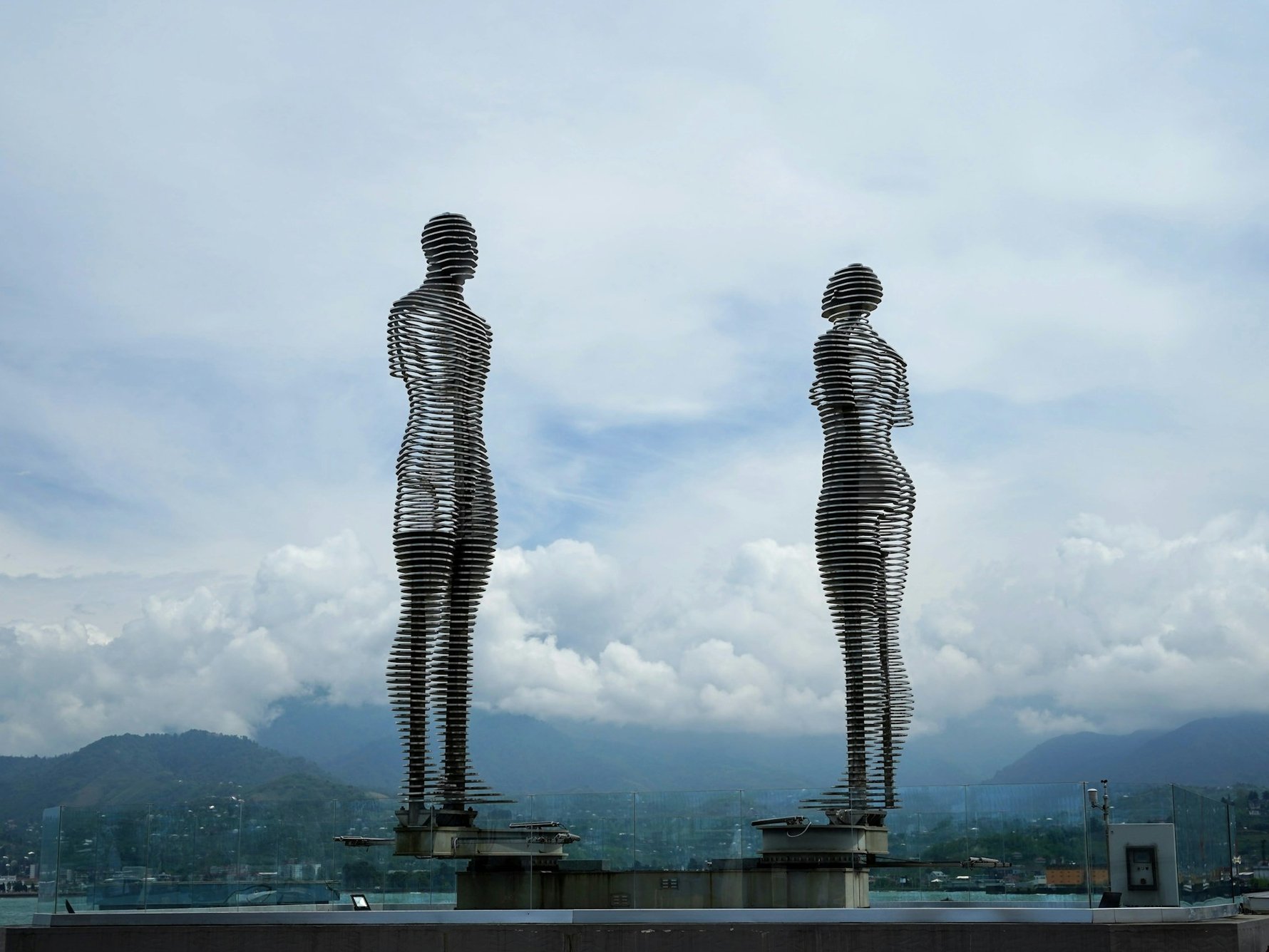
Batumi Boulevard is a 7-kilometre seafront promenade that has been the spine of the city since it was first laid out under Russian Imperial administration in 1881. Most of Batumi’s modern attractions orbit it: the Alphabet Tower to the south, the Ali and Nino sculpture roughly in the middle, the old colonnades near the port. The beach alongside it is stony rather than sandy, which either is or is not a problem depending on your footwear and expectations.
The sculpture that most visitors come to see is the Ali and Nino kinetic statue, an 8-metre-high steel installation by Georgian artist Tamara Kvesitadze, erected in 2010. It depicts two figures – Ali, a Muslim Azerbaijani, and Nino, a Christian Georgian – from the 1937 novel of the same name by Azerbaijani author Kurban Said. Every ten minutes they slowly revolve toward each other, merge, and separate again. It is based on a story set in Baku, installed on the Black Sea coast of Georgia, which might raise questions of geography if the mechanism were not so disarmingly well-executed. The piece was first exhibited at the Venice Biennale and later in London before finding its permanent home here, which gives it slightly better exhibition credentials than most things on the boulevard.
Location: The boulevard runs along the seafront from the port area northward. The Ali and Nino statue is in the southern section, near the Alphabet Tower.
Best time to visit: The statue activates at 7pm and runs until late; evening is the time to see it. The boulevard itself is pleasant at any hour, though July and August bring serious crowds.
Ticket prices: Free. The boulevard is a public promenade.
Good to know: The boulevard colonnades near the port date from the early Soviet period and are among the older structures on the seafront. The summer theatre, tucked into the greenery along the promenade, still hosts performances in the warmer months.
The Alphabet Tower
Batumi’s architectural ambitions run to statements, and the Alphabet Tower is among the more coherent ones. The 130-metre structure, completed in 2012 at a cost of $65 million, wraps all 33 letters of the Georgian alphabet around a double-helix steel frame, the design invoking the phrase “language is the genetic code of a nation.” The comparison between alphabets and DNA strands is the kind of metaphor that sounds better in architectural briefs than in conversation, but the physical result is striking enough that it earns its place on the Batumi skyline regardless of the conceptual scaffolding.
The Georgian alphabet is, in fact, genuinely remarkable: one of only fourteen scripts in the world with its own unique letterforms, dating in its earliest form to the 5th century AD, which makes the monument’s subject matter more interesting than most of what goes up on resort-city waterfronts. An elevator runs to the observation deck at the top, which offers a clear view of the city, the coast and the mountains of Adjara inland. A revolving restaurant operates on the upper floors when staffed, which is not always.
Location: On the southern section of Batumi Boulevard, near the Ali and Nino statue.
Best time to visit: Evening, when the tower is illuminated and the observation deck – if open – gives a view of the lit city and the Black Sea beyond. The exterior is worth seeing regardless of whether you go up.
Ticket prices: Viewing the exterior is free. Elevator access to the observation deck costs around 20 GEL; verify at the tower as prices and opening hours vary. The restaurant requires a separate booking.
Good to know: The observation deck involves two separate elevator rides and has been occasionally closed for maintenance. Check locally before making it the centrepiece of your evening.
Batumi Tower
The Batumi Tower – formally the Technological University Tower – is Batumi’s tallest building at 35 storeys, and its most candid illustration of the gap between the city’s ambitions and the pace at which they get realised. The tower was commissioned under President Mikheil Saakashvili’s urban development programme with the plan of housing Batumi’s Technical University inside it. The plan did not survive contact with reality. The building sat partially empty for years, which makes what distinguishes it architecturally all the more inexplicable and therefore all the more worth seeing: a fully functional Ferris wheel embedded in the upper floors of the façade, gold-coloured and visible from some distance away.
It is the first and, as far as anyone has established, only skyscraper in the world to incorporate a Ferris wheel as a structural feature. It has since been acquired by private investors with hotel conversion plans. Whether that project arrives on schedule is, given precedent, an open question. In the meantime, the building stands on the southern boulevard as an entirely honest portrait of Batumi in the 2010s: vast, showy, not quite finished, hard to look away from.
Location: Southern Batumi Boulevard, near the Alphabet Tower.
Best time to visit: It is an exterior attraction. Walk past it on any boulevard visit.
Ticket prices: Free to observe, which is the main thing to do with it.
Good to know: The Ferris wheel in the upper facade is operational when the tower is open to the public, though access arrangements have varied. Ask locally for the current situation.
Batumi Botanical Garden
Eight kilometres north of the city centre at a headland called Green Cape (Mtsvane Kontskhi), the Batumi Botanical Garden is one of the more significant horticultural collections in the former Soviet Union, which is a category that contains rather more serious gardens than the phrase might imply. It was founded in 1912 by Andrey Krasnov, a professor from Kharkov University who identified the Black Sea coastal climate of Adjara as capable of supporting subtropical species from around the world. The result, spread across 111 hectares of hillside above the sea, is an open-air collection of more than 5,000 plant species grouped by geographical origin: Caucasus, East Asia, New Zealand, South America, the Himalayas, Australia, the Mediterranean. Krasnov’s grave is in the garden, which seems fair given the scale of the undertaking.
The garden is worth the trip for two reasons separately from its botanical content. The views of the Black Sea from the upper sections of the headland are among the better ones in the region, and the garden’s scale means it absorbs even summer crowds without feeling overwhelmed. Mikhail Bulgakov stayed here. Ilya Ilf and Yevgeny Petrov wrote sections of The Twelve Chairs here. This information makes it neither better nor worse as a garden, but it is the sort of thing that changes how you feel about a place.
Location: Mtsvane Kontskhi (Green Cape), approximately 8km north of the city centre. Minibus 31 runs from central Batumi.
Best time to visit: Spring, when the rhododendrons, azaleas and roses are flowering. Summer is the busiest period; early morning is noticeably quieter than midday.
Ticket prices: Around 20–25 GEL for foreign visitors; check the current rate at the entrance. Children under a certain age enter free. The official website is bbg.ge.
Good to know: Allow at least two to three hours; the garden is large enough to spend a half-day if you are not rushing. There is a café inside. Electric cars are available for hire if the hillside terrain is a concern.
Gonio Fortress
Twelve kilometres south of Batumi, at the mouth of the Chorokhi River near the Turkish border, Gonio Fortress – also known as Apsaros – is the oldest standing fortification in Georgia and one of the better-preserved Roman sites in the Caucasus. The rectangular walls, approximately 220 metres by 195 metres with 18 of the original 22 towers still standing, were built by the Romans in the 1st century AD to control access to the Chorokhi and Acharistskali river valleys and anchor the eastern Black Sea frontier. The fortress subsequently passed to Byzantium, then to the Ottomans in 1547, then to the Russian Empire in 1878 under the same Treaty of San Stefano that delivered Batumi itself. It has accumulated a great deal of history in a relatively compact perimeter.
The mythology layered on top of the archaeology is, if anything, more excessive. The fortress is said to stand on the site where Absyrtus – son of King Aeetes of Colchis and brother of Medea – was buried after Jason of the Argonauts killed him, which is why the Roman name was Apsaros. A tomb within the grounds is attributed, by local tradition, to the Apostle Matthew. Archaeologists excavating near the southern wall in 1974 found a treasure cache dating to the 5th century AD; the most significant items are now in the Adjara State Museum in Batumi. The site was declared a museum-reserve in 1994 and ongoing excavations continue to turn things up.
Location: The village of Gonio, approximately 12–15km south of Batumi on the coast road toward Turkey. Around 20 minutes by car or taxi.
Best time to visit: Morning, before the summer heat builds. There is limited shade inside the fortress walls.
Ticket prices: 3 GEL for general admission; 10 GEL with a guide. Verify at the site, as fees may have changed.
Good to know: The site is reachable by minibus (direction Gonio/Kvariati/Sarpi from Tbilisi Square in central Batumi), though a taxi is considerably more straightforward if you are going as a day trip. The beach resort village of Gonio is nearby if you want to combine the fortress with time on the coast.
Mtirala National Park
The name means “crying” in Georgian, and Mtirala National Park earns it: the park receives somewhere in the range of 4,500 millimetres of rainfall per year, making it one of the wettest places in the Caucasus and, depending on your plans for the day, either a drawback or the entire point. The dense subtropical rainforest that results – Kolkheti-type vegetation, old-growth chestnut and beech, ferns and mosses of the sort that require serious precipitation to achieve – is found nowhere else in Georgia in this concentration, and the contrast with Batumi’s beach-resort atmosphere 25 kilometres away is significant enough to feel like a different climate zone entirely, which it more or less is.
The park covers almost 16,000 hectares in the foothills of the Lesser Caucasus and offers two main hiking trails from the visitor centre at Chakvistavi: a two-hour loop and a full-day route that reaches the higher elevations. The shorter trail takes in the park’s waterfall, which, given the rainfall figures, is not likely to disappoint. Birdwatching, ziplining and guided walks with rangers are available from the visitor centre. The park has guesthouses for those who want to stay overnight rather than treating it as a day trip, which it rewards.
Location: Approximately 25–30km east of Batumi, near the village of Chakvistavi. Around an hour by car.
Best time to visit: Spring and early summer for the most dramatic greenery; autumn for colour. Avoid heavy rain periods if possible, though the park’s character means some rain is essentially guaranteed.
Ticket prices: No entrance fee. Activities such as ziplining and guided tours have separate costs. The visitor centre can advise on current arrangements.
Good to know: There is no direct public transport from Batumi to the park. Minibus 40 runs to Chakvi, from where taxis wait to continue the journey to the park; the full round trip from Batumi by taxi costs roughly 80–100 GEL. Renting a car is the most practical option if you want flexibility. Bring waterproofs regardless of the forecast.
What else can you see in and around Batumi?
The city’s cultural infrastructure is thinner than the architecture might suggest, but the Adjara State Museum on Besiki Street covers the region’s history from the Bronze Age through to the Soviet period and holds the significant finds from the Gonio excavations, including the treasure cache discovered in 1974. It is a proper regional museum rather than a tourist attraction, which in the context of Batumi is a relative rarity and worth an hour of your time.
The Argo Cable Car, departing from near the port in the city centre, runs up to Anuria Mountain and gives a view of the city and coastline that is useful for orientation and pleasant in the early evening. The ride takes around ten minutes each way. For those who have not had enough of Batumi’s architectural project variety, the Chacha Tower – named for the Georgian grape spirit and originally intended to dispense it from a fountain on public holidays – stands near Piazza Square as evidence that some ideas do not survive the transition from concept to construction. The fountain was used exactly once, on the day the tower opened in 2012. It has not been used since, which is the most Batumi thing about it.
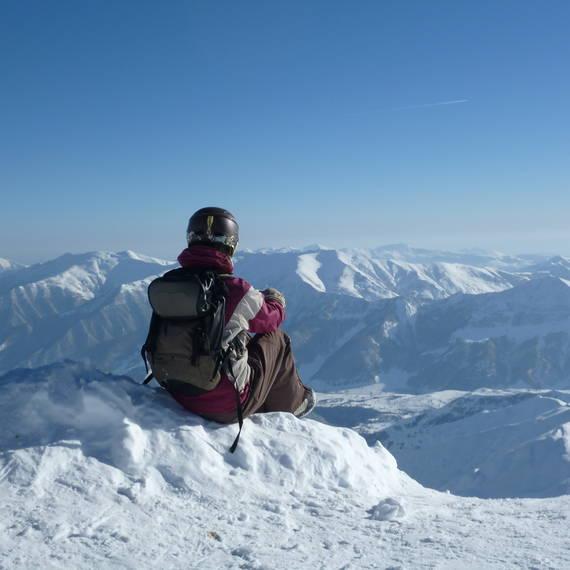
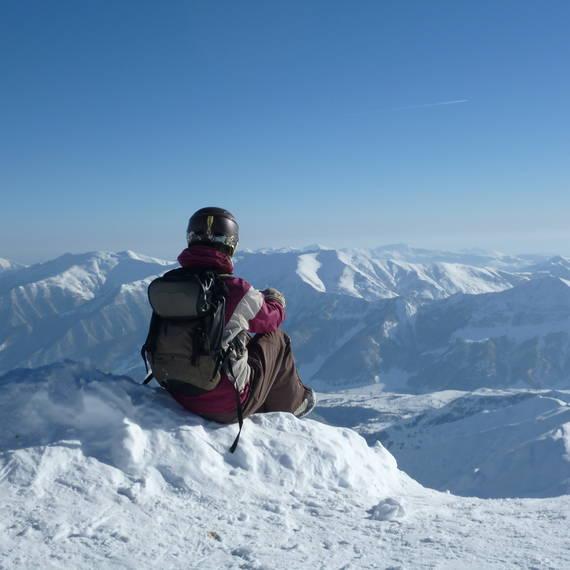
Beyond the city, the Black Sea coast road between Batumi and the Botanical Garden at Green Cape passes through a string of smaller resorts and offers some of the more agreeable stretches of coastline in Adjara. Further afield, the mountain regions of Adjara – particularly the villages of Gödele and Beshumi, reachable in around two hours from Batumi – offer a Georgia that predates the resort development entirely: alpine meadows, wooden churches, and the kind of landscape that makes it difficult to believe you were on a casino-lined seafront promenade a few hours earlier.