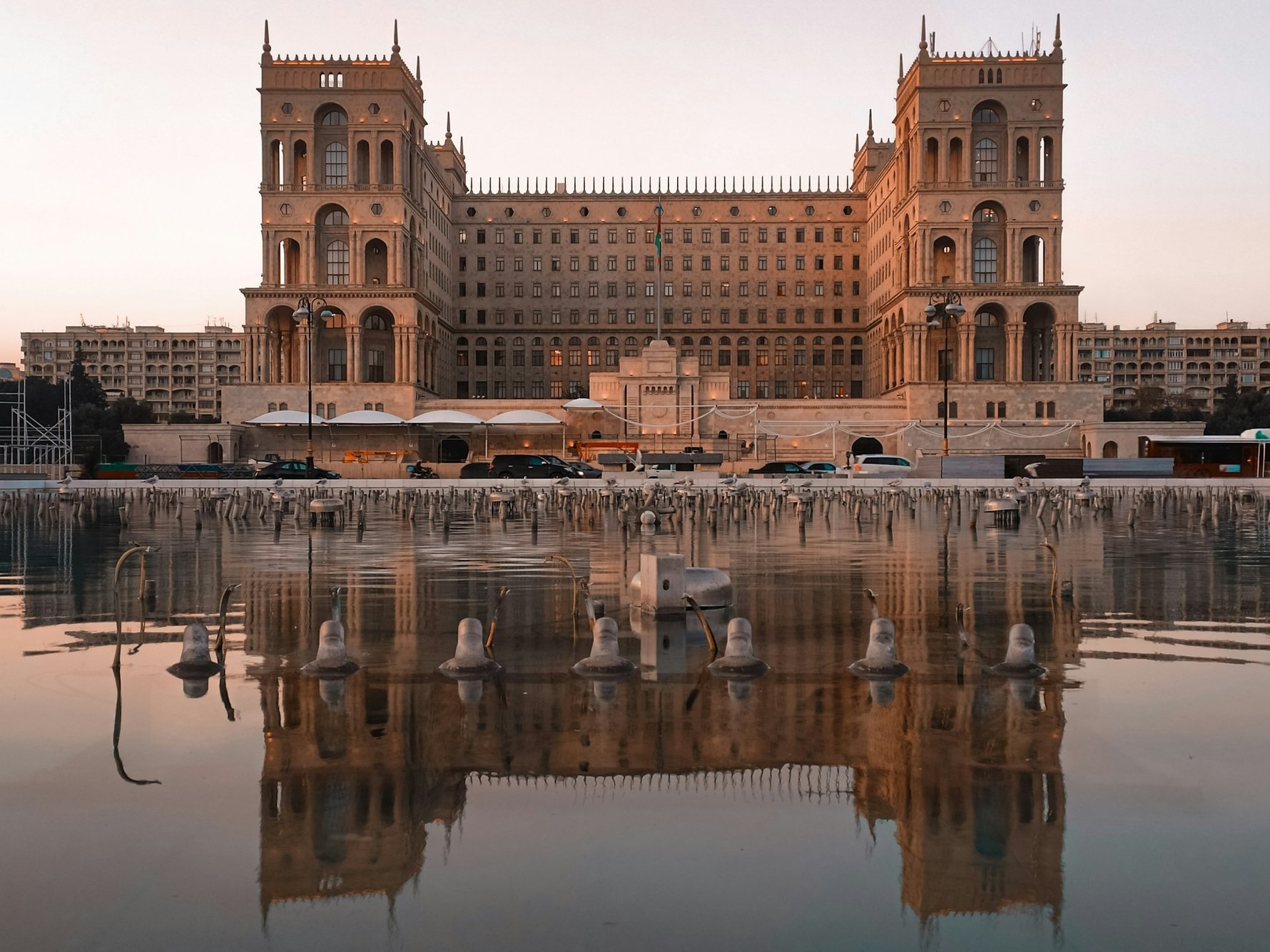
Baku is a city of genuinely startling contrasts. A medieval walled old town sits within comfortable walking distance of three skyscrapers shaped like flames and a concert hall that looks like a crumpled piece of white silk, all of it arranged along the western shore of the Caspian Sea. Azerbaijan has been extracting oil from the Absheron Peninsula since at least the 10th century, and the proceeds of that extraction have transformed Baku into something that periodically causes arriving visitors to check that their plane has landed in the right country. The city that Marco Polo described in the 13th century as notable chiefly for its black oil and its eternal fires now has a Formula 1 street circuit, a carpet museum shaped like a rolled-up carpet, and a seafront boulevard that is apparently on course to become the world's largest urban park, though these things take time.
Azerbaijan calls itself the Land of Fire, which is not marketing invention but geological fact. Natural gas has been seeping through the porous sandstone of the peninsula for millennia, producing the spontaneous flames that fascinated Zoroastrian, Hindu and Sikh pilgrims along the Silk Road and continue to fascinate tourists today, if for rather different reasons. Baku rewards a visit of three days or more; the combination of the ancient old city, the extravagantly modern new one, and the peculiar geology of the Absheron Peninsula makes it one of the more genuinely surprising capitals in the region.
Icherisheher – Inner City, or simply the Old City – is the medieval walled heart of Baku, a UNESCO World Heritage Site since 2000 and the thing most worth seeing in a city that has accumulated a great deal worth seeing. The defensive walls, which stand 8 to 10 metres high and up to 3.5 metres thick, preserve much of their 12th-century character and enclose 22 hectares of cobblestone lanes, ancient mosques, caravanserais, the Palace of the Shirvanshahs, the Maiden Tower, and around 1,300 resident families who live here as they have done for generations despite the neighbourhood becoming, in recent decades, an international tourist attraction.
The UNESCO listing covers evidence of Zoroastrian, Sassanian, Arab, Persian, Shirvani, Ottoman and Russian presence in a single compact urban landscape, which is an impressive curriculum vitae for a walled city of this size. The lanes between the old stone buildings are narrow enough that two people walking side by side constitute moderate congestion. Caravanserais that once housed Silk Road merchants have been converted into restaurants and boutique hotels; the quality of both varies, but the buildings are uniformly good. The old town is best entered on foot from the main gate on Neftchilar Avenue, and best explored without an agenda – getting slightly lost is both inevitable and instructive.
Location: Central Baku, bordered by Neftchilar Avenue to the east. Metro: Icheri Sheher (line 1). The main gate is on Neftchilar Avenue, near the Maiden Tower.
Best time to visit: Early morning, before the tour groups arrive, or evening when the lanes are quieter. Midday in summer is hot.
Ticket prices: Free to enter and walk around. Individual sites within (Maiden Tower, Palace of the Shirvanshahs) charge separately.
Good to know: The old city contains two of the city’s best museums as standalone entries below. The Mohammed Mosque, with its 11th-century minaret, is among the oldest surviving structures in Baku and worth finding in the lanes north of the Maiden Tower. The Museum of Miniature Books – a tiny institution holding over 6,500 miniature books in 64 languages, the largest such collection in the world – is tucked inside the walls and is exactly as endearing as it sounds.
2. The Maiden Tower (Qız Qalası)
The Maiden Tower is the symbol of Baku: an eight-storey cylindrical fortress rising 29.5 metres from the southeastern corner of the old city walls, overlooking what was once the Caspian shoreline (land reclamation has since pushed the water back by several hundred metres). Nobody knows precisely when it was built, what it was built for, or how it acquired its name, which is an unusual combination of mysteries for a structure this prominent and makes it more interesting rather than less. The inscription on its wall, in old Kufic script, names an architect active in the 12th century, but archaeological evidence suggests the foundations are considerably older – possibly 5th or 6th century, with some researchers arguing for a Zoroastrian temple predating the Islamic era. The honest answer is that nobody is entirely sure, and the various theories – watchtower, Zoroastrian temple, astronomical observatory, royal tomb – each have their advocates.
The name has attracted more legends than any single tower deserves. The most famous involves a king’s daughter who, to escape an unwanted marriage, persuaded her father to first build a tower, then threw herself from the top when he refused to relent. The sea that once lapped the base added a certain drama to the ending. Inside, eight floors connected by a narrow spiral staircase contain a museum documenting the history of Baku and the tower itself; each floor has a distinct character. The climb to the roof is rewarded with panoramic views over the old city, the Caspian, and the absurdly photogenic contrast between the medieval walls below and the Flame Towers rising on the skyline above.
Location: Southeastern corner of the Old City, on Kichik Qala Street. Metro: Icheri Sheher (line 1). Website: qizqalasi.az
Best time to visit: Mornings on weekdays for the shortest queues. The exterior is dramatic at night when floodlit.
Ticket prices: Around AZN 15 adults. No elevator; the climb is via steep stone stairs.
Good to know: The tower is also a fixture of the Baku Formula 1 street circuit – Turn 8 of the Azerbaijan Grand Prix passes close by, which is a piece of information that will either delight or be entirely irrelevant, depending on who you are.
3. Palace of the Shirvanshahs
The Palace of the Shirvanshahs sits at the highest point within the old city walls and represents the architectural peak of medieval Azerbaijani culture. Built primarily in the 15th century as the royal residence of the Shirvanshah dynasty – whose rulers controlled much of what is now Azerbaijan and parts of present-day Iran for several centuries – it is one of the finest examples of Azerbaijani architecture anywhere, and the UNESCO World Heritage listing covers it alongside the Maiden Tower as a key element of Icherisheher’s outstanding universal value.
The complex consists of the main palace, the Shah’s mosque with its slender minaret, the Divankhana (an audience hall of unusual octagonal design whose exact purpose is still debated), a mausoleum for the Shirvanshah family and their court scholars, a bathhouse, and the tomb of a court astronomer. The stonework throughout is exceptional: intricate muqarnas, carved Arabic inscriptions and decorative detailing that confirms the Shirvanshahs were spending their considerable revenues in the right places. The interior rooms of the palace hold a museum with artefacts from the Shirvani period and beyond.
Location: Upper section of Icherisheher, accessible via Qala Street. Included in the old city complex. Website: shirvanshahspalace.az
Best time to visit: Morning, when the light falls well on the stonework and the courtyard is less crowded.
Ticket prices: Around AZN 10 adults for the palace complex.
Good to know: The terrace at the front of the complex provides one of the best views within the old city – the old Shah’s mosque in the foreground, the modern glass towers of the new city rising behind the walls. The combination is, depending on your architectural sympathies, either magnificent or absurd, and possibly both.
4. The Flame Towers (Alov Qüllælæri)
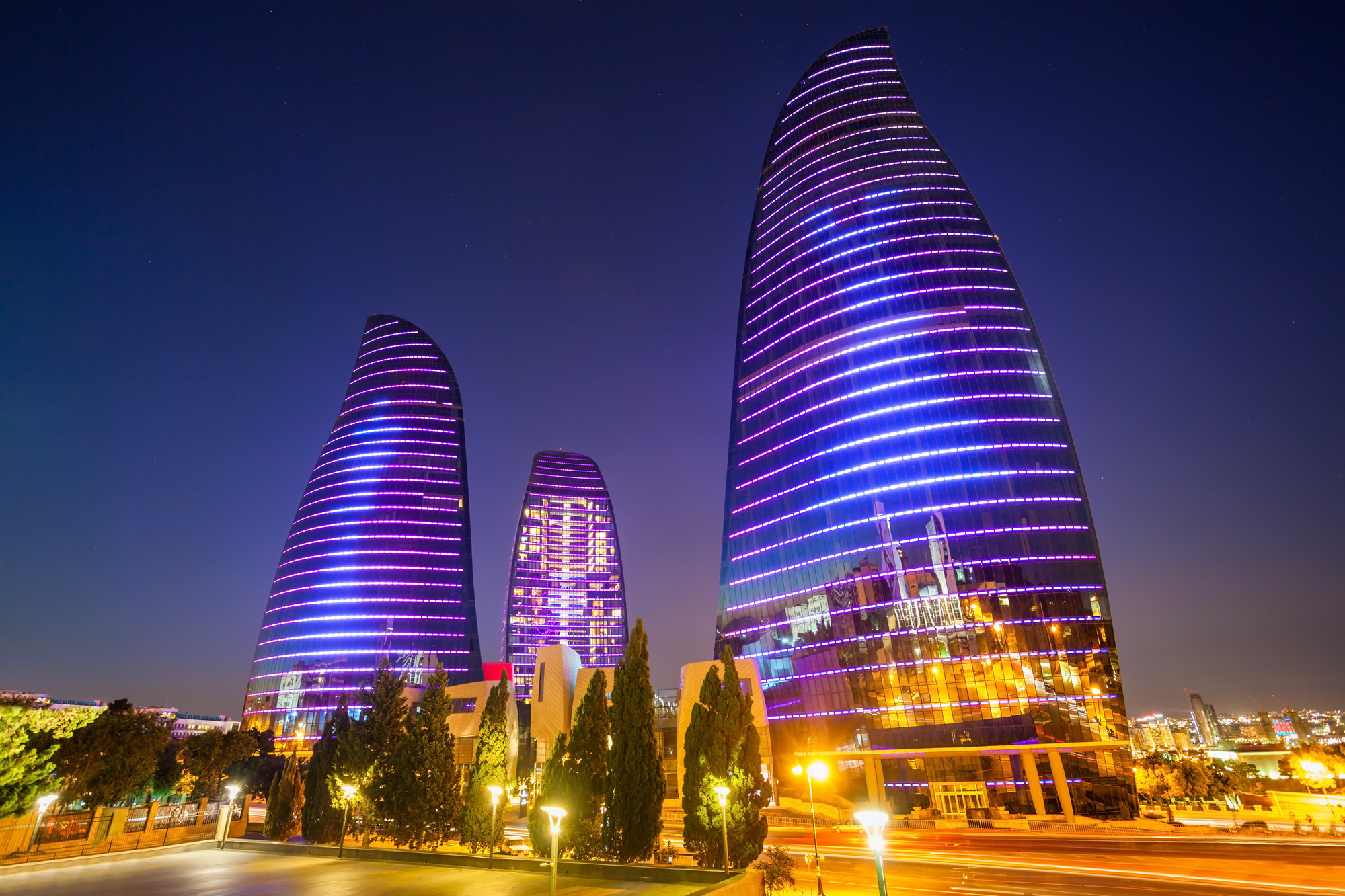
The Flame Towers are three skyscrapers built on the hillside above the old city between 2007 and 2012, each designed in the shape of a flame, clad in glass, and equipped with over 10,000 LED lights that transform the towers into massive screens after dark, displaying rolling animations of fire visible from considerable distances across the city. They contain luxury apartments, offices, and the Fairmont Baku hotel. As architectural statements go, they are not subtle, but subtlety is not the point. The point is that Azerbaijan has oil money and a particular approach to civic self-expression, and the Flame Towers express it with considerable conviction.
The towers work best as part of the Baku skyline rather than as a close-up attraction in themselves. The ideal vantage point is from the Highland Park (Dağüstü Park) above the old city, accessible by funicular from the Boulevard. From the park’s terrace, the towers rise against the Caspian to the east while the old city walls descend to the waterfront below. At sunset this is genuinely spectacular, and the LED show after dark is worth staying for.
Location: On the Baku hillside above the old city; visible from most of central Baku. The Highland Park funicular departs from near the Azerbaijan Carpet Museum on the Boulevard. The Fairmont hotel lobby is open to non-guests and worth a look.
Best time to visit: Sunset from Highland Park; the LED show runs after dark.
Ticket prices: Funicular to Highland Park around AZN 1. The towers themselves are residential and commercial; no public interior access unless you are a hotel guest.
Good to know: The Martyrs’ Lane (Şəhidlər Xiyabanı) memorial is located in Highland Park, dedicated to those killed in the Soviet crackdown of January 1990 and in subsequent conflicts. It is a quiet and significant site, worth a moment of the time you will be spending in the park for the views.
5. The Heydar Aliyev Center
The Heydar Aliyev Center is one of the most remarkable buildings completed anywhere in the world in the 21st century, and we should say upfront that it is named after Heydar Aliyev – former KGB chief, Soviet-era First Secretary of Azerbaijan, and post-independence president from 1993 to 2003 – who is a figure about whom there is quite a lot to say but who we will not be going into here, partly because this is a travel guide and partly because the building genuinely deserves to be judged on its own considerable merits.
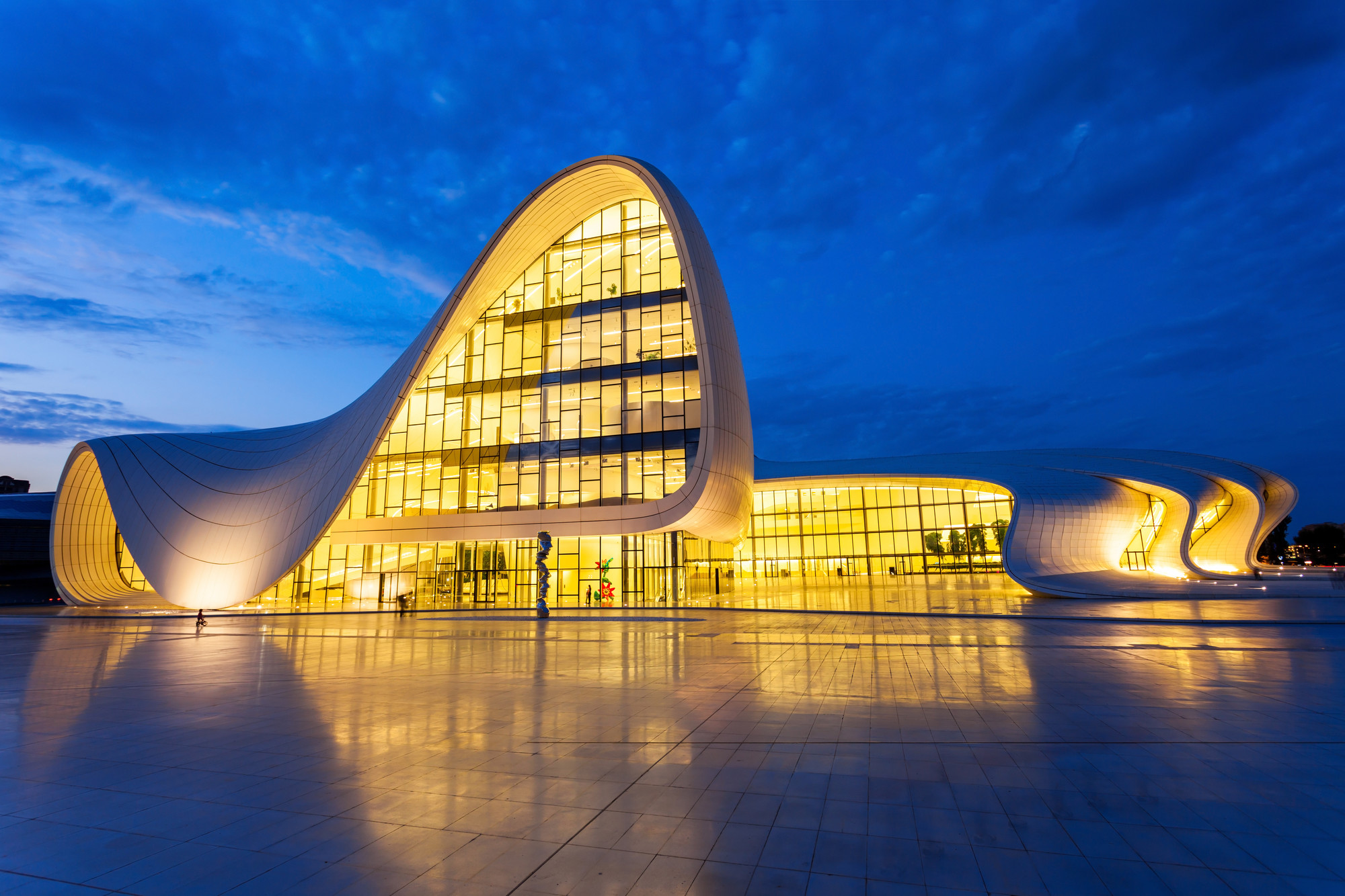
Designed by the Iraqi-British architect Zaha Hadid and completed in 2012, the center is 57,519 square metres of continuous, flowing white surface that appears to have been carved from a single piece of material, with no sharp angles, no straight lines, and no concessions whatsoever to the surrounding Soviet-era urban landscape. It won the Design Museum’s Design of the Year Award in 2014, making Hadid the first woman to win the top prize in that competition. The building houses a concert hall, a conference centre, exhibition galleries, and a museum of Azerbaijani history and culture. Exhibitions have included work by Andy Warhol, Tony Cragg and Bernard Buffet; performances have featured Itzhak Perlman and Dee Dee Bridgewater; Pope Francis addressed religious leaders in the theatre.
The exterior is the main draw for most visitors, and the broad public plaza surrounding it provides the space needed to appreciate the full sweep of the roofline. The building is particularly photogenic in the late afternoon, when the curved surfaces catch the light from different angles simultaneously, and at night, when it is illuminated against the dark sky.
Location: 1 Heydar Aliyev Avenue, about 3km from the old city. Taxi or Bolt from the centre around AZN 4–5. Bus routes 125, 189, and several others. Website: heydaraliyevcenter.az
Best time to visit: Late afternoon for the best light on the exterior; evenings when illuminated. Check the website for the current exhibition programme before visiting.
Ticket prices: Exhibition admission varies; around AZN 10–15 for the main galleries. The exterior and plaza are free to access at any time.
Good to know: The building is worth visiting even if you have no particular interest in the exhibitions. Just walking around the exterior, watching how the curves resolve from different angles, is a genuinely rewarding architectural experience. Zaha Hadid died in 2016; this is widely considered among her finest works.
6. Baku Boulevard (Bulvar)
The Baku Boulevard is a seafront promenade running roughly five kilometres along the Caspian shore from the old city northward, and has been the defining public space of Baku since it was first laid out in the early 20th century during the original oil boom. It is where the city goes to walk, to sit in the evening, to ride bicycles and pedal boats, to eat plov from outdoor restaurants, and to experience the particular pleasure of a warm Caspian evening with a breeze coming off the water. The palm trees, gardens, cafe terraces and the general air of a well-maintained seaside promenade make it an easy few hours regardless of the weather.
The Boulevard contains the Azerbaijan Carpet Museum, housed in a building that is itself shaped like a giant rolled carpet – a design decision that is either inspired or deranged, depending on your tolerance for literal architecture. Inside, the collection spans over 10,000 items including carpets, kilims and textiles from the 17th century to the present, covering the full range of Azerbaijani regional weaving traditions. It is a more substantial institution than the building’s exterior might suggest, and the upper floors contain some genuinely extraordinary pieces. The Little Venice section of the Boulevard – a small network of canals with gondola rides – is unapologetically touristy and is fine for what it is. The 60-metre Baku Eye Ferris wheel provides views if you want them.
Location: Running along Neftchilar Avenue from the old city northward. Metro: Sahil (line 1) for the southern end. The Carpet Museum is at 65 Neftchilar Avenue. Website: acm.gov.az
Best time to visit: Evening, when the Boulevard is at its most lively and the Flame Towers are doing their LED display across the water. The Carpet Museum is open Tuesday to Sunday 10:00–18:00.
Ticket prices: Boulevard free. Carpet Museum around AZN 10 adults.
Good to know: The cable car from near the Carpet Museum to Highland Park (Dağüstü Park) is an alternative to the funicular for reaching the views above the old city, and provides a good aerial perspective of the Boulevard itself.
7. Gobustan National Park
Gobustan is the most significant archaeological site in Azerbaijan and, for anyone with an interest in prehistoric art or the longer perspective of human civilisation, one of the most significant in the entire Caucasus. Located 60 kilometres southwest of Baku, the park covers three rocky highlands rising from a semi-arid plain and contains over 6,000 petroglyphs carved into more than 1,000 rock surfaces – representing a continuous tradition of rock art spanning 40,000 years from the Upper Palaeolithic to the Middle Ages. UNESCO inscribed the site in 2007.
The images are of animals, hunters, fishermen, dancers, boats, warriors and heavenly bodies, executed with varying degrees of sophistication across the chronological range. Among the more startling discoveries is a Latin inscription from the reign of Emperor Domitian (81–96 AD), recording the temporary presence of Legio XII Fulminata on the Caspian shore – the easternmost Roman inscription ever found, and evidence that the empire’s reach extended rather further than most school curricula suggest. There is also the Gaval Dash, a large stone slab that produces a tambourine-like sound when struck, which appears to have been used as a musical instrument for several thousand years and still works. The on-site museum, opened in 2011, provides excellent context before visitors walk the marked circuit among the boulders.
The mud volcanoes of Gobustan, concentrated a short drive from the rock art site, are a separate but complementary attraction: dozens of low, burbling craters oozing grey mud under internal gas pressure, creating a landscape of low cones and flattened discs that has been compared to the surface of another planet. Azerbaijan contains roughly half of the world’s mud volcanoes, and Gobustan is where the density is greatest. Both sites are usually combined in a single day trip from Baku.
Location: 60km southwest of Baku on the road toward Alat. Most easily reached by organised tour or private taxi from Baku (around AZN 50–80 for a car covering both sites). Public buses run to Gobustan town but require a further taxi to the reserve. Website: gobustan-rockart.az
Best time to visit: Autumn and spring for manageable temperatures; summer is very hot. Morning for the rock art before the midday heat.
Ticket prices: Around AZN 10 adults for the rock art reserve. The mud volcanoes accessed via the reserve incur a separate fee; negotiation with local 4WD drivers is standard practice for the private mud volcano sites.
Good to know: Wear sturdy shoes for the uneven rock terrain. The museum is worth visiting before rather than after the outdoor circuit – the images make considerably more sense with the chronological and cultural context. The mud volcano visit requires a 4WD; standard taxis cannot navigate the terrain.
8. Ateshgah (The Fire Temple)
The Ateshgah is a medieval fire temple built in the 17th and 18th centuries in the village of Surakhany on the Absheron Peninsula, on a site where natural gas venting from the earth produced an eternal flame that had drawn fire worshippers for centuries before any permanent structure was built. The temple in its current form was funded by Hindu and Sikh merchants from the Indian subcontinent who had arrived in Baku along the Silk Road, giving it a decidedly syncretic character: the architecture follows a caravanserai-style plan of cells arranged around a central courtyard, the altar shrine at the centre is topped by a trident (sacred in both Hinduism and Zoroastrianism), and the wall inscriptions include fourteen in Sanskrit venerating Shiva and Ganesha, two in Gurmukhi script from Sikh pilgrims, and a single Persian inscription – making this the most cosmopolitan small fire temple you are likely to encounter in a Muslim-majority country.
The natural gas vent that fed the eternal flame was extinguished in 1969 when Soviet-era petroleum extraction depleted the reserves. The flames visible today are fed by a gas pipeline, which means the mystique has been somewhat rationalised but the atmosphere remains. Ascetics who lived in the cells around the courtyard submitted to considerable self-mortification in service of the sacred fire; by the 1880s, as the surrounding oil fields developed, the last pilgrims had left. The temple became a museum in 1975. Alexandre Dumas visited in 1858 and found only an elderly man and two young attendants; within twenty years, even they were gone.
Location: Surakhany village, Absheron Peninsula, approximately 30km east of central Baku. Taxi or Bolt from the centre around AZN 15–20; most efficiently combined with Yanar Dag (entry #9) on the same trip. Metro to Koroglu, then bus 184 to Surakhany. Website: ateshgah.az
Best time to visit: Any time; the site is compact and not excessively crowded on weekday mornings.
Ticket prices: Around AZN 5–8 adults.
Good to know: The cells around the courtyard contain displays showing the religious practices and daily life of the ascetics who lived here. The combination of Hindu, Sikh and Zoroastrian elements in a single site on the Caspian is genuinely unusual and is the main reason to visit beyond the fire itself.
9. Yanar Dag (The Burning Mountain)
Yanar Dag means Burning Mountain, which is accurate. A 10-metre section of sandstone hillside on the Absheron Peninsula has been continuously on fire for an indeterminate number of centuries, fed by natural gas seeping through the porous rock from underground reserves below. The flames reach up to three metres, burn in all weather including rain and snow, and can be heard as well as seen – a steady hiss from the gas escaping through the rock. Marco Polo described mysterious flames all across the Absheron Peninsula in the 13th century; he was writing about phenomena that were already ancient. Most of those fires were extinguished by 20th-century gas extraction. Yanar Dag is one of the last survivors.
Local tradition holds that this particular fire was accidentally ignited by a shepherd who dropped a cigarette in the 1950s, which, if true, makes it the most consequential act of littering in Azerbaijani history. Geologists, unsurprisingly, disagree and point to much older evidence of burning at the site. The reserve around it, established in 2007, now includes a museum, an amphitheatre, a cafe and souvenir stalls – the full infrastructure of a national wonder that has found its audience. The fire is most impressive at night, when the glow is visible against the dark hillside and the heat is perceptible from the viewing path.
Location: Village of Məmmədli, Absheron Peninsula, approximately 27km north of central Baku. Taxi or Bolt from the centre around AZN 15–20 one way; most efficiently combined with Ateshgah (entry #8) on the same day trip. Bus from Koroglu metro station.
Best time to visit: Late afternoon into evening for the best visual effect of the flames. The site is open year-round.
Ticket prices: Around AZN 5–8 adults. Website: yanardagh.az
Good to know: The fire is real, genuinely hot, and somewhat more dramatic in person than photographs generally convey. An organised day tour combining Gobustan, Ateshgah and Yanar Dag is the most efficient way to cover the Absheron Peninsula’s geological attractions; taxi drivers offering informal tours can be found around the old city and the Boulevard. Fix the price before departing.
10. The Palace of the Shirvanshahs’ Baths and the Azerbaijan State Museum of History
Two further institutions round out a comprehensive visit to Baku, both strong enough to stand independently but both easily combined with other entries on this list.
The Azerbaijan State Museum of History, on Tagiyev Street near Fountain Square, is the country’s largest museum and the most complete overview of Azerbaijani history from the Palaeolithic to the present day. Founded in 1920, it holds around 300,000 objects across archaeology, ethnography, numismatics and natural history. The collection covers the successive cultures that have left traces on Azerbaijan – Caucasian Albania, the Sasanians, the Arabs, the Shirvanshahs, the Russian Empire and the Soviet period – and does so with a depth and quality that goes beyond what casual visitors might expect. The building itself, a 19th-century mansion built by the oil baron Haji Zeynalabdin Taghiyev, is worth seeing for its own sake.
Fountain Square (Fəvvarələr Meydanı), the pedestrianised plaza immediately to the east of the old city, is the social hub of the newer part of central Baku – ringed by cafes and restaurants, shaded by trees, and consistently lively in the evenings. It connects naturally to Nizami Street, the main shopping boulevard, which links the old city to the newer districts to the west and provides a concentrated survey of Baku’s cafe culture.
Location: Azerbaijan State Museum of History: 4 Tagiyev Street, a short walk from Fountain Square. Metro: Icheri Sheher or Sahil (line 1). Website: azhistorymuseum.az
Best time to visit: Museum: weekday mornings. Fountain Square: any evening from spring to autumn.
Ticket prices: Museum around AZN 5–8 adults. Fountain Square is free.
Good to know: The Taghiyev mansion also houses a separate museum dedicated to Haji Zeynalabdin Taghiyev himself – a Baku-born oil baron who went from peasant origins to extraordinary wealth in the 19th-century oil boom and spent considerable portions of it on schools, hospitals and charitable works. He is one of the more interesting figures in Azerbaijani history and the museum makes a reasonable case for him.