Tbilisi is the kind of city that makes a strong first impression and then quietly refuses to let go. It sits in a narrow valley on the Mtkvari River, hemmed in by hills and overlooked by a ruined fortress that has been watching the city be conquered and rebuilt for the better part of seventeen centuries. The old town is a cheerful chaos of carved wooden balconies, Orthodox churches, crumbling Soviet apartment blocks and natural wine bars open until 3am, all within ten minutes of each other. The food is extraordinary, the wine is cheaper than water and considerably more interesting, and the locals have a gift for hospitality that stops just short of being alarming. Georgia adopted Christianity in 337 AD and has been defending its right to exist ever since; that combination of deep faith, complicated history and genuine warmth has produced a city unlike anywhere else in the Caucasus, or anywhere else at all.
The name Tbilisi comes from the Old Georgian tbili, meaning warm, a reference to the natural sulphurous hot springs that bubble up beneath the city and have been drawing bathers since the 5th century. King Vakhtang I Gorgasali, whose statue you will encounter at least twice during any visit, is credited with founding the city here after his hunting falcon fell into one of the springs. Georgia was not short of capital cities at the time; Vakhtang just preferred the hot water.
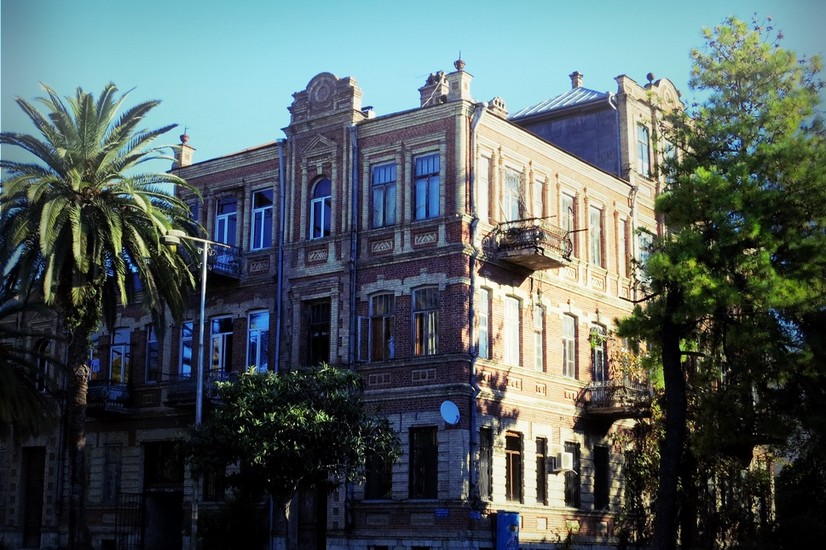
The Old Town is where you start and where you will keep ending up regardless of where you intended to go. It occupies the right bank of the Mtkvari, stretching from Metekhi Bridge up the slopes towards Narikala Fortress, and contains within a walkable area a concentration of history, architecture and decent khinkali restaurants that would keep the averagely curious visitor occupied for several days. The district of Sololaki, just south of Rustaveli Avenue, is the most rewarding for aimless wandering: 19th-century townhouses with elaborate carved wooden balconies, narrow alleys opening into unexpected courtyards, and the kind of quietly crumbling elegance that cities spend their whole tourism budget trying to recreate and usually fail.
Rustaveli Avenue itself is the city's main boulevard, a 1.5-kilometre Georgian equivalent of a Parisian grand avenue laid out in the 19th century under Russian Imperial supervision, lined with theatres, the National Museum, the Parliament building and the Opera House. It is lively, wide and excellent for walking, and the junction with Freedom Square at its eastern end is the natural meeting point of the city. A short walk downriver brings you to Shardeni Street, a narrow pedestrianised lane in the old town that concentrates a remarkable number of good restaurants, wine bars and the Gabriadze Puppet Theatre into one compact area.
The Sioni Cathedral, on the street bearing its name near the river, has been the spiritual heart of Tbilisi since the 6th century. Its current structure is largely 13th century, having been through the usual sequence of invasions and reconstructions that marks Georgian religious history. It houses the Cross of St Nino, made from grapevine branches bound with her hair, which is the holiest relic in Georgian Christianity and draws pilgrims from across the country. The cathedral served as the main seat of the Georgian Orthodox Catholicos-Patriarch until 2004, when Sameba was consecrated.
Location: The old town is centred around Meidan Square and Sioni Street. The nearest metro stations are Rustaveli and Liberty Square (line 1).
Best time to visit: Early morning for the churches and back streets; evening for the restaurants and wine bars. Midday in summer is genuinely hot.
Ticket prices: Free to walk through. Churches are free to enter; a donation is appropriate.
Good to know: Women are expected to cover their heads when entering Orthodox churches; scarves are usually available at the entrance. Both shoulders and knees should be covered. The Gabriadze Puppet Theatre clock tower, on Shavteli Street near Anchiskhati Basilica, performs a brief automated puppet show at noon and 7pm daily – the theatre was founded in 1981 by playwright and artist Rezo Gabriadze and is one of the more charming small institutions in the city.
2. Abanotubani and the Sulphur Baths
The Abanotubani district, directly south of the old town and immediately below Narikala Fortress, is the bathhouse quarter that gave Tbilisi its name. The natural hot springs here bubble up from the earth at 37–42°C and have been exploited for bathing since at least the 5th century. By the 13th century there were reportedly 65 bathhouses in the district. Today around ten functioning baths remain in Abanotubani, identifiable by their distinctive brick domes protruding from the ground and the clouds of steam rising from the street on cold mornings. Alexander Pushkin bathed here in 1829 and declared he had encountered nothing more magnificent in his life – though whether that says more about the baths or about Pushkin’s life is unclear. Alexandre Dumas and Anton Chekhov also visited, leaving the baths with a literary endorsement that most spas could only dream of.
The experience ranges from the basic to the lavish. Public halls – where you bathe in a large shared pool with locals of all ages – cost a few lari and are the most culturally immersive option, though privacy is limited and you need to bring everything yourself. Private rooms, which include a hot pool, stone slab for the scrub, and varying degrees of additional luxury, start at around 70–100 GEL per hour and should be booked in advance, particularly at weekends. The essential addition is the kisi scrub, performed by a mekise using a coarse exfoliating mitt – it is a vigorous process, it costs 10–20 GEL paid separately in cash, and it is the difference between having had a bath and having had the Tbilisi bath experience.
The most photogenic of the bathhouses is Chreli Abano (also called Orbeliani Baths), whose elaborately tiled blue-and-turquoise Persian-inspired façade is the most recognisable exterior in the district and the one that ends up on every postcard. Gulo’s Thermal Spa, named for a legendary bath attendant whose personal following was so loyal that the spa eventually took her name, is consistently praised for the quality of its mosaics and its kisi.
Location: Abano Street, in the Abanotubani district, south of Meidan Square. A 10–15-minute walk from Freedom Square Metro, or a short taxi ride (5–8 GEL via Bolt).
Best time to visit: Evening is the most atmospheric, when steam rises dramatically in the lamplight and the streets are quiet. Booking a private room at least a day in advance is advisable at weekends.
Ticket prices: Public baths from around 5–10 GEL. Private rooms from 70–150 GEL per hour depending on the bathhouse and room. Kisi scrub 10–20 GEL extra, paid in cash to the mekise.
Good to know: Even if you are not bathing, it is worth walking through Abanotubani to see the domed rooftops and the steam. The district is also the starting point for the walk up to Narikala Fortress and the National Botanical Garden. The Legvtakhevi Waterfall, a small urban waterfall at the end of a gorge accessible from Abanotubani, takes about ten minutes to reach and is a genuinely pleasant detour.
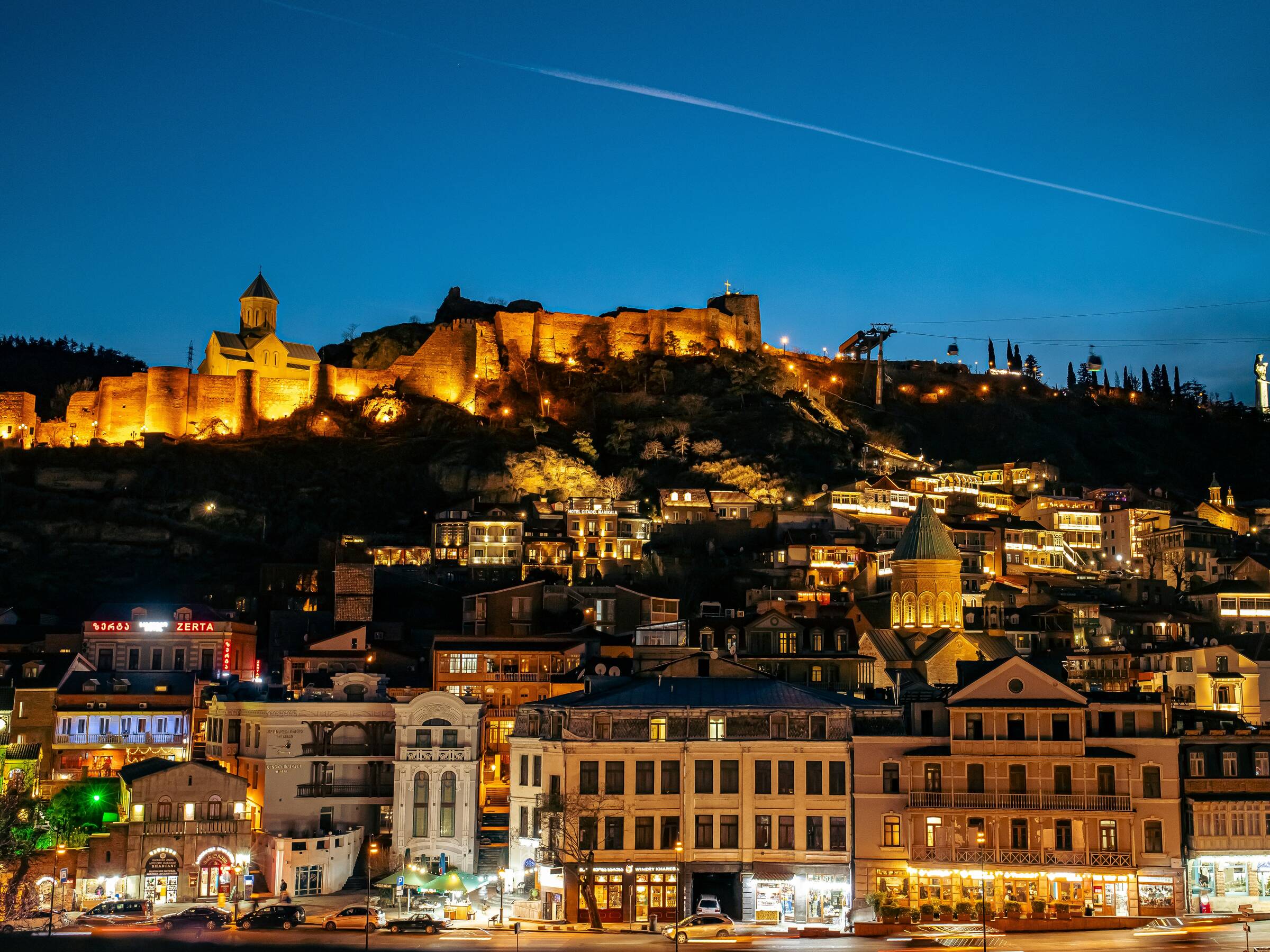
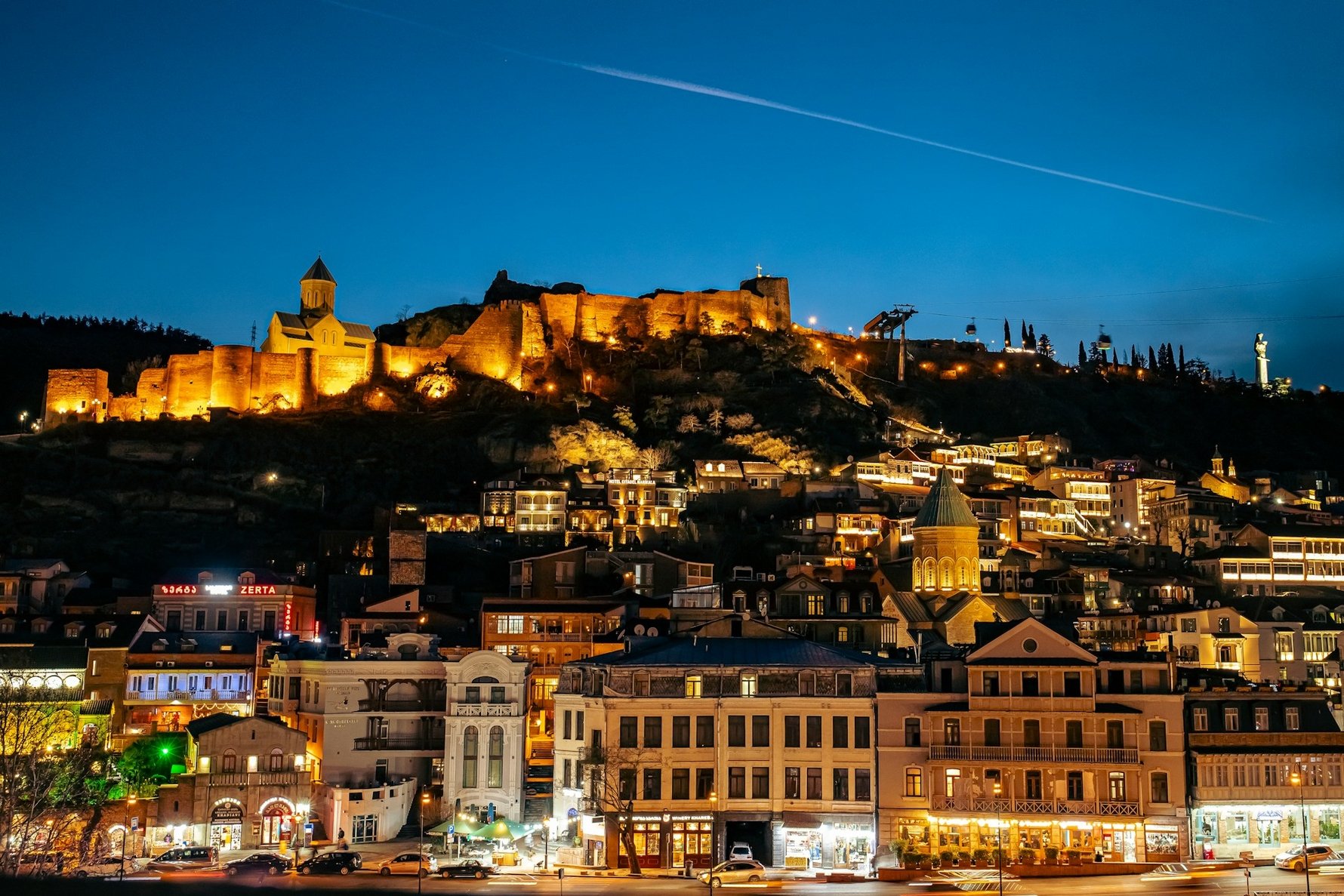
Narikala has been watching over Tbilisi from its rocky outcrop between the sulphur baths and the botanical garden since the 4th century AD, when the Persians built the first citadel here. Its name probably derives from the Persian narin qala – small fortress – which the Mongols coined during their 13th-century occupation, by which point Narikala had already passed through the hands of Arabs, Byzantines and Georgian kings, each leaving their additions to the walls. Most of what survives today dates from the 16th and 17th centuries. A munitions explosion (or possibly an earthquake – sources disagree) in 1827 destroyed much of the interior, leaving the skeletal outer walls and towers that define the skyline today. The reconstructed Church of St Nicholas sits within the lower fortification, its frescoes depicting biblical scenes alongside episodes from Georgian history.
The views from the walls are the main reason to go: the old town spread below, the Metekhi cliff opposite, the silver thread of the Mtkvari river, and on clear days the mountains encircling the city. The cable car from Rike Park offers the most effortless ascent and is worth taking at least one way; the walk up through Abanotubani or via the Betlemi Stairs takes 15–20 minutes and passes through some of the most atmospheric corners of the old town. From Narikala, a further short walk up the ridge leads to Kartlis Deda – Mother of Georgia – a 20-metre aluminium figure erected in 1958 for the city’s 1,500th anniversary. She holds a bowl of wine in her left hand for those who come as friends, and a sword in her right for those who do not. This is not a metaphor.
Location: On the Sololaki ridge above Abanotubani. Cable car from Rike Park (2.5 GEL one way, using a rechargeable Metromoney card). Walking access via Abanotubani district or Betlemi Stairs from Lado Asatiani Street.
Best time to visit: Sunset. The city below lights up as the stone walls glow amber; it is one of the more photographed moments in Tbilisi.
Ticket prices: Free to enter the fortress. Cable car 2.5 GEL one way.
Good to know: As of spring 2026, Narikala Fortress itself is closed to visitors for renovation works. The cable car still runs, and Kartlis Deda and the National Botanical Garden remain accessible. Check the current situation before visiting; the closure is expected to be temporary.
4. Metekhi Church
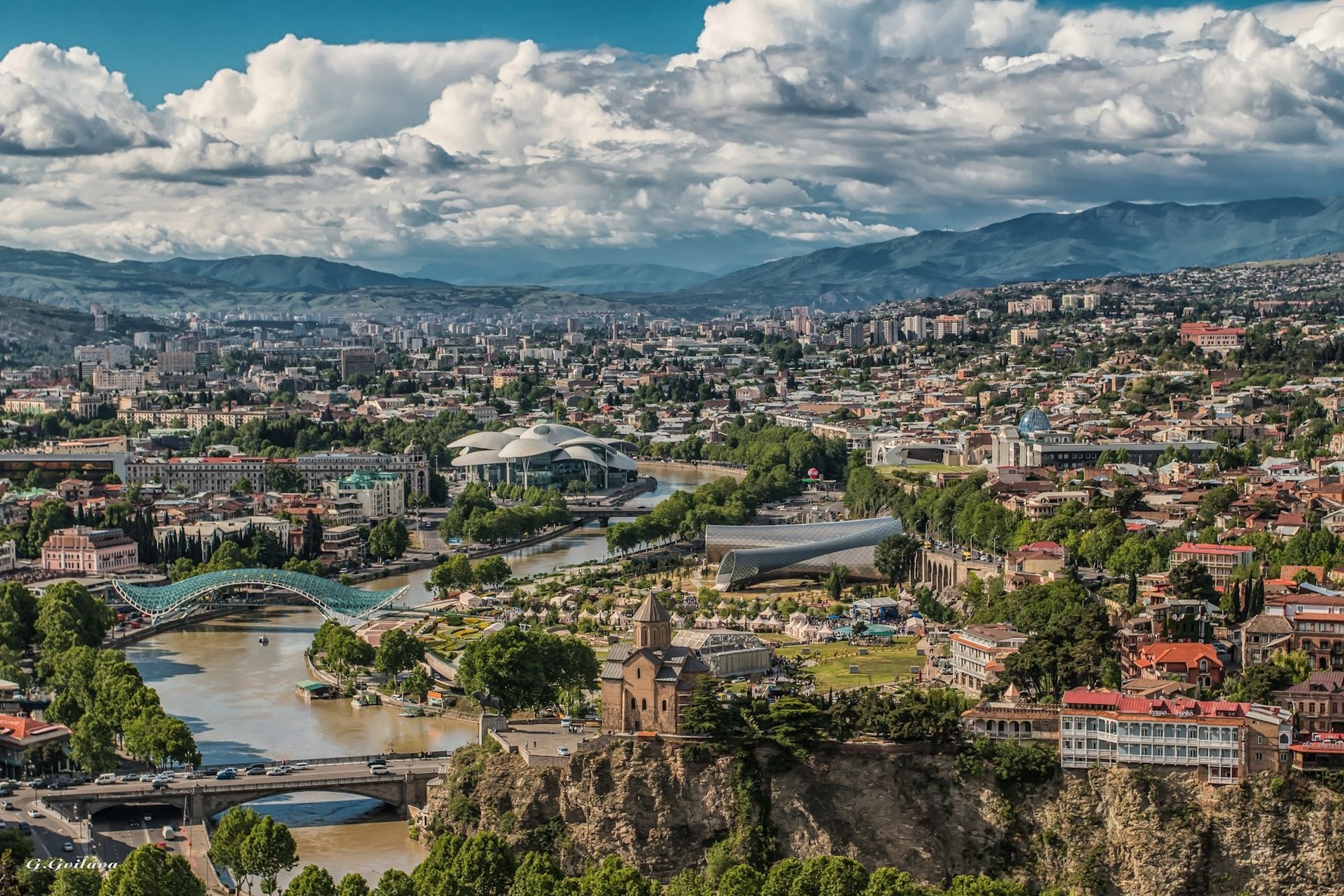
Metekhi is the church on the cliff, which is a description that sounds poetic but is also simply accurate: it sits on the Metekhi Rise, a sheer rock face above the left bank of the Mtkvari directly opposite the old town, and appears from the riverbank to grow out of the stone rather than stand on it. The current structure dates from the late 13th century, built by King Demetrius II between 1278 and 1289, though a church has stood on the site since the 5th century when Vakhtang Gorgasali reportedly built his court chapel here. Metekhi is the Old Georgian word for “territory around a palace”, and the church was indeed once part of a much larger royal and fortified complex, most of which the Mongols saw to in 1235.
The building served as a prison under the Russian Empire, as a theatre under the Soviets (the State Youth Drama Theatre performed here until 1979), and as an artists’ workshop thereafter – a curriculum vitae that most Orthodox churches would find undignified but which Metekhi has survived without obvious complaint. It reopened for services after Georgian independence and is now one of the most active churches in the city. In the courtyard, the equestrian statue of Vakhtang Gorgasali surveys the city he founded. The view across the river from outside the church – the old town rising up the hillside, the cable car gliding above, the ruined Narikala on the ridge – is one of the defining Tbilisi images.
Location: Metekhi Rise, Avlabari. Accessible via Metekhi Bridge from the old town, or a short walk from Avlabari Metro Station (line 1).
Best time to visit: Early morning, when the church is quiet and the light on the river is good. Sunday morning liturgy is worth attending for the polyphonic chanting.
Ticket prices: Free.
Good to know: The spot where St Abo of Tiflis – Tbilisi’s patron saint, a perfumer from Baghdad who converted to Christianity and was martyred by the ruling Persians in 786 – is said to have been executed is at the foot of the Metekhi cliff. A small chapel marks the site, accessible on some days via the gated steps below the bridge.
5. Sameba (Holy Trinity Cathedral)
Sameba is not subtle. The largest church in Georgia and the third-tallest Eastern Orthodox cathedral in the world rises 101 metres from the Elia Hill in the Avlabari district, its gilded dome visible from virtually every point in central Tbilisi. Construction began in 1995 and the cathedral was consecrated on St George’s Day 2004, funded almost entirely by donations from Georgian citizens and several prominent businessmen in a project that was proclaimed a symbol of national and spiritual revival after the Soviet collapse. The architect was Archil Mindiashvili, who won the design from an international competition with a building that synthesises traditional Georgian church forms at various scales into something that manages to be very large and very Georgian simultaneously. Not everyone loves it; the Wikipedia entry quotes the view that it is “regarded as an eyesore by many people”, which is balanced by the observation that it is “equally venerated by as many others”. This is about as much consensus as Sameba is likely to generate.
The interior is enormous, with five underground chapels, frescoes covering most surfaces, marble floors, and the residence of the Catholicos-Patriarch of All Georgia adjoining the main building. The complex also includes a seminary, a monastery, a bell tower housing nine bells (the largest weighing 8,000 kilograms, cast in Germany), and grounds that include a duck pond, a peacock, and a children’s toy shop – an ecclesiastical range of amenities that reflects the degree to which Sameba functions as a community institution rather than purely a tourist attraction.
Location: Avlabari district, on Elia Hill. A 15-minute walk from Avlabari Metro Station (line 1), or a short taxi from the old town (5–10 GEL via Bolt).
Best time to visit: Sunday morning Divine Liturgy (around 10:00) for the Trinity Cathedral Choir and the full ceremonial weight of Georgian Orthodox practice. Evening, when the floodlit dome is visible across much of the city.
Ticket prices: Free.
Good to know: Modest dress is required: covered shoulders and knees, women’s heads covered. Scarves are available at the entrance. The panoramic terrace outside the main entrance offers one of the better views of downtown Tbilisi.
6. The Dry Bridge Market
The Dry Bridge Market is an open-air flea market that began in the early 1990s, when Georgia’s post-Soviet economic collapse left many families selling household possessions to survive, and has evolved over thirty years into one of the more characterful markets in the Caucasus. It occupies the banks of the Mtkvari just north of Rustaveli Avenue and runs daily, with weekends being the busiest and most rewarding.
The inventory is a comprehensive survey of the 20th century arranged on cloths on the ground and folding tables along the riverbank: Soviet military medals and uniforms, old cameras, samovars, antique silver jewellery, carved wooden items, oil paintings, vintage Georgian wine labels, chess sets, surgical instruments still in their cases, and a category best described as “objects that have been somewhere interesting and arrived here without explanation.” Prices are negotiable; the line between genuine antique and recent reproduction is blurry enough that knowledge helps. The paintings section is worth particular attention – works by Georgian artists, some significant, appear regularly alongside purely decorative material, and the difference is not always obvious from the framing.
Immediately east of the main market, and accessible from the same stretch of riverbank, is a separate section of stalls selling contemporary Georgian handicrafts, ceramics, jewellery and artwork. The quality here is more consistent and the prices are fixed.
Location: Right bank of the Mtkvari, between Saarbrucken Square and Atoneli Street. Closest Metro: Liberty Square (line 1), about 12 minutes’ walk. Also accessible by bus routes 20, 23 and 95.
Best time to visit: Saturday or Sunday morning, when the market is at its fullest and the light is good. Opens daily around 09:00–10:00.
Ticket prices: Free to browse.
Good to know: Bargaining is expected and normal. Cash only. The market operates in all weather except heavy rain. The cafes along Atoneli Street at the southern end of the market are good for a coffee before or after.
7. Mtskheta: Jvari and Svetitskhoveli
Mtskheta is not technically in Tbilisi, but it is 20 kilometres up the road and deserves treatment as an essential half-day from the capital rather than an optional excursion. It was the capital of the ancient Kingdom of Iberia for nearly a thousand years before Vakhtang Gorgasali moved things to Tbilisi in the 5th century, and it was here, in 337 AD, that King Mirian III declared Christianity the state religion of Georgia – making Georgia one of the first countries in the world to do so. The city was awarded UNESCO World Heritage status in 1994; standing in it on a clear day, with the two rivers below and the monasteries above, it is not difficult to understand why.
The unmissable pair of sites requires visiting in a specific order for maximum effect. Start at Jvari Monastery, the 6th-century Georgian Orthodox monastery perched on a rocky hilltop above the confluence of the Mtkvari and Aragvi rivers. The building itself is relatively small and austere – an early example of the domed cross-in-square plan that would define Georgian ecclesiastical architecture for centuries – but the view from the terrace is one of the most celebrated in Georgia: Mtskheta directly below, the two rivers meeting in a visible colour difference between their waters (the Aragvi runs lighter than the darker Mtkvari), and the mountains stretching in every direction. The Russian poet Lermontov described this confluence in his 1840 poem Mtsyri, and it has not become less impressive since.
Descend to the town for Svetitskhoveli Cathedral, the second-largest church in Georgia after Sameba and the holiest site in the country for many Georgians. The current structure dates from the 11th century, built during the reign of King David the Builder, though the site has held a church since the 4th century. The name translates as “Life-Giving Pillar” and refers to a cedar tree that is said to have sprung from the burial place of Christ’s robe – which a Georgian Jew named Elias reportedly purchased from a Roman soldier at the Crucifixion and brought back to his hometown, where his sister grabbed it and died on the spot, the robe and her body becoming inseparable. The pillar that stands in the centre of the cathedral marks the spot. Georgia’s relationship with its sacred relics involves a narrative ambition that deserves respect on its own terms.
Location: Mtskheta is 20km northwest of Tbilisi. Marshrutka (minibus) from Didube Metro Station (line 1), 1–2 GEL, 20–30 minutes. Taxi 25–40 GEL one way. Jvari Monastery is 12km from Mtskheta town; taxi from Mtskheta around 20 GEL return.
Best time to visit: Weekday mornings. Weekends draw Georgian wedding parties to Svetitskhoveli in considerable numbers – the cathedral is a popular venue and the atmosphere, while festive, is not exactly meditative.
Ticket prices: Free. Both Jvari and Svetitskhoveli charge no admission. Appropriate dress required.
Good to know: The drive from Tbilisi to Jvari along the Georgian Military Highway offers the first clear views of the Caucasus mountains to the north. The combination of Jvari, Svetitskhoveli, and a lunch in Mtskheta town makes a comfortable half day; adding the Samtavro Monastery, a 4th-century nunnery associated with St Nino, fills a full day.
8. The National Botanical Garden
The National Botanical Garden of Georgia occupies a narrow gorge behind Narikala Fortress, running for around 1.5 kilometres up from Abanotubani into the hills above the old town. It is a genuine green escape from the city rather than a formal horticultural showpiece: the gorge contains a waterfall, a ruined 17th-century Persian bridge, and 4,500 plant species from across the Caucasus and beyond, arranged with an informality that reflects both the difficulty of the terrain and the funding available. The garden was formally established here in 1845, though the first royal gardens on the site were founded in the 17th century.
The main draw is less botanical than geographical: the gorge provides one of the few opportunities in central Tbilisi to walk through something that feels genuinely wild, and the path through to the waterfall takes about 20 minutes each way from the main entrance. The gardens can also be entered directly from the Narikala ridge above, making them a natural extension of a fortress visit.
Location: Main entrance on Botanikuri Street, behind Abanotubani. Also accessible from the Narikala ridge. A 10-minute walk from Metekhi Bridge.
Best time to visit: Spring (April–May), when the gorge is in flower, or early morning in summer before the heat builds. The garden is pleasantly uncrowded on weekday mornings.
Ticket prices: Around 2 GEL adults, 0.50 GEL children.
Good to know: The garden closes at dusk. Comfortable shoes are advisable; the paths are uneven. The waterfall at the top of the gorge is a legitimate reward for the walk and considerably more impressive than the maps suggest.
9. The Georgian National Museum
The Georgian National Museum is not a single building but a network of institutions, the main branch of which is on Rustaveli Avenue opposite the parliament. It is the primary repository for the archaeological and cultural heritage of a country whose history runs to several thousand years, and the permanent collection covers an impressive range: prehistoric artefacts from across Georgia, the famous treasury of Colchian gold, medieval manuscripts and religious objects, and what the museum correctly identifies as one of the finest collections of ancient jewellery in the region.
The most celebrated room for most visitors is the hall dedicated to Niko Pirosmani (1862–1918), Georgia’s best-known painter, who spent most of his life in extreme poverty painting tavern signs and scenes of Georgian life on black oilcloth. His work is naive in technique and completely original in feeling; the large canvases of animals, feasts and Georgian landscapes have a directness that photographs do not adequately convey. Pirosmani died in obscurity and was discovered by the Russian avant-garde shortly before his death; he is now revered as a national cultural figure on a level that his contemporaries would have found baffling.
Best time to visit: Weekday mornings. The museum is closed on Mondays.
Ticket prices: Around 15 GEL adults, 1 GEL children. The treasury requires a separate ticket and guided tour.
Good to know: The museum is large enough to absorb most of a morning, and the Pirosmani hall alone justifies the entrance fee. The gift shop has a reasonable selection of art books and reproductions. The Simon Janashia Museum of Georgia, housed in the same complex, covers natural history if that is your preference.
10. Mtatsminda Park and the Funicular
Mtatsminda is the forested hill that rises directly above the old town to 740 metres, and going up it – by funicular, for preference – is one of those activities that pays off disproportionately for the effort involved. The funicular has been running since 1905, departing from a station on Chonkadze Street and ascending in two stages, stopping midway at the Mtatsminda Pantheon, the hillside necropolis where prominent Georgians are buried: writers, composers, scientists, and heroes of various kinds. Ilya Chavchavadze, the 19th-century writer who is effectively the father of modern Georgian nationalism, is here. So is the poet Akaki Tsereteli. The graves are not simply historic monuments but functioning places of pilgrimage.
The upper station delivers you to Mtatsminda Park, which covers 120 hectares and combines Soviet-era amusement park infrastructure (Ferris wheel, various rides, several restaurants of varying ambition) with genuinely spectacular views over the city, the surrounding mountains and, on clear days, the Greater Caucasus range. The park hosts an annual programme of festivals including wine, honey, cheese and ice cream fairs, which amounts to a fairly comprehensive account of Georgian priorities. The view at sunset, with the city below and the mountains turning pink, is one of the better free experiences available in Tbilisi, provided you have already paid the funicular fare.
Location: Funicular lower station at 2 Chonkadze Street, Sololaki. Metro: Rustaveli (line 1), then 10-minute walk. The funicular operates daily 09:00–midnight. A rechargeable Metromoney card is required – standard public transport card.
Best time to visit: Late afternoon into evening, catching the sunset from the upper platform. The Pantheon is best visited in the morning on a weekday when it is quiet.
Ticket prices: Funicular approximately 2.5–5 GEL one way depending on stage; park entry free. Individual rides within the park are ticketed separately.
Good to know: The Mtatsminda Pantheon is open daily during daylight hours and is free to enter. The abandoned lower cable car station, visible near the funicular departure point, closed after a fatal accident in 1990 and has been left as-is since then – it is a quietly compelling piece of urban archaeology if you know to look for it.