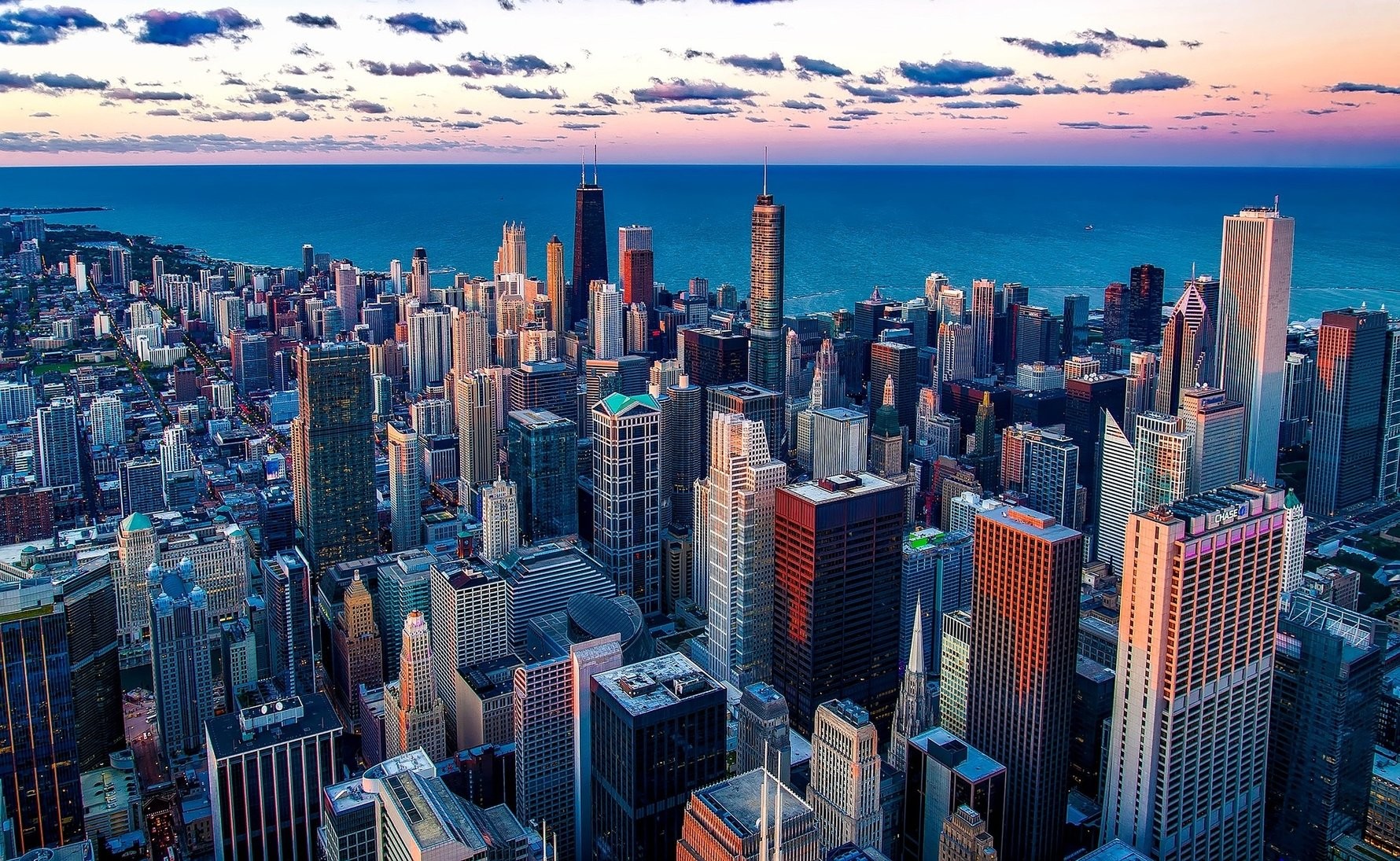
Chicago is a city that was rebuilt from scratch after a fire destroyed much of it in 1871, decided to invent the skyscraper while it was at it, and has spent the century and a half since producing architecture, music, food, and civic institutions at a rate that most cities find difficult to match. It sits on the southwestern shore of Lake Michigan, which gives it a waterfront, a horizon, and a weather system that explains the nickname better than any wind speed measurement could. The city is large enough to reward multiple visits and compact enough, at its centre, that the major attractions cluster into walkable groups. Admission prices and opening hours were accurate at time of writing; verify before visiting, as Chicago’s institutions tend to move on these without much notice.
The Art Institute of Chicago is, by most measures, one of the finest art museums in the world – a claim that does not require Chicago boosters to make it, since TripAdvisor’s users elected it the best museum in the world four years running and the building’s permanent collection makes the case without assistance. The museum was founded in 1879, occupies a Beaux-Arts building on Michigan Avenue that opened in time for the 1893 World’s Columbian Exposition, and was extended in 2009 by Renzo Piano’s Modern Wing, a glass-and-steel addition that nearly doubled the available gallery space and delivered one of the better museum entrances in the country via the Griffin Court.
The collection runs to over 300,000 works across virtually every culture and period, but its particular strengths reward attention. The Impressionist and Post-Impressionist holdings are the finest outside of Paris: Georges Seurat’s “A Sunday on La Grande Jatte” takes up an entire wall of Gallery 240 and justifies the journey on its own. The American galleries hold Grant Wood’s “American Gothic” and Edward Hopper’s “Nighthawks,” two of the most reproduced paintings in American art. The Thorne Miniature Rooms – 68 meticulously constructed 1:12 scale interiors representing European and American decorative arts across four centuries, commissioned by Narcissa Thorne in the 1930s – are a curatorial eccentricity that earns its place in any serious visit. The Arms and Armour galleries are among the strongest in North America. Plan for half a day; plan to come back.
Location: 111 South Michigan Avenue, Grant Park. Steps from the Adams/Wabash and Monroe stations on the elevated loop.
Best time to visit: Weekday mornings. The Seurat and the Impressionist galleries draw the largest concentrations of visitors; arriving when the museum opens gives the paintings room to breathe. Thursday evening hours extend to 8pm.
Ticket prices: Around $25–$35 for adults; Illinois residents receive discounted admission. Check artic.edu for current prices. Chicago residents under 14 enter free.
Good to know: The Modern Wing’s Renzo Piano bridge connects directly to Millennium Park at the second-floor level, making it easy to move between the two without returning to street level. The combination of both in a single morning is one of the more satisfying ways to start a Chicago visit.
2. Millennium Park
Millennium Park opened in July 2004, four years behind schedule and $340 million over its original budget, on a former rail yard and parking lot at the northern edge of Grant Park. By any measure, it worked. The 24.5-acre park has become Chicago’s dominant public space and, by visitor numbers, its most attended attraction – an estimated 20 million people arrive each year to see what happens when a city commissions serious artists and architects rather than the usual park furniture.
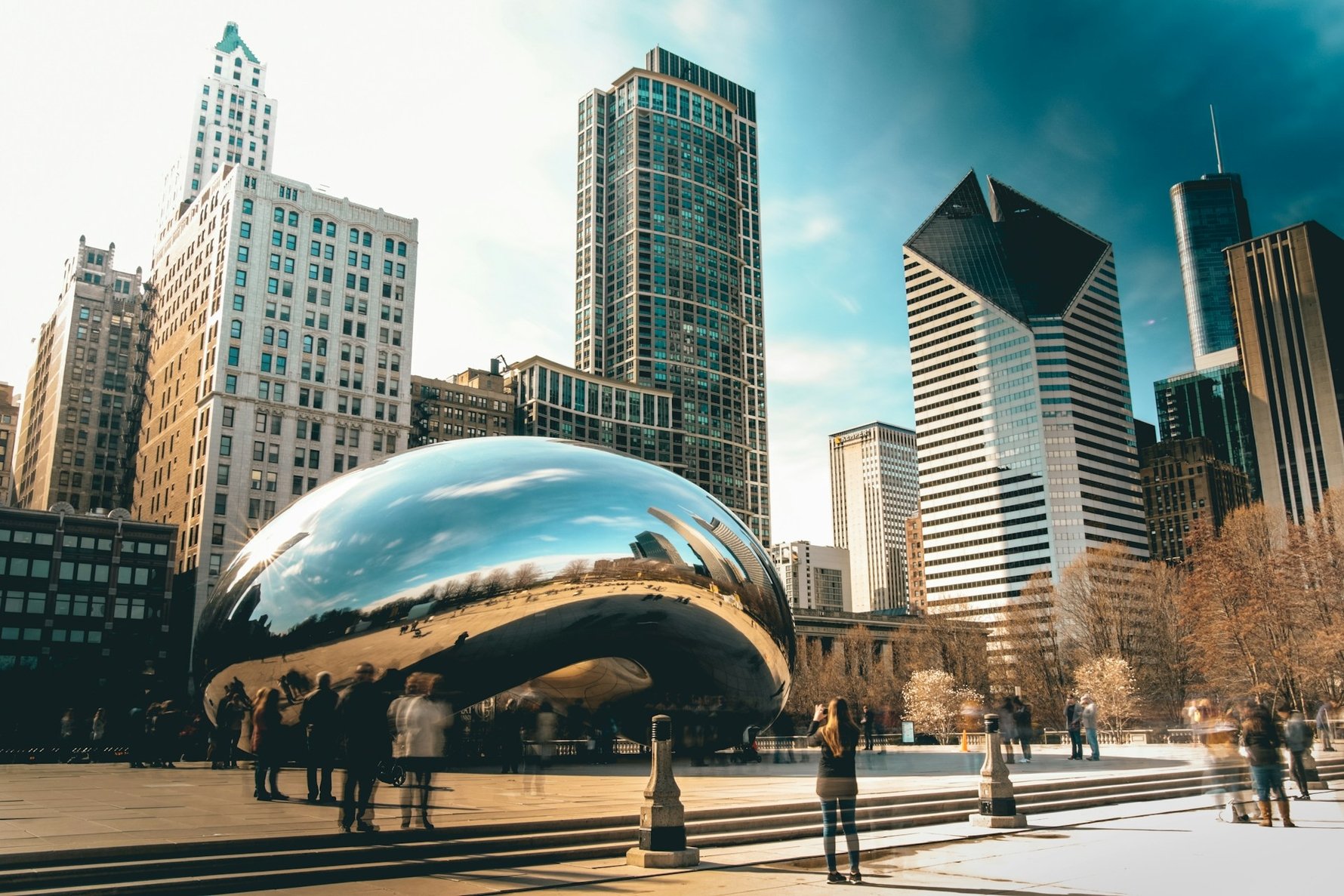
The centrepiece is Cloud Gate – Anish Kapoor’s 110-tonne, 168-plate polished steel sculpture, known universally as the Bean, which reflects both the skyline and the faces of everyone standing in front of it in ways that remain surprising regardless of how many photographs have prepared you for it. Frank Gehry’s Jay Pritzker Pavilion, the bandshell at the park’s eastern end, seats 4,000 and accommodates another 7,000 on the Great Lawn; the Grant Park Music Festival – free classical concerts on Wednesdays, Fridays, and Saturdays throughout summer – has been running here since the park opened and is one of the more civilised things the city does. Jaume Plensa’s Crown Fountain, two 15-metre glass-brick towers at either end of a shallow reflecting pool, projects video portraits of Chicago residents and serves as an urban paddling pool for children in summer with a pragmatism that the more austere public art installations would do well to consider.
Location: 201 E. Randolph Street, between Michigan Avenue and Columbus Drive. Multiple CTA station options; the Madison/Wabash stop on the elevated loop is the most convenient.
Best time to visit: Early morning for Cloud Gate without crowds; summer evenings for Pritzker Pavilion concerts. Winter brings ice skating on the McCormick Tribune Plaza rink, which is free to use (skate hire charged separately).
Ticket prices: Free. The park is a public space, and the concerts on the Great Lawn are free. Individual food and drink vendors within the park charge their own prices.
Good to know: The Lurie Garden, at the park’s southern end, is a 2.5-acre designed landscape with over 200 plant species that most visitors walk past without stopping. It is considerably more interesting than its low profile suggests, and quiet in a way the rest of the park is not.
3. Architecture River Cruise
Chicago invented the skyscraper. The Home Insurance Building, designed by William Le Baron Jenney and completed in 1885, was the first structure to use a steel skeleton frame as its primary load-bearing system – the technique that made tall buildings possible and changed what cities could look like. The building itself is gone, demolished in 1931, but the tradition it initiated is visible from every direction in downtown Chicago, and the most efficient way to understand it is from the water. The Chicago Architecture Center River Cruise, operated aboard the First Lady, covers all three branches of the Chicago River in 90 minutes, with trained volunteer docents discussing over 50 buildings. It is, by a considerable margin, the best introduction to the city available.
From the river you see things that are invisible from the street: the full profile of Bertrand Goldberg’s Marina City twin towers (1964), their circular balconies stacked like corn cobs 65 storeys high; the white terra cotta of the Wrigley Building (1924), modelled on the Giralda tower in Seville; the neo-Gothic Tribune Tower (1925), with stones from the Parthenon, the Berlin Wall, and the White House embedded in its base; and 333 West Wacker Drive (1983), its curved green glass façade following the bend of the river in a way that only makes sense from the water. The Chicago Architecture Center at 111 East Wacker also runs walking tours of the Loop for those who want to continue after the cruise.
Location: Departures from the Chicago Architecture Center dock at 112 E. Wacker Drive, and from Navy Pier. The CAC itself is at 111 E. Wacker Drive.
Best time to visit: The cruise runs March through November. A departure roughly 90 minutes before sunset gives the best combination of natural light for photography and atmosphere. Book online; popular departure times sell out.
Ticket prices: Around $45–$55 for adults; check architecture.org for current prices. Adding CAC admission ($15) for those who want to extend their architectural education is worth doing.
Good to know: Multiple operators run river architecture cruises, ranging from fully narrated to pre-recorded audio. The CAC cruise with volunteer docents is the most consistently informative option. Wendella and Shoreline Sightseeing are reliable alternatives if CAC times do not fit.
4. The Field Museum
The Field Museum of Natural History sits on Museum Campus, the landscaped promontory on Lake Michigan’s shore that also houses the Shedd Aquarium and the Adler Planetarium, in a 1921 Daniel Burnham-designed Classical Revival building with a façade long enough to make the walk from one end to the other a minor exercise. The collection runs to 30 million specimens across geology, biology, anthropology, and archaeology, spread across 480,000 square feet of gallery space. It is the kind of museum that defeats a single visit; most people spend a day and feel they have seen half of it.
The entry point for most visitors is SUE, the largest and most complete Tyrannosaurus rex skeleton ever found – 40 feet long, 90% complete, discovered in South Dakota in 1990 and acquired by the museum at auction in 1997 for $8.36 million, a record at the time. SUE now occupies the Griffin Halls of Evolving Planet, alongside Maximo, a titanosaur measuring 122 feet from head to tail, the largest dinosaur ever discovered, which stretches diagonally across Stanley Field Hall at a scale that requires some adjustment. Beyond the dinosaurs: the Inside Ancient Egypt exhibition, with 23 mummified remains in a recreated tomb; the Grainger Hall of Gems, with the 217.45-carat Brazilianite crystal and the 1,400 other specimens; and permanent galleries covering the Pacific, the Americas, Tibet, and African cultures with a depth that rewards sustained attention.
Location: 1400 S. Lake Shore Drive, Museum Campus. The CTA #146 bus runs from Michigan Avenue. The museum is a 20-minute walk from the southern end of Grant Park.
Best time to visit: Weekday mornings. The museum opens at 9am and the entry hall – where SUE and Maximo both live – is quieter before the late-morning school groups arrive.
Ticket prices: Around $25–$30 for adults; check fieldmuseum.org for current prices. Illinois residents receive discounted admission on select dates. Special exhibitions require an additional ticket.
Good to know: The Museum Campus is worth treating as a half-day rather than a single stop. The lakefront path runs north from the campus back toward downtown, and the view of the skyline from the promontory – water in the foreground, towers behind – is the best available from ground level.
5. Wrigley Field
Wrigley Field opened on 23 April 1914 as Weeghman Park, built for the Chicago Whales of the short-lived Federal League. The Whales folded with the league in 1915; Charles Weeghman bought the Chicago Cubs and moved them to his stadium; William Wrigley Jr., chewing-gum magnate, acquired a controlling interest in the team in 1920 and the park was renamed in 1926. It is the second-oldest active ballpark in Major League Baseball, after Fenway Park, and the more self-consciously lovable of the two – the ivy planted on the outfield walls by Bill Veeck in 1937, the hand-operated scoreboard that has been running since 1941, the rooftop bleacher seating on the apartment buildings across Sheffield and Waveland that has been part of the stadium’s vernacular for decades. It was designated a National Historic Landmark in 2020.
The Cubs went 108 years without winning the World Series, a drought explained variously by the Curse of the Billy Goat (a tavern owner was ejected from a 1945 World Series game for bringing his goat, and cursed the team on the way out), bad management, and the particular cruelty of baseball, which distributes suffering over enough seasons to become genuinely personal. They won in 2016. The neighbourhood around the park – Wrigleyville, officially part of Lakeview on Chicago’s North Side – is bars, restaurants, and Cubs merchandise from Addison Street outward in every direction, and functions as a destination on game days regardless of your interest in the sport. Tours of the park run daily when the team is away.
Location: 1060 W. Addison Street, Wrigleyville. The Red Line to Addison is the obvious approach; it deposits you half a block from the main gate.
Best time to visit: A day game in summer, with the afternoon light on the ivy. Night games have atmosphere but lose the visual particularity of the park. Tours run on non-game days and cover the press box, the dugout, and the field.
Ticket prices: Game tickets vary by opponent and date; check mlb.com/cubs. Stadium tours are around $30 for adults; check cubs.com/wrigley-field/tours for current pricing and availability.
Good to know: The rooftop clubs on Sheffield and Waveland – private businesses on apartment buildings directly overlooking the outfield – offer an unusual way to watch a game. They are expensive and book up quickly for popular matchups, but the perspective is unlike anything available inside the stadium.
6. Chicago Blues
The story of the Chicago Blues is a story about the Great Migration. Between 1910 and 1970, around six million Black Americans moved from the rural South to Northern cities, and a significant portion of them came to Chicago, settling primarily on the South Side. They brought the Delta blues with them – the acoustic, voice-and-guitar tradition of the Mississippi Delta – and the city changed it: amplified it, added drums and piano and electric bass, sharpened it into something that could fill a club and be recorded. Muddy Waters arrived from Mississippi in 1943 and, recording for Chess Records from 1947 onwards, defined the electric Chicago blues sound; Howlin’ Wolf, Little Walter, Sonny Boy Williamson, Willie Dixon, and Chuck Berry followed on the same label. The Rolling Stones visited the Chess studios in 1964 and Muddy Waters helped them carry their equipment in.
Chess Records, founded by brothers Leonard and Phil Chess at 2120 South Michigan Avenue, is now preserved as Willie Dixon’s Blues Heaven, a museum and foundation open for tours on the South Side. The live blues scene remains substantive. Buddy Guy’s Legends at 700 South Wabash, operated by the Grammy-winning guitarist who is one of the last direct links to the Chess Records era, has live music every night and Buddy Guy himself performs there each January. Kingston Mines at 2548 North Halsted, open since 1968, runs two stages simultaneously Thursday through Saturday until 4am and is the oldest continuously operating blues club in the city.
Location: Buddy Guy’s Legends: 700 S. Wabash Avenue, South Loop. Kingston Mines: 2548 N. Halsted Street, Lincoln Park. Willie Dixon’s Blues Heaven: 2120 S. Michigan Avenue, South Side.
Best time to visit: Any night at Buddy Guy’s for consistent quality; Thursday through Saturday at Kingston Mines for the full two-stage experience. The annual Chicago Blues Festival, held in Millennium Park each June, is free and draws headline acts.
Ticket prices: Buddy Guy’s Legends cover charge varies by night; check buddyguy.com. Kingston Mines cover runs around $15–$20 depending on the night. Blues Heaven tours are around $15; check bluesheaven.com for current prices and hours.
Good to know: Buddy Guy’s Legends also serves Louisiana-style food, which is better than it needs to be. Arriving before 9pm on weeknights usually secures a table.
7. The Chicago Riverwalk
The Chicago Riverwalk is a 2-kilometre pedestrian promenade running along the south bank of the Chicago River between Lake Shore Drive and Lake Street, completed in its current form in 2016. It is the best street-level view of Chicago’s architecture available – the river cuts through the canyon of the Loop’s towers, and the Riverwalk puts you at water level, looking up at the facades of buildings you can only see from above or from the Architecture Cruise from the water. From here: the corncob towers of Marina City, the glass curve of 333 West Wacker, the white Gothic crown of Tribune Tower, and the Wrigley Building’s clock tower, all within a few hundred metres of each other.
The Riverwalk is lined with bars, restaurants, and food stalls that operate from spring through autumn, ranging from serious to casual. Chicago Water Taxi runs along the river and out to Navy Pier, providing river transport that doubles as a boat tour. Kayak hire is available at the McCormick Bridgehouse, adjacent to the Michigan Avenue bridge – the 1920 Michigan Avenue Bridge (now DuSable Bridge) itself is one of the more photographed pieces of engineering in the city, a double-leaf bascule bridge with four ornamental bridge houses containing relief sculptures depicting scenes from Chicago’s history. The Riverwalk connects naturally at its eastern end to Lake Michigan and the lakefront trail, which runs 18.5 miles north and south along the shore.
Location: South bank of the Chicago River, from Lake Shore Drive west to Lake Street. Accessible from multiple points along Wacker Drive. The closest CTA stations vary by entry point; State/Lake and Washington/Wabash on the elevated loop are the most convenient.
Best time to visit: Late afternoon and early evening from May through October, when the restaurants are open and the light on the river is at its best. Winter reduces the Riverwalk to a scenic walk without the food and drink options.
Ticket prices: Free to walk. Kayak hire, water taxi fares, and restaurant prices are the relevant costs.
Good to know: The McCormick Bridgehouse & Chicago River Museum, inside one of the Michigan Avenue bridge houses, is a small but worthwhile museum covering the river’s history and the engineering of the city’s movable bridges. It is open in summer and charges a nominal admission.
8. Robie House
The Frederick C. Robie House, completed in 1910 on the campus of the University of Chicago in Hyde Park, is the building Frank Lloyd Wright described as “a cornerstone of modern architecture” and that the American Institute of Architects has named one of the ten most significant structures of the 20th century. It is a UNESCO World Heritage Site. It is also, from the outside, the kind of building that takes a moment to resolve: the dramatically cantilevered rooflines extending well beyond the walls, the continuous bands of art glass windows that run the length of the façade, the deliberate concealment of the entrance, the way the entire structure sits low and horizontal in a way that reads as American rather than European. This was the point. Wright was trying to invent an architecture that belonged to the Midwest prairie rather than to any imported tradition, and the Robie House is the fullest statement of what that meant.
The house was commissioned by Frederick C. Robie, a bicycle and motorcycle manufacturer who wanted a building as progressive as his products. Wright was 40 and at the height of his Oak Park years. The structure cost $58,500 to build, was listed as a National Historic Landmark in 1963, and faced demolition three separate times before the University of Chicago took ownership and restored it. Tours run Thursday through Monday and cover both the exterior and the interior, including the original art glass, the built-in furniture, and the sequence of spaces Wright designed to flow horizontally rather than be divided by conventional walls. The Hyde Park neighbourhood, home to the University of Chicago and the Obama Presidential Center (under development nearby), is worth additional time after the tour.
Location: 5757 South Woodlawn Avenue, Hyde Park. The Metra Electric line from Millennium Station to 59th Street is the most direct public transport option; the Green Line is an alternative with a longer walk.
Best time to visit: Weekday mornings. Tours are small-group and the house is intimate; weekend tours fill quickly. Book directly at flwright.org.
Ticket prices: Around $20–$25 for adults; verify at flwright.org before visiting. The museum is closed Tuesdays and Wednesdays.
Good to know: Oak Park, 10 miles west of downtown, holds the largest collection of Frank Lloyd Wright-designed structures in the world, including his former home and studio. A dedicated Wright day combining Robie House in the morning with Oak Park in the afternoon is feasible and worthwhile for those with specific architectural interest.
9. The Magnificent Mile
The Magnificent Mile is the 13-block section of North Michigan Avenue running from the Chicago River north to Oak Street, and its nickname, coined by developer Arthur Rubloff in 1947, has proved accurate enough that no one has seriously contested it since. It is Chicago’s main commercial spine and one of the architecturally richest stretches of street in the country – the buildings on and immediately around it constitute an accidental museum of 20th-century commercial architecture, accumulated over a century without any single governing plan.
At its southern end, the Wrigley Building (1924) and the Tribune Tower (1925) face each other across Michigan Avenue, the former gleaming white in terra cotta, the latter a Gothic competition winner with its famous embedded stones from the Pyramids, the Taj Mahal, the Berlin Wall, and dozens of other structures collected by Tribune reporters worldwide. The Water Tower, at 806 North Michigan Avenue, is a castellated limestone structure completed in 1869 and one of the few buildings to survive the Great Chicago Fire of 1871 – it now houses a small gallery and serves primarily as the most photographed evidence of what the city looked like before it rebuilt itself. At the north end, the John Hancock Center (875 North Michigan Avenue), completed in 1969, is identifiable by the giant X-braces on its exterior, a structural innovation by Skidmore, Owings & Merrill that allowed the 100-storey tower to be built with less steel than conventional methods would have required.
Location: North Michigan Avenue, from the Chicago River (Wacker Drive) to Oak Street. The Red Line to Grand is the most convenient stop for the central section.
Best time to visit: Morning for the architecture, when the light is on the eastern facades; evening for the atmosphere, when the buildings are lit and the street is in full use.
Ticket prices: The street is free. The 360 Chicago observation deck on the 94th floor of the Hancock Center charges admission; check 360chicago.com for current prices. Individual shops, restaurants, and galleries charge their own rates.
Good to know: The building lobby of the Tribune Tower is freely accessible and contains the embedded stones at eye level – worth five minutes before continuing north. The Chicago Water Tower Gallery inside the Water Tower is free and mounts rotating exhibitions of Chicago photographers and artists.
10. Chicago Cultural Center
The Chicago Cultural Center at 78 East Washington Street is the former Chicago Public Library, completed in 1897 in a Beaux-Arts and Renaissance Revival style that the city has had the good sense not to repurpose into anything requiring admission. It is now a free cultural centre hosting rotating art exhibitions, concerts, film screenings, and civic events, and most visitors walk past it entirely because it does not behave like the attraction it is. The exterior gives little indication of what is inside: two monumental staircases, a grand hall sheathed in Carrara marble and Favrile glass mosaic, and two Tiffany art glass domes – the Preston Bradley Hall dome, 38 feet in diameter, and the Garland Room dome on the floor above, 30 feet across – that are among the finest examples of Tiffany glass in existence and the largest in the world.
The domes were commissioned from the Tiffany Studios of New York and installed between 1897 and 1910. The Preston Bradley Hall dome uses 30,000 individual pieces of opalescent glass; the colours shift through the day as the light changes. The building also contains the Landmark Chicago Gallery, a permanent exhibition on the city’s architectural history that provides useful context before or after the Architecture River Cruise, and the Chicago Visitor Information Center, which is as functional as it sounds. The Cultural Center is three minutes on foot from Millennium Park, directly on the route between the Art Institute and the Riverwalk, and costs nothing to enter.
Location: 78 E. Washington Street, the Loop. Directly across from Millennium Park; the Washington/Wabash elevated station is immediately adjacent.
Best time to visit: Midday, when the Tiffany domes are receiving direct light. The building is open Monday through Sunday; check chicagoculturalcenter.org for current exhibition and event listings.
Ticket prices: Free. All exhibitions and the permanent galleries are free of charge. Individual events, concerts, and films may have their own ticketing.
Good to know: The Preston Bradley Hall dome is on the third floor of the Randolph Street side of the building; the Garland Room dome is on the fourth floor. Both are worth finding. Maps are available at the information desk on the ground floor.
What else can you see in Chicago?
The Willis Tower Skydeck, on the 103rd floor of what was the tallest building in the world from 1973 until 1998, is the obvious observation deck option: the views extend to four states on a clear day and the glass-floored Ledge boxes, which project four feet beyond the building’s exterior, provide the kind of vertigo that photographs reliably underestimate. Queues are long and tickets are not cheap; booking online in advance is the only sensible approach. The Museum of Science and Industry, in Hyde Park in the same visit as Robie House, occupies a 1893 World’s Fair building and covers everything from coal mines to space shuttles across 14 acres of floor space; it is primarily oriented toward younger visitors but functions at a level of seriousness that makes the category distinction irrelevant for anyone with an actual interest in science.
The Second City comedy club on North Wells Street in Old Town has been the primary training ground for American sketch comedy since 1959 – the list of alumni runs from John Belushi and Gilda Radner through Bill Murray, Tina Fey, Stephen Colbert, and Steve Carell, among several dozen others – and continues to run shows nightly, with free improv sets after the main performance on most evenings. The Lincoln Park Zoo, on the lakefront in Lincoln Park, is free to enter and one of the last major free urban zoos in the country, which is worth knowing. Pilsen, the predominantly Mexican-American neighbourhood southwest of the Loop, has the best murals in the city and the National Museum of Mexican Art, which is also free and holds the largest collection of Mexican art in the United States.
For day trips, Oak Park to the west is an easy 25-minute CTA ride and holds Wright’s home, studio, and a concentration of his early residential work that earns a dedicated half-day. Evanston, 30 minutes north on the Purple Line, is the home of Northwestern University and a handsome lakefront town with a good independent restaurant scene and the Block Museum of Art on campus. Indiana Dunes National Park, on the southern shore of Lake Michigan around 90 minutes by commuter rail, is 15,000 acres of beach, dunes, and wetland that most Chicagoans regard as their personal secret, which it is not, but which remains one of the better pieces of shoreline accessible from a major American city.