Las Vegas is many things, most of them requiring a disclaimer. It is one of the most visited cities in the United States, a monument to the proposition that people will travel enormous distances to lose money in air-conditioned rooms, and a place that has spent the better part of a century making sure you cannot tell what time it is. It is also, beneath the neon and the manufactured spectacle, a genuinely strange and historically interesting city that rewards visitors who know where to look.
This guide leans toward the real Las Vegas rather than the corporate one: the downtown that predates the Strip, the museums that take the city’s past seriously, the bar where people once climbed onto the roof to watch nuclear explosions. Casinos appear where their architecture or history earns them a place; they are otherwise left to find their own visitors, which they are extremely good at doing. Admission prices were accurate when this was written, though Las Vegas has a talent for changing things without notice – verify before you visit.
The Fremont Street Experience is the original Las Vegas: the street that existed before anyone thought to build a resort on a desert highway south of town and call it the Strip. Fremont Street was where Las Vegas began, where the first licences were issued, where the early casinos opened, and where the city’s mythology was assembled before Hollywood got involved. It remains the more honest and considerably more interesting half of the city, even with the enormous LED canopy – 460 metres long, 27 metres above the pedestrian mall – that the Fremont Street Experience Corporation installed in 1995 to stop the area losing ground to the Strip.
The canopy shows are free, loud, and exactly as excessive as you would expect. More interesting than the light shows are the buildings. The Golden Gate Hotel & Casino, at 1 Fremont Street, opened in 1906 as Hotel Nevada, making it the oldest operating hotel in Las Vegas; the first telephone in the city was installed here, its number simply “one.” The Golden Nugget, opened in 1946, was for a time the largest casino in the world and retains a lobby of considerable swagger. The El Cortez, two blocks east of the main canopy at 600 Fremont Street, has been operating continuously since 1941, making it the longest-running hotel-casino in the city; it was briefly owned by Bugsy Siegel and Meyer Lansky, a period the building has survived with rather more dignity than either of its former owners. It is on the National Register of Historic Places – the only casino in Las Vegas with that designation – and is still genuinely cheap to stay in, which puts it in a category of one.
Hunter S. Thompson based himself at the old Mint Hotel on Fremont Street for the Mint 400 desert race in 1971, the assignment that became Fear and Loathing in Las Vegas. The Mint was absorbed into Binion’s in 1988 and is now Hotel Apache, but Fremont Street still carries the DNA of the city Thompson wrote about: the feeling that Las Vegas is a place where the American Dream came to be tested to destruction, found wanting, and celebrated anyway.
Location: Fremont Street between Main Street and 4th Street, Downtown Las Vegas. The El Cortez is at 600 E Fremont Street, two blocks east of the main canopy.
Best time to visit: After dark, when the canopy shows run and the neon is doing what neon was designed to do. Daytime is better for the buildings and the history; evening is better for the spectacle.
Ticket prices: The canopy shows and the street itself are free. Individual casinos and hotels have their own charges for rooms and, obviously, for gambling.
Good to know: The SlotZilla zipline, which launches riders across the length of the canopy from a 11-metre platform, is the most Las Vegas possible way to see the Fremont Street Experience. Tickets are available at the zipline tower; prices vary by time and experience level.
2. Atomic Liquors
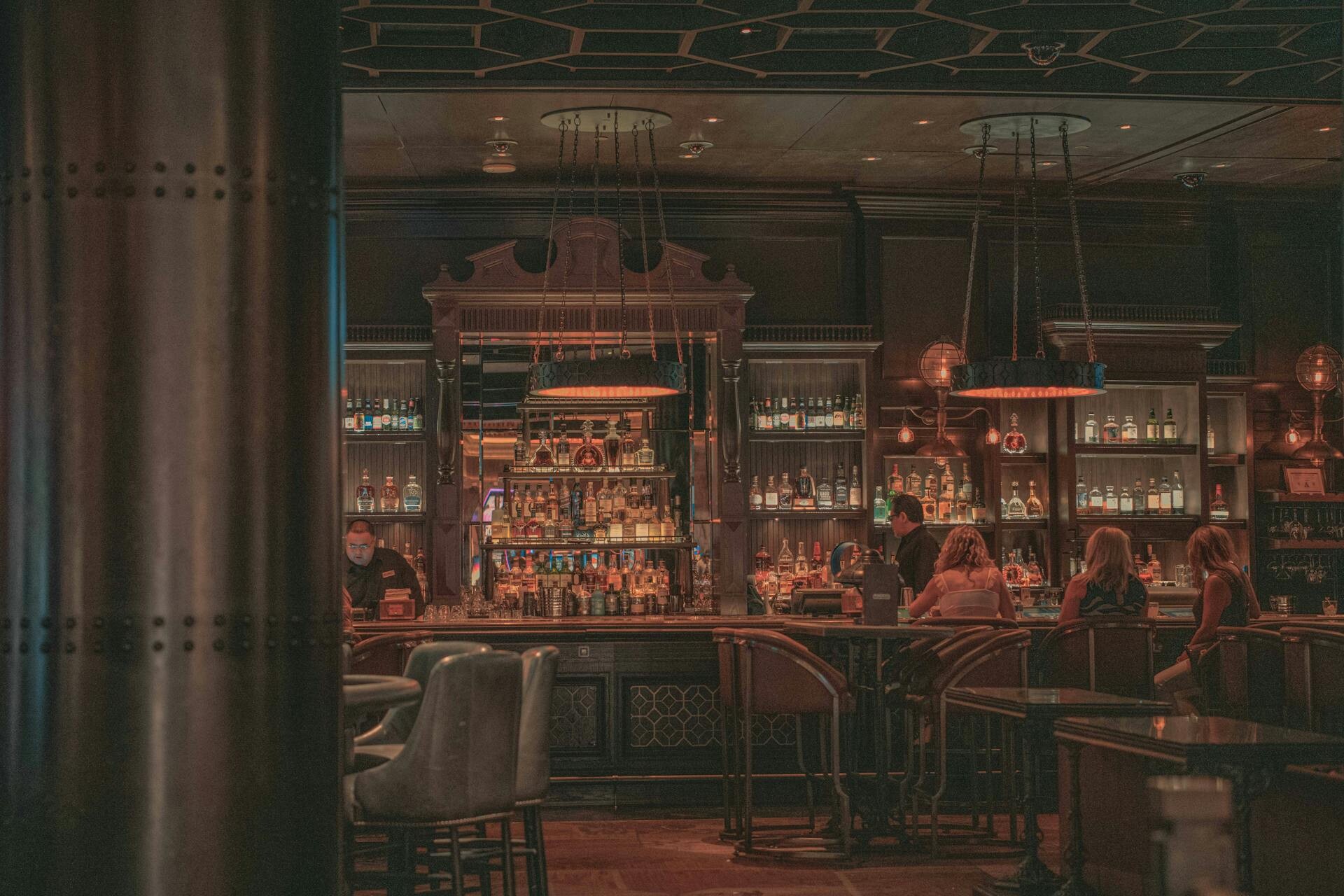
Atomic Liquors at 917 Fremont Street is Las Vegas’s oldest freestanding bar, which would be a fine enough distinction on its own. What makes it extraordinary is how it got its name. When the United States began testing nuclear weapons at the Nevada Test Site – roughly 100 kilometres northwest of the city – in January 1951, the owners of what was then Virginia’s Café noticed that their rooftop offered a clear view of the desert horizon. Patrons began climbing up to watch the blasts, drinks in hand. The cafe became a liquor store in 1952, then a full bar in 1954, the name changed to reflect what was happening on the roof, and Joe Sobchik started serving a house cocktail he called the Atomic Cocktail to the people watching mushroom clouds rise 60 to 70 miles away over the Mojave. This was considered normal at the time.
Above-ground testing ended in 1963. The bar carried on, went through lean years when Fremont Street declined, was purchased and restored to its original configuration in 2012, and now operates with the original curved bar, the original neon out front, and a sealed floor safe discovered during renovation that contained receipts and paperwork from the 1950s, left exactly where it was found under glass. The decor pays appropriate tribute to the nuclear history, and the cocktail menu includes a drink named the Hunter S. Mash, a nod to Thompson’s sustained relationship with this end of Fremont Street. It is the rare bar that works equally well as a piece of American history and as a place to have a drink.
Location: 917 Fremont Street, at the east end of the Fremont Street Experience, just past the main canopy area.
Best time to visit: Evening, when the bar is in its element. The patio along the front catches what passes for pleasant weather in Las Vegas.
Ticket prices: Not a museum. Order something.
Good to know: The rooftop is still accessible and still offers a view of the desert horizon, now without the mushroom clouds. The floor safe is visible behind its glass cover at the bar. The historical photographs on the walls are worth studying.
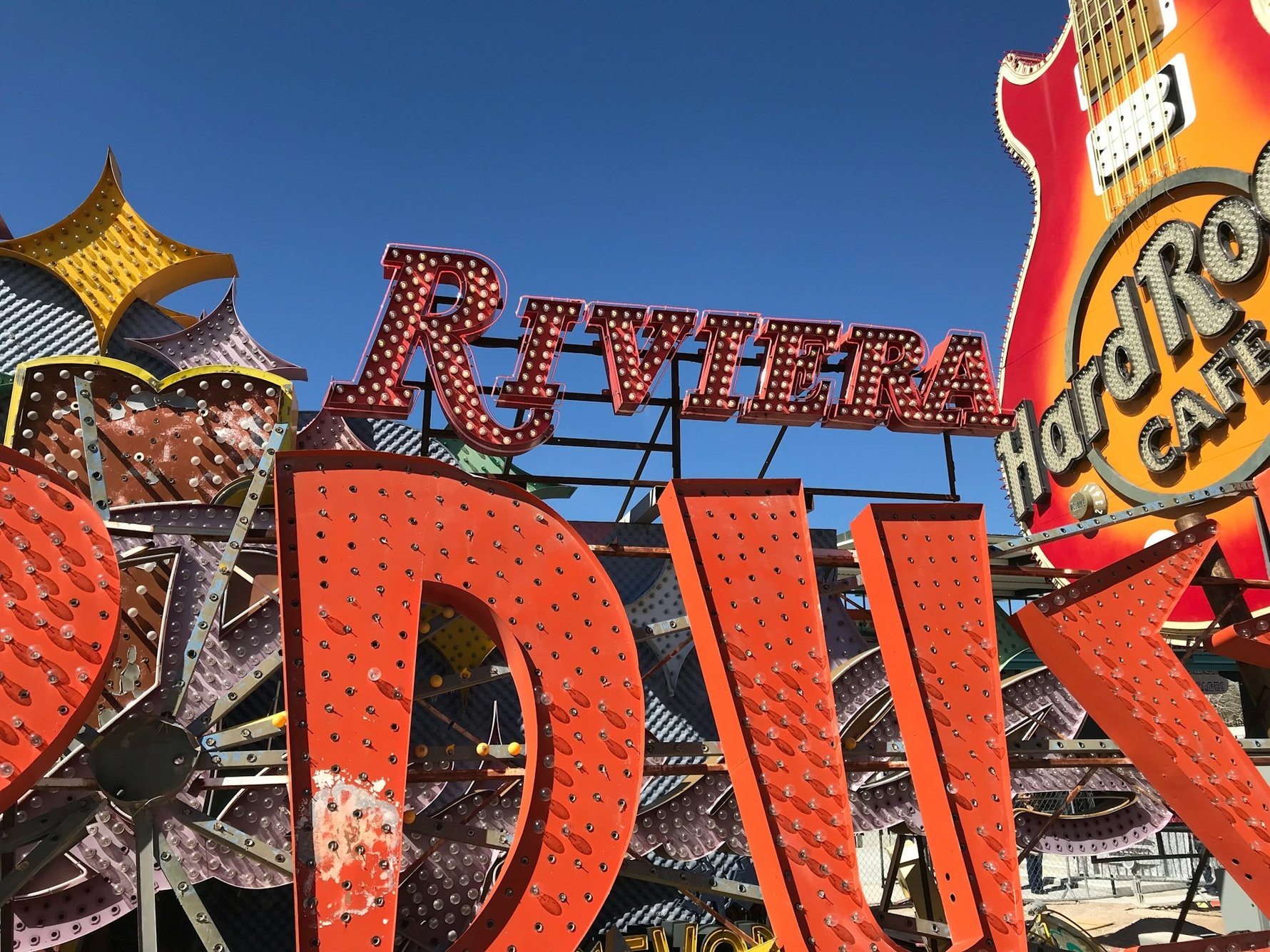
The Neon Museum collects and preserves the historic neon signs of Las Vegas: the ones pulled down when casinos were demolished, rebranded or updated, and which would otherwise have been lost. The outdoor collection known as the Neon Boneyard is the centrepiece – more than 200 unrestored signs arranged in an open-air site north of downtown, their paint faded and their metal weathered, alongside 27 fully restored signs that light up at night. Stardust, Sahara, Desert Inn: the names are the history of the Strip, and seeing the physical signs in this context is unexpectedly affecting in a way that a photograph of the same objects would not be.
The visitor centre is housed in the former lobby of the La Concha Motel, a 1961 Paul Revere Williams design that was rescued from demolition in 2006 and moved here piece by piece. Williams, a Black architect who worked in an era when he was refused entry to some of the buildings he designed, was one of the most prolific architects in Las Vegas history; the La Concha lobby, with its shell-shaped concrete canopy, is one of his most distinctive surviving works. The museum also operates evening tours in which projection mapping re-illuminates non-restored signs in the Boneyard, producing something that goes well beyond the usual museum experience.
Location: 770 Las Vegas Boulevard North, between Downtown and the Arts District.
Best time to visit: Daytime for detail and photography in natural light; evening for the atmosphere of the illuminated night tours, which sell out well in advance.
Ticket prices: Daytime general admission from around $20; evening and guided tours are priced higher. Book online – the museum operates timed entry and popular sessions do sell out. Check neonmuseum.org for current prices.
Good to know: The museum is a short drive or long walk from the Fremont Street Experience, making the two a natural pairing for a downtown afternoon and evening. The gift shop sells reproductions of several historic signs at a scale suitable for taking home.
4. The Mob Museum
The Mob Museum – formally the National Museum of Organized Crime and Law Enforcement – is housed in the former federal post office and courthouse at 300 Stewart Avenue, a 1933 Art Deco building that was the site of the Kefauver Committee hearings in 1950, at which the United States Senate investigated organised crime and made the uncomfortable discovery that Las Vegas was essentially running on it. The building’s courtroom has been restored to its 1950 configuration; you can sit in the same seats where mob figures were questioned by senators. This kind of institutional self-awareness – the museum occupying the very courthouse where the thing it documents was investigated – is rare and genuinely worthwhile.
The collection across four floors covers the rise of the American mob, its relationship with Las Vegas from the Flamingo onwards, the law enforcement efforts that eventually dismantled the major families, and the Prohibition-era context that created the conditions for organised crime to flourish. The exhibits are well-designed and the artefacts are serious: actual weapons, actual evidence, the electric chair from the Nevada State Prison. In the basement, the museum operates a working speakeasy and distillery, which in context is either a strange irony or a completely logical extension of the theme, depending on your tolerance for that kind of thing.
Location: 300 Stewart Avenue, Downtown Las Vegas, three blocks from the Fremont Street Experience.
Best time to visit: Weekday mornings, when it is least crowded. Allow at least two hours; three is more realistic.
Ticket prices: Around $30–35 for general adult admission; discounts available for early morning and evening entry. Check themobmuseum.org for current pricing.
Good to know: The basement speakeasy operates as a bar and requires separate entry. The walk between the Mob Museum and the Neon Museum takes about 15 minutes and passes several other points of downtown interest.
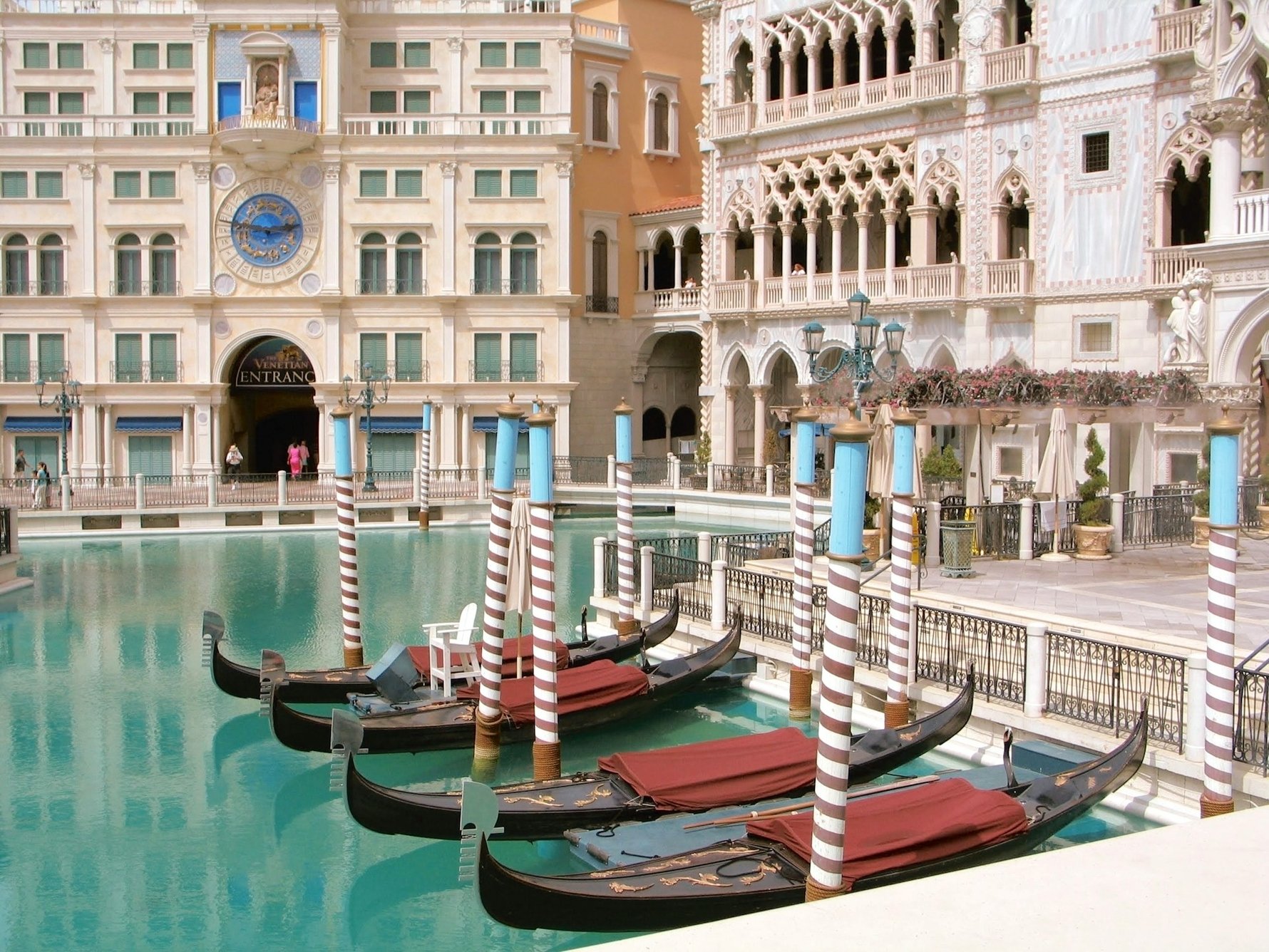
A note on methodology: this guide is not in the business of recommending casinos. The Venetian earns its entry not as a gambling destination but as a feat of committed architectural derangement that should be seen by anyone with an interest in what enormous amounts of money can persuade the built environment to do. The casino opened in 1999 on the site of the demolished Sands Hotel and was built to reproduce a version of Venice, including the Grand Canal, gondoliers, a replica of the Doge’s Palace, and an interior shopping street under a painted sky that is perpetually set to a pleasant afternoon in a city that is not Las Vegas.
The painted ceiling is the thing. It runs the length of the Grand Canal Shoppes on the second floor, convincingly rendered in a way that disorients the senses just enough to make you forget, briefly, that you are in a desert in Nevada at an unspecifiable time of day. The gondola rides on the indoor canal operate continuously and cost money; the experience of walking beneath the sky costs nothing and is more than sufficient. It is not Venice. It is something stranger than Venice: a serious attempt by serious architects and very serious money to make Venice in a place where Venice cannot exist, and the sincerity of the effort is somehow more interesting than the result.
Location: 3355 Las Vegas Boulevard South (the Strip), between Spring Mountain Road and Sands Avenue.
Best time to visit: Midday, when the natural light through the skylights reinforces the painted sky effect in a way that stops making sense if you examine it too closely.
Ticket prices: Free to enter and walk through. Gondola rides are priced separately.
Good to know: The Venetian and the adjacent Palazzo (now part of the same resort complex) together form one of the largest hotel buildings in the world. You can walk considerable distances inside without repeating yourself, which is either a feature or a warning depending on your relationship with casinos.
6. The Fountains of Bellagio
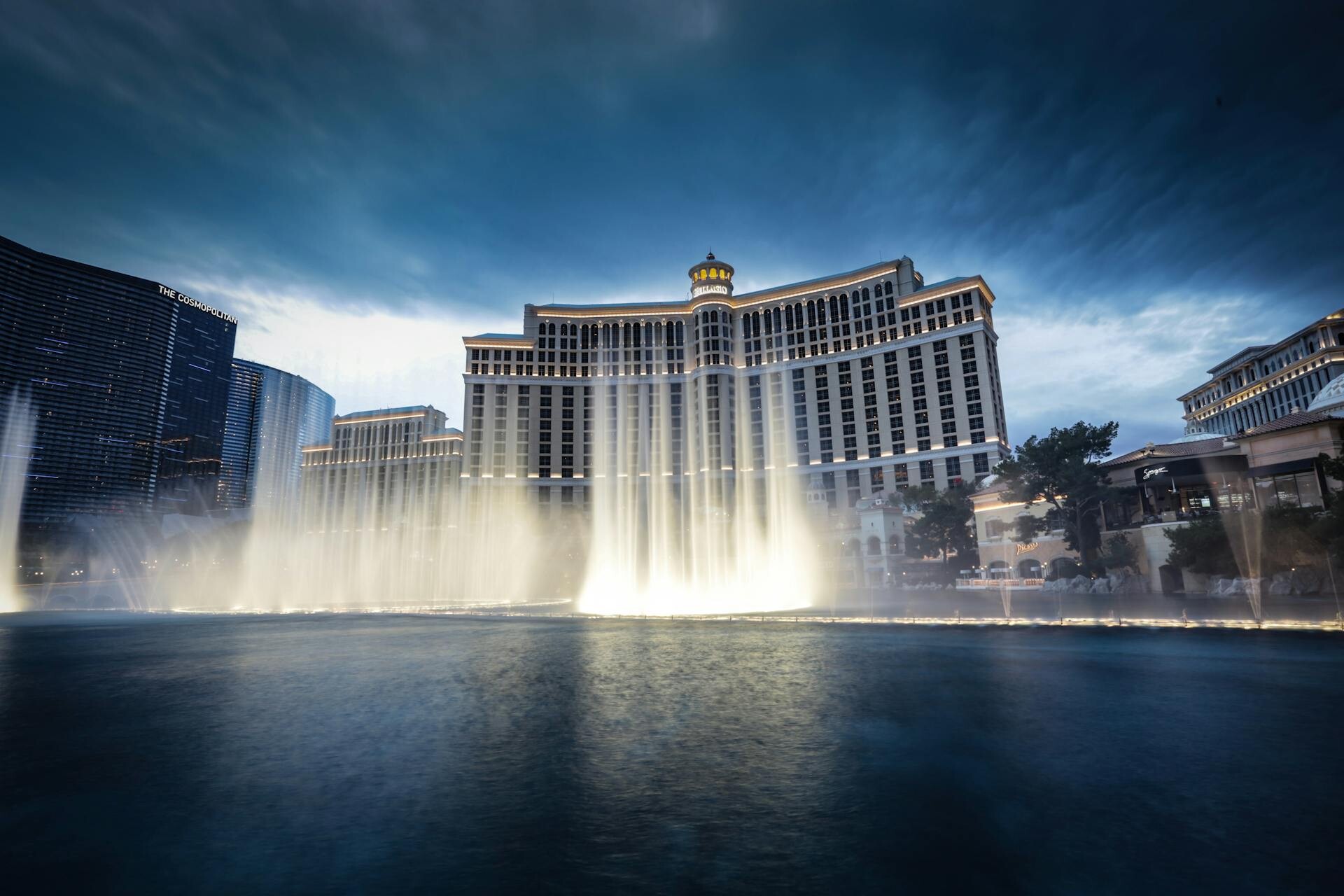
The Fountains of Bellagio are what happens when $40 million meets an 8.5-acre artificial lake and an unironic desire to create something spectacular. The choreographed water and light show – 1,214 individually controlled jets, water reaching 46 storeys high, set to music ranging from Sinatra to opera – runs every 15 to 30 minutes from early afternoon until midnight and is free to watch from the pavement on Las Vegas Boulevard. It is also, against reasonable expectation, excellent. The engineering is extraordinary, the scale is properly operatic, and the fact that it is happening in front of a casino in the desert rather than in a European capital does not diminish it.
The Bellagio opened in 1998 on the site of the demolished Dunes hotel, part of the wave of implosions that remade the Strip in the 1990s. The fountains were designed by the firm WET, which also designed the Dubai Fountain that eventually surpassed them in scale in 2009. For almost a decade they were the largest fountain show in the world; they remain among the most visited free attractions in the United States.
Location: In front of the Bellagio, 3600 Las Vegas Boulevard South. Visible from the pavement on both sides of the Strip.
Best time to visit: After dark, when the lighting is at its most effective. The show runs every 15 minutes from 7pm to midnight on weekdays; every 15 minutes from noon on weekends. Shows are cancelled in high winds.
Ticket prices: Free.
Good to know: The best free viewing position is on the pavement directly in front of the lake. The Bellagio’s conservatory and botanical garden, inside the hotel near the main entrance, is also free and changes its installation seasonally.
7. Springs Preserve
Las Vegas exists where it does because of water: a series of artesian springs in the desert floor that made the valley habitable long before the Hoover Dam or the Colorado River aqueduct changed the regional hydrology. The Springs Preserve sits on the site of those original springs, 180 acres of desert garden, museum complex, trails and archaeological sites about ten minutes from the Strip, and it is among the most undervisited significant attractions in the city.
The site includes the Origen Museum, with exhibits covering Nevada’s natural history and the sustainable management of desert landscapes; the Nevada State Museum, with collections covering the state’s human history from indigenous cultures through the atomic era; and 3.7 miles of trails through indigenous desert habitat. The Boomtown 1905 section recreates early Las Vegas in life-size form, which sounds like a theme park but is more interesting than that description suggests. The whole complex is operated by the Las Vegas Valley Water District and runs with the low-key seriousness of an institution that exists to educate rather than to extract money, which in Las Vegas makes it an anomaly.
Location: 333 South Valley View Boulevard, about 10 minutes by car from the Strip.
Best time to visit: Morning, before the desert heat builds. Avoid summer midday entirely – the trails are exposed and the temperature is not forgiving.
Ticket prices: Around $19 for adult general admission; discounts for Nevada residents and seniors. Check springspreserve.org for current prices.
Good to know: The preserve is on the National Register of Historic Places. The combination of outdoor trails and substantial indoor museum space makes it workable even in summer, provided you alternate between the two.
8. The 18b Arts District
The 18b Arts District – named for the 18 blocks it originally occupied – is the part of Las Vegas that exists for people who live there rather than people passing through. Centred on the intersection of Charleston Boulevard and Casino Center Drive, about a mile south of Fremont Street, it has the galleries, murals, independent bars and restaurants, and general texture of a neighbourhood that developed organically rather than by casino planning committee.
First Friday, held on the first Friday of each month, transforms several blocks into an open street event with live music, artist markets, food trucks and gallery openings. It is a legitimate arts event, attended primarily by locals, and offers a fairly complete antidote to the Strip experience. Outside of First Friday, the district rewards walking: the Art Square complex on Wynwood Road hosts several galleries and a bar; the murals are substantial and change periodically; the independent restaurants on Charleston and the surrounding streets are consistently better value than their Strip equivalents.
Location: Centred on Charleston Boulevard and Casino Center Drive, approximately one mile south of the Fremont Street Experience.
Best time to visit: First Friday evenings for the full event; Saturday mornings for galleries and coffee without crowds.
Ticket prices: First Friday is free. Individual galleries and venues have their own arrangements.
Good to know: The Arts District is walkable from the Mob Museum and the Neon Museum, making a downtown itinerary that connects all three a reasonable half-day on foot.
9. Red Rock Canyon
Thirty kilometres west of the Strip on State Route 159, the Mojave Desert asserts itself in a way that the casino corridor makes it easy to forget is possible. Red Rock Canyon National Conservation Area is a 13-mile scenic loop through formations of Aztec Sandstone that range from deep red to cream, with hiking trails, rock climbing routes, desert wildlife and views that are entirely incompatible with anything else you can see in Las Vegas. The contrast, after a day on the Strip, is genuinely startling.
The geology is Jurassic: the red formations were sand dunes roughly 180 million years ago, compressed and cemented over time into the layered stone that now rises in escarpments above the valley floor. The highest peak, Bridge Mountain, reaches 2,080 metres. The shorter hikes – Calico Hills, Ice Box Canyon, Pine Creek Canyon – are manageable in a half-day; the longer routes require proper preparation and water. Between October and May, timed entry reservations are required for the scenic drive; outside those months, the area is open and accessible from first light.
Location: 17 miles west of the Strip on W Charleston Boulevard (State Route 159). About 30–40 minutes by car.
Best time to visit: Early morning year-round; spring and autumn for the most comfortable temperatures. Summer mornings before 8am are viable; summer midday is not.
Ticket prices: $20 per vehicle for the scenic drive; $5 per pedestrian. Timed entry reservations required October through May, bookable at recreation.gov. The America the Beautiful annual pass is valid here.
Good to know: The visitor centre has trail maps and condition updates. Water is available at the centre; there is no water on the trails. The calico hills area near the entrance is the most photographed section and the most accessible for short walks.
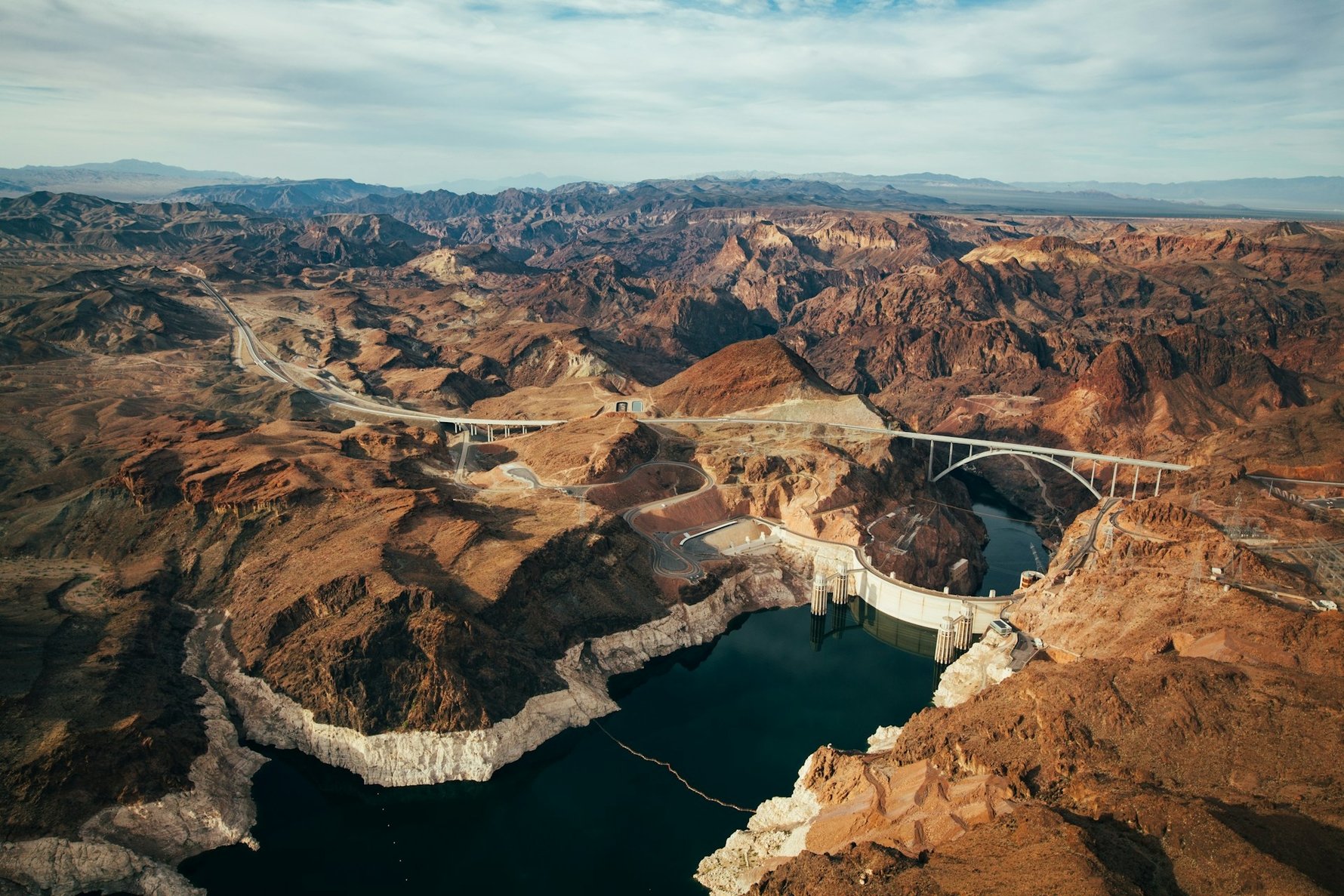
The Hoover Dam is about 50 kilometres southeast of Las Vegas on the Nevada–Arizona border, and the drive down US Route 93 through Boulder City is part of the point. Boulder City was built by the federal government in 1931 specifically to house the dam’s construction workers – a planned company town in the desert, dry by federal order, which gave it a character distinct from everything around it and still does. The dam itself, completed in 1936, is a piece of engineering so confident in its own importance that it commissioned sculptural programmes, terrazzo floors and a dedication ceremony attended by President Franklin D. Roosevelt. It is 221 metres tall, holds back 35 cubic kilometres of water in Lake Mead, and generates hydroelectric power for Nevada, Arizona and California. The Art Deco details on a civil engineering project of this scale are an argument for taking design seriously.
The visitor centre admission covers the observation deck and an exhibit on the dam’s construction; the powerplant tour goes inside the structure to the generator room, 150 metres below the crest of the dam, and is the more rewarding option. The Mike O’Callaghan–Pat Tillman Memorial Bridge, built in 2010, offers the most complete view of both the dam and the canyon below it from a walkway 270 metres above the Colorado River.
Location: On US Route 93, approximately 50km southeast of Las Vegas. About 45 minutes by car.
Best time to visit: Morning on weekdays. The dam attracts large tour groups by midday, particularly in summer.
Ticket prices: Visitor centre admission around $15; powerplant tour around $30–40. Parking costs extra. Check usbr.gov/lc/hooverdam for current prices before visiting.
Good to know: The dam is a federal security zone; bags are screened and large vehicles are subject to inspection. The top of the dam is open to pedestrians and crosses between Nevada and Arizona, which allows visitors to stand in two states simultaneously, an observation that should perhaps be kept to oneself.
What else can you see in Las Vegas?
The city’s entertainment offer is, for obvious reasons, deep. On the Strip, the Cirque du Soleil productions at various casino venues are the most consistently high-quality shows in the city, and the residency system that brings major music acts to the large auditoriums at MGM Grand, Caesars and elsewhere means the live music calendar is rarely thin. The High Roller observation wheel at the LINQ, at 167 metres the tallest in the world when it opened in 2014, is worth the ticket for the views of the valley from above, which give the city’s improbable geography a clarity that street level does not.
The National Atomic Testing Museum, on East Flamingo Road, is the more academic complement to Atomic Liquors: a Smithsonian-affiliated institution that covers the Nevada Test Site and the nuclear testing programme with the seriousness it deserves, including a Ground Zero Theatre that simulates a test observation. The Smith Center for the Performing Arts, in the downtown cultural campus adjacent to the Mob Museum, is a genuinely distinguished concert hall with a 2,050-seat main auditorium that hosts the Las Vegas Philharmonic and touring Broadway productions; it is the kind of institution that reminds you Las Vegas has a permanent population of two million people who presumably want something more from their city than slot machines.
For further day trips, the Valley of Fire State Park – 80 kilometres northeast of the city – has sandstone formations of a different character from Red Rock Canyon, more remote and considerably less visited. Grand Canyon West, on the Hualapai Nation’s land on the south rim, is about three hours away and includes the glass-floored Skywalk if that is your thing. Death Valley National Park is a three-hour drive northwest and is, in every sense, a different world.