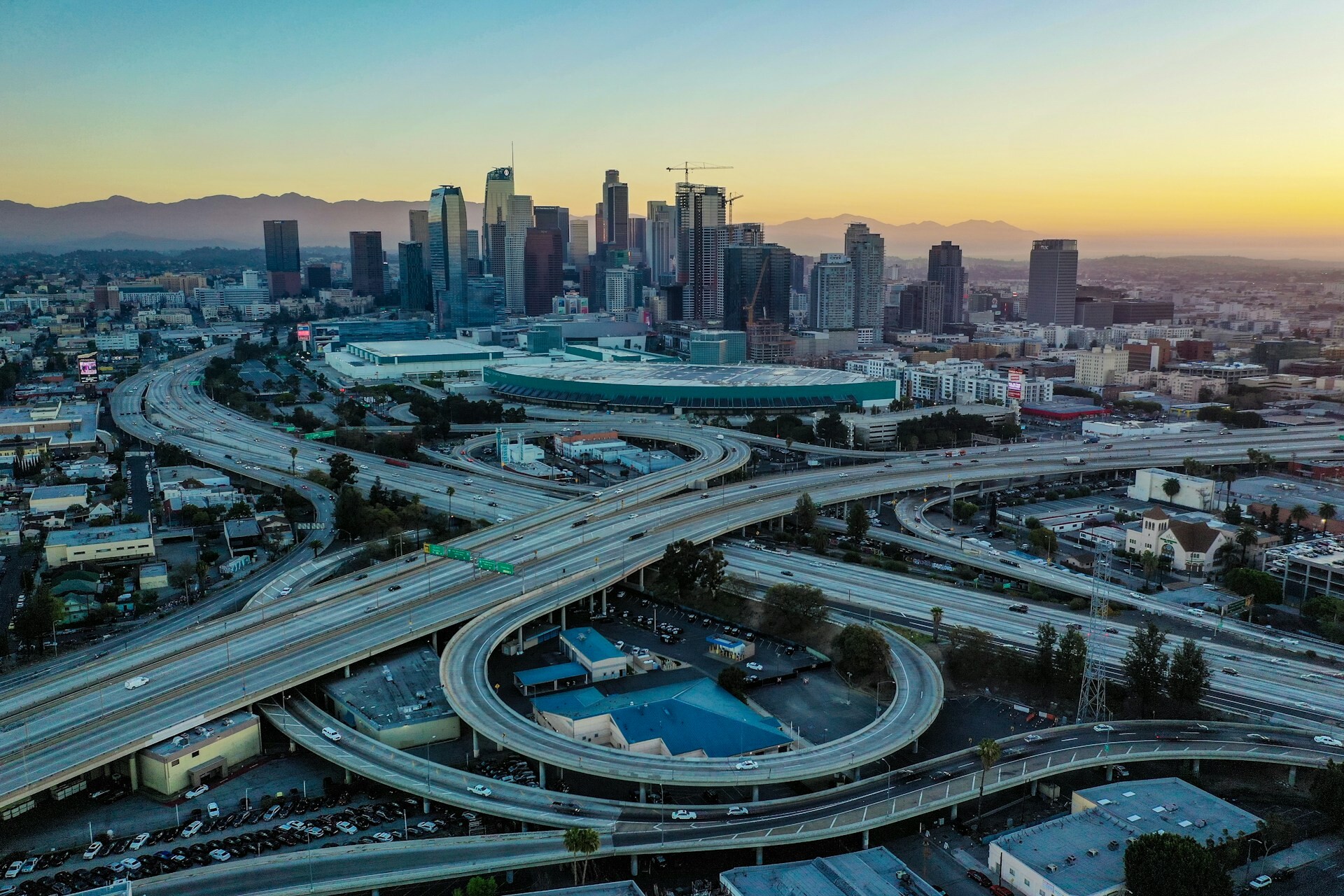
A word of warning before we begin: Los Angeles is not a city so much as a county, a sprawl of 503 square miles containing 88 incorporated municipalities, all of them theoretically distinct and all of them blurring, in practice, into a single enormous metropolitan fact. Getting from one end of it to another takes the kind of time that other cities reserve for day trips. The attractions below are spread across a significant chunk of this territory, and any itinerary that attempts more than three or four of them in a single day will require a commitment to the freeway that most visitors are not emotionally prepared for. Plan accordingly, be realistic about distances, and accept early that Los Angeles will not be hurried.
Getting around is more manageable than the city’s car-obsessed reputation suggests. The Metro rail and bus network is reasonably extensive by American standards, connects many of the major attractions, and has been expanding steadily; it is worth consulting before assuming a hire car is the only option. For gaps in the network, Uber, Lyft and similar rideshares are ubiquitous and often the most practical solution, particularly for the hillside destinations that public transit sensibly declines to attempt. A full guide to getting around Los Angeles is available here.
That said, the rewards for patience are considerable. Few cities on earth have quite this combination of geography, cultural weight and sheer visual strangeness, and the prices below, accurate at time of writing, are likely to shift before you arrive. Check official websites before visiting.
Griffith J. Griffith was a Welsh-born landowner who donated 3,015 acres of land to the City of Los Angeles in 1896 with instructions that it be used as a public park. He later left funds in his will for a public observatory to be built within it, expressing the view that every person should have access to a telescope. The Griffith Observatory opened on May 14, 1935, on the southern slope of Mount Hollywood, and has been the city’s most democratic cultural institution ever since: free to enter, free to use the telescopes on clear nights, and commanding a view that stretches from the Pacific Ocean to the San Gabriel Mountains with downtown Los Angeles glittering somewhere in between.
The observatory has appeared in well over a hundred film and television productions, most durably in Nicholas Ray’s 1955 film Rebel Without a Cause, which featured it in its field trip scene, its knife fight and its climax, and which holds the distinction of being the first film to use a planetarium theatre as a location. A bronze bust of James Dean stands on the grounds to confirm the association. The same planetarium theatre was later used for the dreamy dance sequence in La La Land (2016). Inside, the original 1935 Hugo Ballin rotunda mural, a swirling depiction of celestial mythology covering the ceiling in blues and golds, is worth the visit on its own merits.
Location: 2800 E Observatory Road, Los Angeles, CA 90027 (Griffith Park)
Best time to visit: Late afternoon through dusk, when the city lights emerge below and the telescopes open above. Clear winter evenings are the best of all. Avoid weekend afternoons in summer.
Ticket prices: Free entry to the building and grounds. Planetarium shows charge a separate fee; check griffithobservatory.org for current prices and times.
Good to know: There is no parking at the observatory on busy days; the DASH Observatory shuttle runs from Los Feliz on weekends and holidays and is considerably less stressful than the road. The hike up from the Fern Dell trailhead takes about 45 minutes and is one of the better walks in the city.
2. The Getty Center
J. Paul Getty made his fortune in oil, spent a significant portion of it acquiring European art, and at the time of his death in 1976 was reputed to be the richest private citizen in the world. He bequeathed the bulk of his estate to the Getty Trust, which used it to build one of the more extraordinary cultural institutions in the United States. The Getty Center, designed by architect Richard Meier and opened in 1997 after a decade of construction, sits on a hilltop in Brentwood at the edge of the Santa Monica Mountains, accessible by a computer-operated tram from the parking structure below. The construction cost $1.3 billion. Admission is free.
The six-building campus is clad in Italian travertine and commands panoramic views of Los Angeles, the Pacific Ocean and, on clear days, the Channel Islands. The collection covers pre-20th-century European paintings, illuminated manuscripts, sculpture and decorative arts alongside 19th and 20th-century photography; van Gogh’s Irises is here, along with Monet, Rembrandt, Cézanne and Degas. The Central Garden, designed by Robert Irwin, is a work in its own right: a winding, densely planted acre that descends to an azalea-covered pool. The Getty Villa in Pacific Palisades, a separate site housing the antiquities collection in a re-creation of a Roman villa, is a worthwhile second visit.
Location: 1200 Getty Center Drive, Los Angeles, CA 90049 (Brentwood)
Best time to visit: Weekday mornings. The museum is closed on Mondays. Evening openings are occasionally offered; check getty.edu for the current schedule.
Ticket prices: Free. Parking costs around $25 per vehicle; arriving by bus or rideshare avoids this. Check getty.edu for current parking prices.
Good to know: Allow at least half a day. The tram journey, the garden, the architecture and the collection are each individually worth time, and rushing any of them is a waste of the trip up the hill.
3. Hollywood Boulevard: The Walk of Fame and TCL Chinese Theatre
The story of how Hollywood became Hollywood is, at its core, a story about real estate. In the 1910s, film studios relocated from the East Coast to Southern California for the weather and the variety of landscapes available within driving distance, and the industry settled in a quiet suburb that had been founded as a Methodist temperance community in 1887. The neighbourhood has not been quiet since.
The Hollywood Walk of Fame has been embedding star-shaped plaques into the pavement of Hollywood Boulevard and Vine Street since 1960; there are now over 2,700 of them, spread across fifteen blocks of Boulevard and three of Vine, honouring achievements in film, television, music, radio and live performance. The TCL Chinese Theatre, a quarter of a mile along the Boulevard, opened on May 18, 1927 as Grauman’s Chinese Theatre, the creation of showman Sid Grauman, at a cost of $2 million. Its signature feature, the Forecourt of the Stars, began by accident: actress Norma Talmadge reputedly stepped in wet cement during construction in 1927, and Grauman recognised the commercial potential immediately. The forecourt now contains the hand and footprints of over 200 stars. The theatre is still a working cinema, still hosts major premieres, and remains, whatever its corporate naming rights history, one of the more atmospheric buildings in a city not short of them.
Location: Hollywood Boulevard between La Brea Avenue and Vine Street; TCL Chinese Theatre at 6925 Hollywood Blvd, Hollywood, CA 90028
Best time to visit: Weekday mornings, before the crowds and the costumed character performers reach full operational capacity. Evening visits have their own atmosphere.
Ticket prices: The Walk of Fame is free. The TCL Chinese Theatre forecourt is free to enter; interior tours and film screenings charge separately.
Good to know: The costumed performers along the Boulevard operate on tips and can be persistent. The Hollywood Museum, a short walk east at the old Max Factor building, is an undervisited trove of genuine film memorabilia.
4. La Brea Tar Pits
Somewhere between 10,000 and 50,000 years ago, the animals of Ice Age Southern California had a problem: the asphalt seeping up through the ground in what is now the Miracle Mile district of Los Angeles was sticky enough to trap them. Mammoths, mastodons, giant ground sloths, dire wolves and saber-toothed cats all came to investigate distressed animals caught in the tar and became distressed animals caught in the tar themselves, which explains the nine-to-one ratio of carnivore to herbivore fossils recovered from the site. The tar is an exceptionally good preservative, and over 3.5 million specimens representing more than 600 species have been recovered since systematic excavation began in 1913.
The La Brea Tar Pits are the only active urban Ice Age excavation in the world, which means visitors can watch working palaeontologists through glass windows in the Fossil Lab as they clean and catalogue material pulled from the ground that morning. The tar still bubbles visibly in the outdoor pits, mammoths still rear up in fibreglass effigy around the lake, and the whole enterprise has the slightly surreal quality of a world-class scientific institution that happens to be sandwiched between Wilshire Boulevard traffic and the Los Angeles County Museum of Art. This is, in fact, precisely what it is.
Location: 5801 Wilshire Blvd, Los Angeles, CA 90036 (Miracle Mile)
Best time to visit: Weekday mornings, when the Fossil Lab is most active and the school groups have not yet arrived.
Ticket prices: Check tarpits.org for current admission prices. The outdoor pits and lake area are free to view.
Good to know: LACMA is immediately adjacent, making the two a natural pairing. The tar does not smell as dramatic as it sounds, but it is unmistakeable once you notice it.
5. Venice Beach
In 1904, tobacco millionaire Abbot Kinney bought a stretch of coastal marshland south of Santa Monica and spent the next year transforming it into “Venice of America”: a resort town with 16 miles of canals, gondoliers imported from Italy, a miniature railroad and a colonnaded arcade on the beach. It opened on July 4, 1905, and attracted enormous crowds. Most of the canals were filled in during the 1920s to make roads, and Venice was absorbed into Los Angeles in 1926. The Doors formed here in 1965. Jean-Michel Basquiat had a studio here. Dennis Hopper lived here. The neighbourhood has a habit of attracting people who need somewhere that will tolerate them.
Today the Venice Canal Historic District preserves a small network of the original waterways, complete with arched bridges and ducks, while the famous Ocean Front Walk boardwalk runs two miles along the beach hosting the full range of human expression: bodybuilders at Muscle Beach (a Venice institution since the 1930s), skaters at the concrete skate park, street performers of highly variable quality, and a rotating cast of vendors, artists and people who have simply decided that this is where they live now. It is not serene, but it is genuinely unlike anywhere else, and the surrounding streets – particularly Abbot Kinney Boulevard, a mile of boutiques and restaurants running inland – provide a useful decompression chamber afterwards.
Location: Ocean Front Walk, Venice, Los Angeles, CA 90291. Approximately 30–45 minutes from Downtown by car, traffic permitting.
Best time to visit: Weekend mornings for the boardwalk at its most energetic; weekday afternoons for a quieter version of the same. Sunset is reliably good.
Ticket prices: Free. Parking lots along the beachfront charge by the hour.
Good to know: The Venice Canal Historic District, a short walk east of the boardwalk, is significantly more peaceful and largely unknown to casual visitors. The canals run between Carroll Avenue and Eastern Canal Court; twenty minutes there is twenty minutes well spent.
6. Walt Disney Concert Hall
In 1987, Lillian Disney, widow of Walt, donated $50 million to the City of Los Angeles for a new concert hall to serve as home for the Los Angeles Philharmonic. An international competition attracted over 70 entries; Frank Gehry won. What followed was sixteen years of planning, fundraising, community politics and construction before the Walt Disney Concert Hall finally opened in October 2003 on Bunker Hill in Downtown, at a total cost that had rather exceeded the initial $50 million.
The result was worth the difficulty. The exterior, a cascading collision of brushed stainless steel panels, is the kind of building that changes how you think about what buildings are allowed to do; Gehry has described his approach as “liquid architecture” and the description is accurate. The interior was designed from the inside out, with the 2,265-seat auditorium – its walls clad in Douglas fir for acoustic warmth – determining the structure around it. The organ, a sculptural centrepiece of asymmetrical pipes nicknamed “the French fries” by the musicians, was built in collaboration with tonal designer Manuel Rosales. The rooftop Blue Ribbon Garden, centred on a mosaic fountain made from over 200 broken Delft porcelain vases as a tribute to Lillian Disney, is free to visit on non-performance days and is one of the better-kept secrets in downtown Los Angeles.
Location: 111 S Grand Avenue, Los Angeles, CA 90012 (Bunker Hill, Downtown)
Best time to visit: Exterior and garden can be visited any time; the interior is accessible on non-performance days via free self-guided tours. Check laphil.com for the current schedule.
Ticket prices: The exterior and garden are free. Concert tickets vary considerably; check laphil.com for current prices and programmes.
Good to know: The building reflects and concentrates sunlight from its steel panels in ways that were initially problematic for neighbouring buildings and drivers. This has since been addressed. The Grand Avenue neighbourhood around the hall has been developing steadily since the building arrived and now includes MOCA, the Broad and several worthwhile restaurants within easy walking distance.
7. Los Angeles County Museum of Art (LACMA)
The largest art museum in the western United States has been on Wilshire Boulevard since 1965 and now holds a collection of over 135,000 objects spanning 6,000 years of art history. The encyclopaedic range runs from ancient Egyptian artefacts and pre-Columbian gold to Japanese screens, Islamic tiles, Impressionist paintings and 20th-century American art, with few obvious gaps and several outstanding concentrations. LACMA is also the museum that has most thoroughly colonised its own exterior: the forecourt on Wilshire Boulevard is dominated by Chris Burden’s Urban Light (2008), 202 cast-iron street lamps from the 1920s and 1930s, collected and restored by Burden over several years after finding his first one at a Rose Bowl flea market, and arranged in a grid that has since become one of the most photographed sites in Los Angeles. It is open 24 hours a day.
Burden had a habit of making the monumental feel personal. The street lamps were real; each one once lit a different Los Angeles neighbourhood. Arranged together they function simultaneously as a forest, a civic statement and a very large art installation, and the effect at dusk, when they illuminate against the failing light, is one of the best free experiences the city offers. The museum behind them is large enough to require an honest reckoning with your own stamina; the collection of Japanese art alone is among the finest outside Japan.
Location: 5905 Wilshire Blvd, Los Angeles, CA 90036 (Miracle Mile; immediately east of the La Brea Tar Pits)
Best time to visit: Weekday mornings. The museum is closed on Wednesdays. Urban Light is worth visiting at dusk regardless of whether you go inside.
Ticket prices: Check lacma.org for current admission prices. Los Angeles County residents receive discounted rates.
Good to know: The La Brea Tar Pits are directly adjacent; a combined visit to both in a single day is feasible and satisfying. The Pavilion for Japanese Art, a separate building on the campus designed by Bruce Goff and completed by Bart Prince in 1988, is architecturally distinctive and often quieter than the main galleries.
8. Santa Monica Pier and Beach
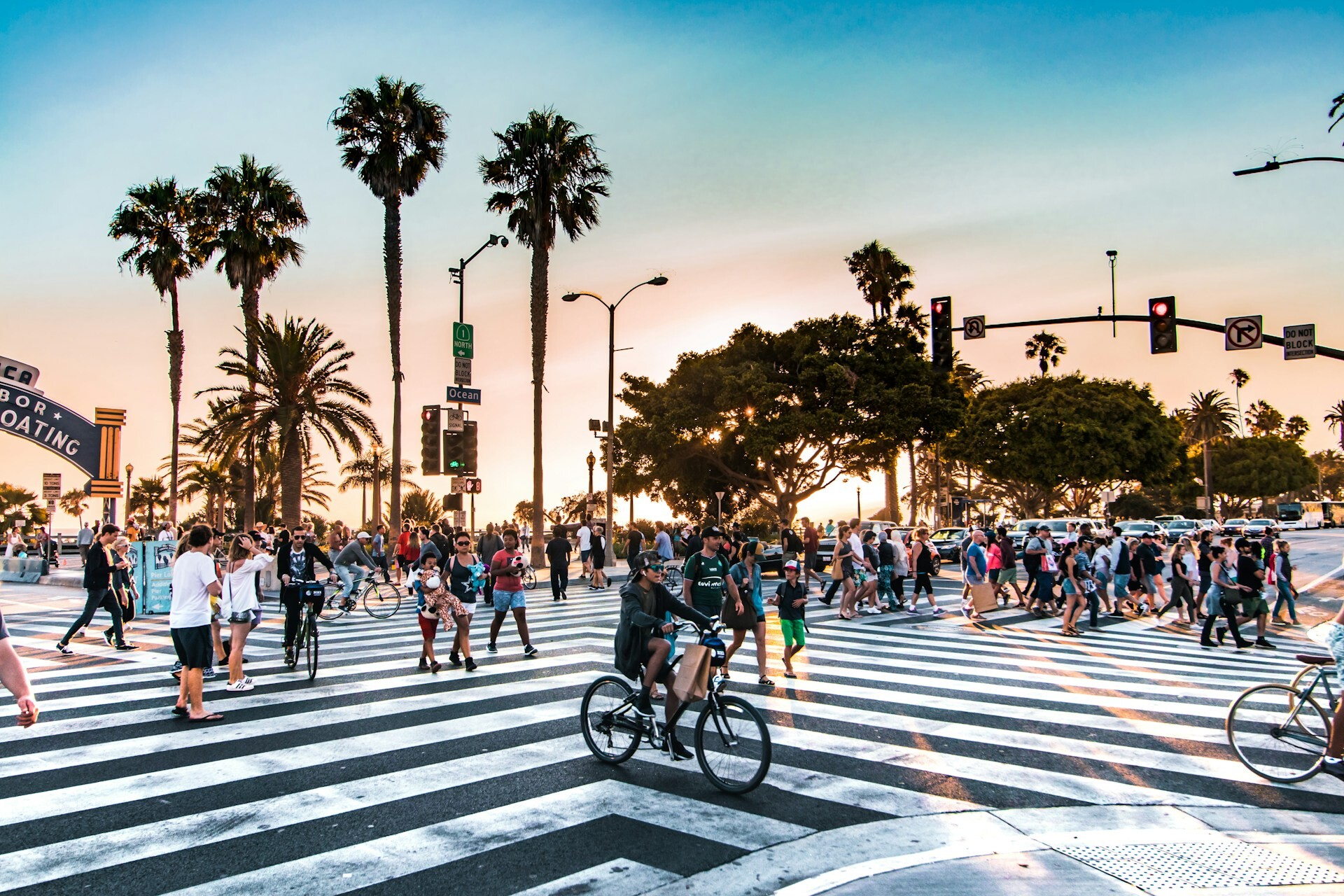
The Santa Monica Pier opened in 1909, making it one of the oldest pleasure piers on the West Coast and the western terminus of Route 66 – the 2,448-mile highway from Chicago that, for several decades of the 20th century, was the primary road for Americans heading to California. A sign at the end of the pier marks the spot. The pier also contains Pacific Park, an amusement park whose solar-powered Ferris wheel rises 130 feet above the Pacific Ocean and is visible from a considerable distance in either direction along the coast, and the Santa Monica Pier Aquarium, which operates beneath the pier itself and focuses on the marine life of Santa Monica Bay.
The beach to the south is among the most famous in the world, though “most famous” is doing a lot of work here since it refers largely to decades of television and film production that found it a convenient and photogenic location. It is, more straightforwardly, a very good beach: wide, sandy, reliably sunny, backed by the low-rise buildings of Santa Monica proper and bookended by the pier to the north and Venice to the south. The cycle path running between them is the most pleasant way to cover the distance.
Location: 200 Santa Monica Pier, Santa Monica, CA 90401. Approximately 30–60 minutes from Downtown by car, significantly longer in traffic.
Best time to visit: Weekday mornings; sunset at any time of week is consistently worthwhile. Summer weekends are packed.
Ticket prices: The pier and beach are free. Pacific Park rides charge separately; check pacpark.com for current prices.
Good to know: The Metro Expo Line connects Downtown Los Angeles to Santa Monica, which removes the parking problem entirely. The Third Street Promenade, a pedestrian shopping street a short walk from the pier, has good restaurants and provides a useful decompression from the beach.
9. Chinatown
Los Angeles had a Chinatown before it had a recognisable downtown. The original neighbourhood, established in the 1880s around Alameda Street, was one of the oldest Chinese communities in California. By the 1930s, the city had decided it wanted a railway station on the same ground, and the community was given weeks to vacate. The demolition began in 1933; Union Station opened on the site in 1939.
What happened next is the more interesting story. A group of Chinese Americans led by Peter Soo Hoo, who had grown up in Old Chinatown, formed the Los Angeles Chinatown Corporation, acquired land a few blocks to the north, and built an entirely new neighbourhood from scratch. New Chinatown opened on June 25, 1938, in front of 30,000 people, and was the first Chinese district in the United States to be conceived, planned and owned by Chinese Americans rather than imposed upon them. The Garnier Building, the only structure from the original Chinatown still standing, now houses the Chinese American Museum near the Plaza de Los Angeles.
Roman Polanski’s 1974 film Chinatown is set in the neighbourhood but was almost entirely shot elsewhere – the film uses Los Angeles and its water politics as its real subject, with Chinatown functioning more as a state of mind than a location. Worth knowing before you arrive expecting the geography to match. What you will find is a working neighbourhood of restaurants, herb shops, bakeries, galleries and tea houses, with a density of genuinely good food and a history worth understanding before the walking starts.
Location: Centred on N Broadway between Cesar Chavez Avenue and College Street, Downtown Los Angeles, CA 90012
Best time to visit: Weekend mornings, when the markets and dim sum restaurants are operating at full capacity. The Lunar New Year celebrations in January or February are worth timing a visit around.
Ticket prices: Free to explore. Individual restaurants and shops vary.
Good to know: The Chinese American Museum at the Garnier Building is free and provides essential context for the neighbourhood’s history. Union Station, a five-minute walk away, is one of the finest surviving examples of Mission Moderne architecture in the country and worth a look in its own right.
10. Runyon Canyon and the Hollywood Sign
The Hollywood Sign was erected in 1923 as a real estate advertisement for a housing development called “Hollywoodland,” each letter 45 feet tall and studded with light bulbs. The “land” was removed in 1949 when the Hollywood Chamber of Commerce took over maintenance of what had by then become an entirely unintended landmark. It is not possible to visit the sign itself – the surrounding area is fenced off and monitored – but it is visible from most of the city, and several hiking trails approach close enough to make the letters readable at reasonable proximity.
Runyon Canyon, a 160-acre public park cutting through the Santa Monica Mountains directly above Hollywood, provides the most accessible combination of the two: trail access from the park’s main entrance on Fuller Avenue, views of the sign from several points along the upper trails, and the additional spectacle of the city sprawling south toward the coast from an elevation of around 1,300 feet. The park is heavily used, free, open from dawn to dusk, and operates as an unofficial social institution for the neighbourhoods below it. Dogs are welcome on most trails. The view from the summit takes in downtown, the Griffith Observatory, the ocean, and on clear days the islands, which is the kind of view that makes the 45-minute climb feel, for a moment, like a reasonable trade for the Los Angeles real estate prices that surround it.
Location: Main entrance at 2000 N Fuller Avenue, Hollywood, CA 90046. Also accessible from Mulholland Drive at the north end.
Best time to visit: Early morning on a weekday for the clearest views and the fewest people. Smog permitting, winter mornings after rain offer the best visibility.
Ticket prices: Free.
Good to know: The Lake Hollywood Reservoir overlook on Weidlake Drive, a short drive from the canyon, offers what is arguably the single best direct view of the Hollywood Sign and can be reached without hiking. Griffith Park, which contains Griffith Observatory, is accessible from the canyon’s north entrance and can be combined into a longer walk.
What else can you see in Los Angeles?
The honest answer is: a great deal, spread over distances that will test your patience. The Museum of Contemporary Art (MOCA) has three locations, the most architecturally notable being the Isozaki Arata-designed Grand Avenue building in Downtown, and a collection that charts American art from the 1940s to the present with unusual coherence. The Natural History Museum of Los Angeles County, also in Exposition Park, holds one of the largest natural history collections in the world, a genuine dinosaur hall and a garden of California native plants. Exposition Park itself also contains the California Science Center, where the Space Shuttle Endeavour is on permanent display in a purpose-built pavilion.
Beverly Hills is worth a drive-through as a cultural phenomenon, even for those with no intention of shopping on Rodeo Drive: the juxtaposition of the commercial mythology with the very ordinary street grid behind it is an education in the gap between image and reality that Los Angeles cultivates better than anywhere else. The Huntington Library, Art Museum and Botanical Gardens in San Marino, thirty minutes east, is one of the great undervisited institutions in California: 120 acres of gardens, a research library holding the Ellesmere manuscript of the Canterbury Tales and a Gutenberg Bible, and an art collection that includes the original Pinkie and Blue Boy. It is considerably more rewarding than it sounds in summary.
The food in Los Angeles is, by any fair assessment, exceptional. The city’s size and diversity mean that every regional cuisine of any significance is represented somewhere, and represented well: the Korean food in Koreatown, the Mexican food in East LA and the San Gabriel Valley, the Japanese food in Little Tokyo, the Ethiopian food on Fairfax, and the seafood within driving distance of the harbour all reward sustained investigation. The one thing Los Angeles does not do well is rush.