Where do you even start? New York City has been welcoming visitors with the same basic pitch for over a century: everything is here, most of it is the best in the world, and the subway will get you there eventually. The city has 8.3 million residents, five boroughs, and a well-documented inability to be modest about itself, which turns out to be largely justified. The problem for the first-time visitor is not finding things to do but establishing some kind of order among them. What follows is not an exhaustive list; calling any ten things in New York exhaustive would be an act of considerable optimism. It is, however, a reasonable place to begin.
Prices in New York change frequently enough that any figure here should be treated as an approximation. Check official websites before visiting, and factor in the very real possibility that what was free last year now costs $28.
In the 1840s, the poet-editor William Cullen Bryant looked around at the rapidly expanding city and concluded that Manhattan needed a large public park before developers took the last available ground. The city agreed, held a design competition in 1857, and selected the “Greensward Plan” submitted by Frederick Law Olmsted and Calvert Vaux. To build it, approximately 20,000 workers relocated roughly five million cubic yards of stone and earth, planted 500,000 trees and shrubs, and constructed 36 bridges and arches. To make way for it, a thriving community called Seneca Village, home to some of the city’s largest population of free Black property owners, was demolished by eminent domain. The park opened in stages from 1858 and was completed in 1873.
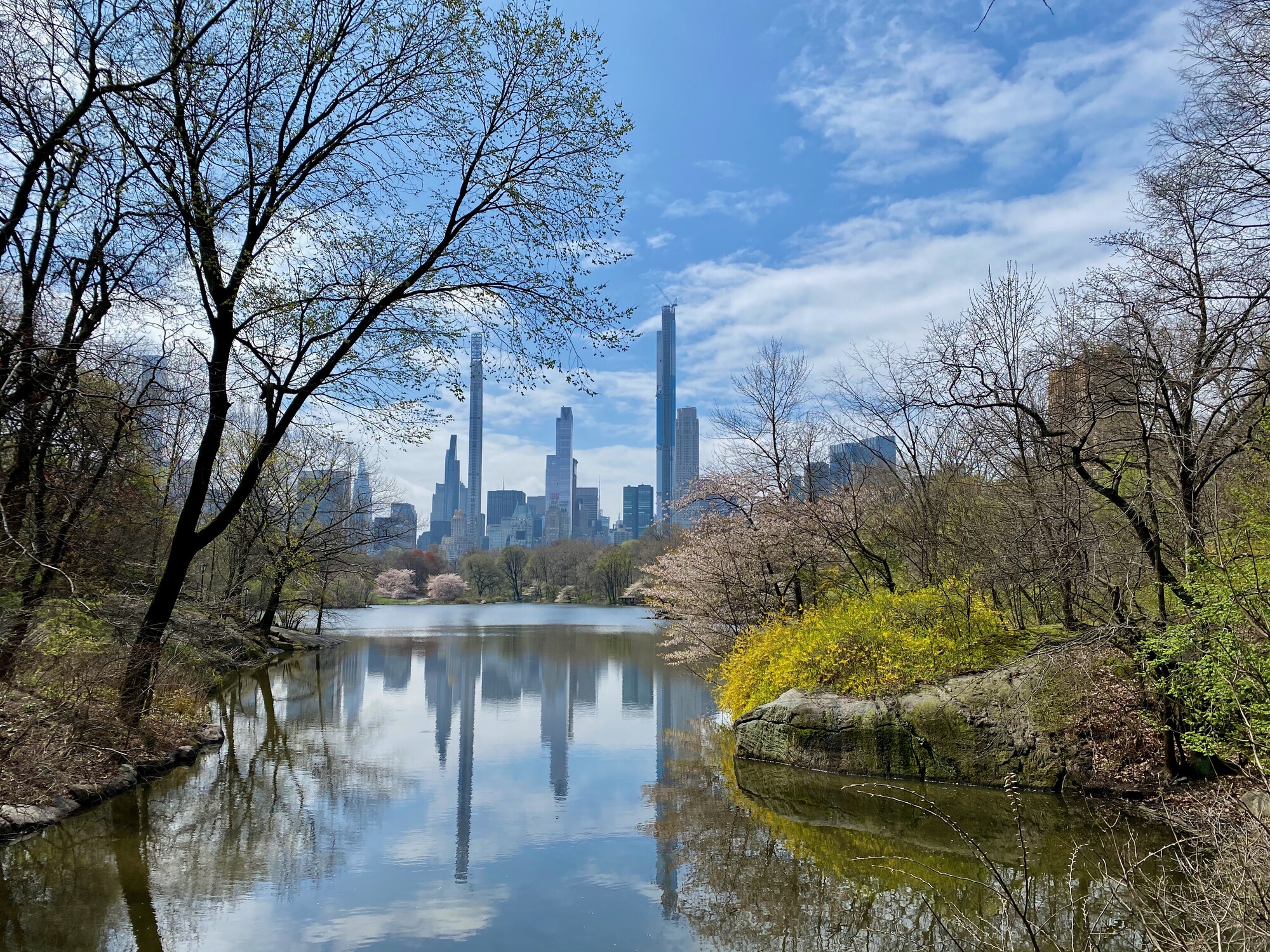
Central Park covers 843 acres between 59th and 110th Streets, and draws roughly 42 million visitors a year, which puts it comfortably among the most visited urban parks on the planet. The entire thing is man-made. Olmsted and Vaux sank four transverse roads below the park’s surface to keep cross-town traffic invisible from within, a piece of design foresight that still works 150 years later. The park contains, among other things, a zoo, two ice rinks, a carousel, a lake, a reservoir, the Great Lawn, the Ramble, Bethesda Terrace and its fountain, the Sheep Meadow, and Strawberry Fields. It is a National Historic Landmark. It is also, on a good spring morning, almost aggressively pleasant.
Location: Between 59th Street and 110th Street, Fifth Avenue and Central Park West, Manhattan
Best time to visit: Weekday mornings in spring or autumn. Midsummer weekends are survivable but crowded. The park in early snow is something else entirely.
Ticket prices: Free. The zoo and certain attractions charge separate admission.
Good to know: The park is surrounded by Museum Mile along Fifth Avenue, where the Metropolitan Museum of Art sits at 82nd Street. Combining the two in a single day is straightforward and deeply satisfying.
2. The Metropolitan Museum of Art
The idea for the Metropolitan Museum of Art was born on the Fourth of July 1866, at a restaurant in Paris, where a group of wealthy Americans celebrated their independence from Britain and concluded that their country deserved an art museum to rival the great European institutions. The Met was incorporated in 1870, acquired its first object (a Roman sarcophagus) later that year, and has not really stopped since. Its main building on Fifth Avenue was designed by Richard Morris Hunt and completed in 1902; the collection it now houses covers more than five thousand years of human history and consists of somewhere in the region of two million objects, across everything from Egyptian antiquities to 20th-century American art, medieval armour, musical instruments, Islamic decorative arts, the Temple of Dendur, and a roof garden with rotating sculpture installations and, crucially, a bar.
Two million objects is, of course, far too many to see in any reasonable visit. The practical approach is to pick a few departments and commit to them. The Egyptian collection, the European paintings galleries, the arms and armour hall, and the Costume Institute (whose fundraising event, the Met Gala, has become considerably better known than most of the things it funds) are all good starting points. The Cloisters, the Met’s medieval branch in Fort Tryon Park at the northern tip of Manhattan, is worth a separate trip. The same ticket covers both.
Location: 1000 Fifth Avenue, at 82nd Street, Upper East Side, Manhattan
Best time to visit: Weekday mornings; Friday and Saturday evenings when the museum stays open until 9pm. Avoid weekend afternoons, when the Great Hall achieves something close to chaos.
Ticket prices: Around $30 for adults; reduced rates for students and seniors. Free for children under 12. New York state residents and tristate students pay what they wish. Check metmuseum.org for current prices; the ticket covers both the Fifth Avenue building and the Cloisters.
Good to know: The museum’s roof garden, open April through October, is one of the better vantage points in Manhattan. The temporary exhibitions are often as compelling as the permanent collection and are typically included in the admission price.
3. The Statue of Liberty and Ellis Island
The Statue of Liberty was a gift from France, dedicated on October 28, 1886, after sculptor Frédéric Bartholdi spent more than a decade persuading people on both sides of the Atlantic to fund it. The internal iron framework was engineered by Gustave Eiffel, who would go on to build something slightly more famous three years later. The statue stands 151 feet tall on Liberty Island in New York Harbour; with its pedestal and foundation, the total height is 305 feet. It was designated a National Monument in 1924 and designated a UNESCO World Heritage Site in 1984. The poem by Emma Lazarus, with the “Give me your tired, your poor” passage, was written in 1883 to help raise funds for the pedestal and was later mounted inside it, which gives the whole thing considerably more poetic coherence in retrospect.
A short ferry ride away, Ellis Island processed more than 12 million immigrants between 1892 and 1954. The first was a 15-year-old girl named Annie Moore, from County Cork, who arrived on January 1, 1892. The last was a Norwegian merchant seaman in 1954. In between: an estimated 40% of the current American population traces an ancestor through this building, which makes the immigration museum here rather more personally resonant for many visitors than the average history exhibit.
Location: Liberty Island and Ellis Island, New York Harbour. Ferries depart from Battery Park, Lower Manhattan, and Liberty State Park, New Jersey.
Best time to visit: First ferry of the day. The return journey gives you the best view of the Manhattan skyline from the water.
Ticket prices: Ferry tickets cover both islands and the Statue of Liberty Museum. Climbing to the crown requires a separate, timed-entry ticket booked well in advance; supply is very limited. Check statuecruises.com for current prices.
Good to know: The pedestal observation deck offers fine views and is significantly easier to book than the crown. The Ellis Island museum is substantial and deserves at least two hours on its own.
4. The Brooklyn Bridge
John Roebling designed the Brooklyn Bridge, was fatally injured during an early survey of the site in 1869, and never saw it built. His son Washington took over as chief engineer, suffered a crippling attack of decompression sickness from working in the pressurised underwater caissons, and spent the remaining years of construction confined to his apartment in Brooklyn Heights, directing operations through field glasses and sending instructions via his wife, Emily Warren Roebling. Emily effectively ran the project for eleven years. When the bridge opened on May 24, 1883, she was the first person to cross it. Washington watched from his window.
At the time of its completion, the Brooklyn Bridge was the longest suspension bridge in the world and the first to use steel cable wire. Its span of 1,595 feet between the towers held the record until 1903. Construction cost $15 million and at least 27 lives. Six days after it opened, a rumour spread that the bridge was about to collapse; twelve people were killed in the stampede. The following year, P.T. Barnum led 21 elephants across it to demonstrate structural soundness, which is the kind of publicity stunt that tends to stick in the memory. The bridge now carries roughly 100,000 vehicles and pedestrians daily, and the walk across remains one of the better free things to do in New York City.
Location: Spanning the East River between Manhattan and Brooklyn. The Manhattan pedestrian entrance is at Centre Street and Park Row, near City Hall.
Best time to visit: Early morning for the light and the lack of company. Sunset, heading toward Brooklyn, is reliably spectacular.
Ticket prices: Free.
Good to know: The walk to Brooklyn takes about 30 minutes and deposits you in DUMBO, a neighbourhood with good coffee, good views back to Manhattan, and the unmistakeable feeling that you have earned both. The bridge is a National Historic Landmark.
5. The Empire State Building
The Empire State Building was built in 410 days, which for a 102-storey Art Deco skyscraper rising from the demolished Waldorf-Astoria Hotel on Fifth Avenue is the kind of statistic that makes modern construction timelines look embarrassing. Construction began in March 1930; it opened on May 1, 1931, at which point it was the tallest building in the world, a title it held until 1971. The 102nd floor was originally designed as a mooring station for airships, a vision of the future that did not survive contact with actual meteorological conditions above Midtown Manhattan. The spire was eventually repurposed as a broadcast antenna, which is less romantic but considerably more practical.
At 1,454 feet including antenna, the Empire State Building is currently the fourth-tallest building in New York City. None of its successors have quite managed to displace it from the cultural imagination. Observation decks on the 86th and 102nd floors both offer panoramic views of the city; the 86th is open-air, which is either an advantage or a problem depending on the weather and your relationship with wind at 1,050 feet. The building is an American Society of Civil Engineers’ Historic Civil Engineering Landmark, ranked alongside the Hoover Dam and the Panama Canal, which gives some sense of the regard in which it is held.
Location: 350 Fifth Avenue, at 34th Street, Midtown Manhattan
Best time to visit: Weekday evenings for the city at night. Clear days in autumn offer the longest sight lines. Avoid peak summer weekend afternoons.
Ticket prices: Check esbnyc.com for current prices, which vary by floor and time of day. Buying in advance online is cheaper than at the door.
Good to know: If choosing between the city’s observation decks, the Empire State Building’s 86th floor is the only major open-air option; Top of the Rock at Rockefeller Center offers an unobstructed view of the Empire State Building itself. The choice depends on what you want to photograph.
6. The High Line
By 1910, the freight trains running along street-level tracks on Manhattan’s West Side had killed more than 500 pedestrians. Tenth Avenue acquired the nickname “Death Avenue.” In response, the railroad hired men on horseback called “West Side Cowboys” to ride ahead of trains waving red flags. This arrangement lasted until 1941. The eventual solution was to elevate the tracks, and the High Line opened in 1934, running freight 30 feet above street level through the meatpacking and industrial districts of Chelsea and the West Village. The last train to use it, in 1980, carried three cars of frozen turkeys. After that: abandonment, weeds, urban explorers, and two decades of argument about whether to demolish it.
The campaign to save and repurpose the structure was led by the Friends of the High Line from the late 1990s onwards. The park opened in sections between 2009 and 2014, running 1.45 miles from Gansevoort Street in the Meatpacking District to West 34th Street in Hudson Yards. It was designed by James Corner Field Operations and Diller Scofidio + Renfro, with planting by Dutch designer Piet Oudolf, whose approach involves letting things grow in a way that looks untamed while being meticulously considered. The result is a park that feels genuinely different from every other park in New York, partly because of what it is and partly because the views of the Hudson River and the city that open up along it are not available from street level.
Location: Running from Gansevoort Street (at Washington Street) to West 34th Street (at 12th Avenue). Multiple access points along the route.
Best time to visit: Early morning on a weekday. Spring and autumn offer the best combination of weather and plant interest. It can be uncomfortably crowded on summer weekends.
Ticket prices: Free.
Good to know: The Whitney Museum of American Art sits at the southern end of the High Line and is worth combining with a walk. Hudson Yards at the northern end contains the Vessel, a climbable honeycomb sculpture that provokes strong opinions.
7. Grand Central Terminal
The original Grand Central was built in 1871 by Cornelius Vanderbilt. By 1902 it was overcrowded, the steam locomotives were causing problems, and a collision in the Park Avenue tunnel killed 15 people. The New York State Assembly banned steam locomotives south of 42nd Street, which forced electrification, which made it possible to put the tracks underground, which made it possible to build something considerably more ambitious on top of them. The current Grand Central Terminal, designed by Reed and Stem and Warren and Wetmore in the Beaux-Arts style, opened in 1913 after ten years of construction.
The Main Concourse, roughly three-quarters the size of a football field, has a 125-foot vaulted ceiling painted with 2,500 stars representing the winter constellations of the Mediterranean sky. The ceiling is painted backwards, as if viewed from outside the celestial sphere looking in, a fact which provoked considerable complaint when the terminal opened; the architects claimed it was intentional and based on a medieval manuscript. Around 750,000 people pass through Grand Central on an average day, making it simultaneously one of the world’s great public spaces and one of its busier commuter hubs. The building was nearly demolished in 1967; Jackie Kennedy led the preservation campaign that stopped it.
Location: 89 E 42nd Street, at Park Avenue, Midtown Manhattan
Best time to visit: Mid-morning on a weekday, when the rush-hour crowd has thinned and the concourse can be properly appreciated. Avoid the evening rush unless crowds are precisely what you are after.
Ticket prices: Free to enter. Guided tours are available for a fee; the terminal’s self-guided audio tour covers the architecture in detail.
Good to know: The Whispering Gallery, in the lower-level dining concourse, is an architectural quirk worth knowing: two people standing at opposite corners of the arched passage can hold a whispered conversation despite being 30 feet apart.
8. The Museum of Modern Art (MoMA)
In 1929, three women – Lillie P. Bliss, Mary Quinn Sullivan, and Abby Aldrich Rockefeller – decided that New York needed a museum devoted exclusively to modern art, and created the Museum of Modern Art to prove it. The founding director, Alfred H. Barr Jr., had the idea that a truly modern museum should collect not just painting and sculpture but film, design, architecture, photography and performance, a curatorial instinct that was radical at the time and has since become standard practice. The museum opened with eight prints and one drawing; the collection now runs to roughly 200,000 works.
MoMA’s permanent collection includes van Gogh’s The Starry Night, Picasso’s Les Demoiselles d’Avignon, Monet’s Water Lilies, Warhol’s Campbell’s Soup Cans, and around 199,996 other things depending on how you count. The building, in Midtown at 53rd Street, has been expanded and reconfigured several times; the most recent major renovation was completed in 2019. The Abby Aldrich Rockefeller Sculpture Garden, designed by Philip Johnson, is one of the better outdoor spaces in Midtown and provides a calm counterpoint to the museum’s interior intensity.
Location: 11 West 53rd Street, between Fifth and Sixth Avenues, Midtown Manhattan
Best time to visit: Weekday mornings. Friday evenings offer extended hours and a livelier atmosphere. The museum is closed on Tuesdays.
Ticket prices: Around $30 for adults; reduced rates for students and seniors. Check moma.org for current prices. MoMA PS1 in Queens, which focuses on contemporary art, is affiliated and worth a separate visit.
Good to know: The design and architecture collection, spread across several floors, is frequently overlooked in favour of the painting galleries upstairs. It is worth the detour. The museum shop is also, by the standards of museum shops, genuinely good.
9. American Museum of Natural History
The American Museum of Natural History was founded in 1869, with support from, among others, Theodore Roosevelt Sr. and J. P. Morgan, which gives you a fair sense of the ambitions involved from the outset. President Ulysses S. Grant laid the cornerstone of the current building in 1874; President Rutherford B. Hayes presided over the opening in 1877. The museum has been expanding more or less continuously ever since and now occupies 45 buildings on a 17-acre site along Central Park West, containing around 34 million specimens and artefacts covering natural history, anthropology and the physical sciences. It sends out more than a hundred research expeditions a year. By any measure, it is a serious institution.
The most famous resident is a 94-foot fibreglass and foam model of a blue whale, suspended from the ceiling of the Milstein Hall of Ocean Life since 1969, weighing 21,000 pounds and requiring an annual dusting that takes several days. It is the largest animal model in any museum in the world. The dinosaur halls, renovated in 2019, contain actual fossils rather than casts for much of their collection, including a T. rex in a hunting pose that was controversial among palaeontologists and thrilling to everyone else. The Rose Center for Earth and Space, housed in a glass cube at the museum’s northwest corner, contains the Hayden Planetarium. The film Night at the Museum was set here, though the interior scenes were largely recreated on sets in Vancouver, which is the kind of detail that makes the actual building no less impressive but does explain why the exhibits don’t come alive after closing time.
Location: Central Park West at 79th Street, Upper West Side, Manhattan
Best time to visit: Weekday mornings. School groups arrive in force on weekday afternoons; plan accordingly. The Rose Center planetarium shows run throughout the day and are worth booking in advance.
Ticket prices: Check amnh.org for current prices; combination tickets covering the planetarium shows are available. New York state residents can pay what they wish for general admission.
Good to know: The museum is directly across Central Park from the Metropolitan Museum of Art, making the two a logical pairing – though doing both properly in a single day is optimistic. The museum’s fourth floor, with its early fossil mammals and the famous Barosaurus skeleton rearing up in the Roosevelt Rotunda, tends to be quieter than the dinosaur halls and is equally worth the time.
10. Greenwich Village and Washington Square Park
Before it was a park, the ground now occupied by Washington Square Park was a potter’s field – a mass burial site for the poor, the indigent and the victims of epidemic disease. An estimated 20,000 people remain buried beneath it. It was converted to a public park in 1826, and the army used it as a parade ground before the surrounding neighbourhood gentrified around it. The Washington Square Arch, modelled on the Arc de Triomphe and designed by Stanford White, was completed in 1892 to commemorate the centennial of George Washington’s inauguration. In 1838, NYU professor Samuel F. B. Morse gave the first public demonstration of the telegraph here. The park later became a gathering point for abolitionists, suffragists, Beat poets, folk singers and anyone else who needed a forum and a fountain.
The surrounding Greenwich Village has been the centre of American bohemian life since the early 20th century, when writers and artists began moving in for the cheap rents and congenial company. Edgar Allan Poe, Mark Twain, Henry James, Eugene O’Neill, e.e. cummings, Bob Dylan and a significant portion of the Beat Generation all lived in the neighbourhood at various points. The Stonewall Inn, on Christopher Street, was the site of the 1969 uprising that launched the modern gay rights movement and is now a National Monument. The neighbourhood has not had cheap rents in some time, but the streets retain their character: narrow, tree-lined, and structured on a pre-grid plan that gives Greenwich Village a consistently disorienting quality that the rest of Manhattan, with its numbered grid, largely lacks.
Location: Centred on Washington Square Park, at the intersection of Fifth Avenue and Waverly Place, Lower Manhattan
Best time to visit: Any time; the park is particularly alive on summer evenings. The surrounding streets are best explored on foot without a fixed plan.
Ticket prices: Free.
Good to know: Bleecker Street, MacDougal Street and the streets around them contain a concentration of bars, restaurants and music venues that reflect the neighbourhood’s history more directly than most. The Stonewall National Monument visitor centre is free and well worth thirty minutes.
What else can you see in New York?
The five boroughs contain considerably more than ten things worth seeing, and anyone staying more than a few days should cross at least one bridge. Brooklyn has a claim to being the most culturally interesting borough at the moment: the Brooklyn Museum is the second-largest art museum in the city, the Brooklyn Botanic Garden is excellent in spring, and the neighbourhoods of Williamsburg, DUMBO and Prospect Heights repay exploration on foot. The Guggenheim Museum, a ten-minute walk up Fifth Avenue from the Met, is as much an experience of Frank Lloyd Wright’s 1959 spiral building as it is of the collection inside. The New York Public Library’s Stephen A. Schwarzman Building on Fifth Avenue, completed in 1911, has a reading room that makes working through a to-do list feel more important than it probably is.
Times Square is worth seeing once, preferably at night, and then largely avoided thereafter. Top of the Rock, the observation deck at 30 Rockefeller Center, is a credible alternative to the Empire State Building and has the advantage of putting the Empire State Building in the view rather than underneath your feet. The Staten Island Ferry runs continuously, is free, passes the Statue of Liberty at close range, and provides one of the better value experiences in the city. For the record: no one who lives in New York refers to it as “The Big Apple.”
New York’s food scene is large enough that attempting to summarise it is an act of futility. The practical advice is to eat where New Yorkers eat, which requires stepping off the main tourist circuits. Chinatown in Lower Manhattan, the food halls of Chelsea Market and Grand Central, the various “Little” neighbourhoods across Queens and the Bronx, and the pizza available at any number of unremarkable-looking slice shops are all more reliable guides to what the city actually tastes like than most places whose existence is primarily explained by their proximity to Times Square.