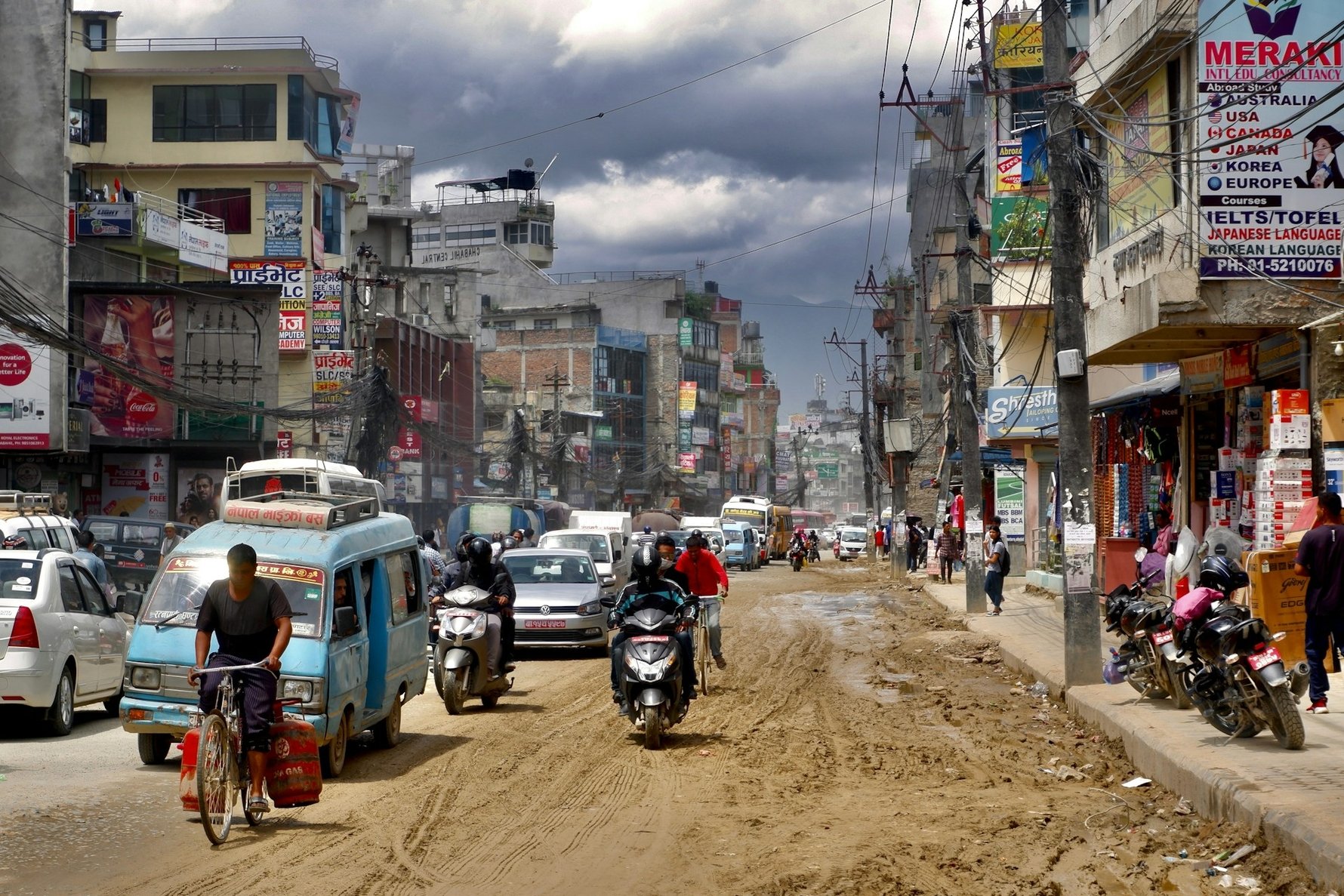
Kathmandu is not a city that rewards passive observation from the back of a tour bus. It rewards getting slightly lost down a lane you weren't supposed to turn into, stumbling across a butter-lamp shrine wedged between a mobile phone shop and a hardware stall, and arriving somewhere approximately where you meant to go, maybe twenty minutes later than planned. The traffic is chaotic, the roads are patchy, the pavements are optional, and the air in the centre can be thick enough to taste. With all that said, getting around is actually pretty manageable once you understand the system – and the system is simpler than it looks.
This guide covers every practical option for moving around Kathmandu and across the valley, from apps to local buses, with honest notes on when each one makes sense. For the bigger picture on visiting the valley, see our Kathmandu Valley guide.
Before anything else: pick up a Nepali SIM card. You can buy one at the airport arrivals hall from Ncell or Nepal Telecom, or from any of the dozens of small shops in Thamel or elsewhere in the city. Bring your passport – it's required for registration. Data is very cheap, and a local number is essential for using ride-hailing apps, which are by far the most useful tool in your Kathmandu transport toolkit. Without a Nepali number, those apps simply won't verify or work properly.
Ride-Hailing Apps
There is no Uber in Nepal. There is, however, a thriving local equivalent that works on the same principle and – once you're set up – is genuinely excellent.
Pathao and InDrive are the two apps most visitors will want. Both offer car rides and motorbike taxis; both are available on Android and iOS. Pathao gives you a fixed upfront fare, while InDrive uses a negotiation model where you propose a price and drivers accept or counter. In practice both produce similar results and both are substantially cheaper than hailing a taxi off the street. A car ride from Thamel to Patan, for example, will typically run NPR 300–500 on an app versus whatever a street taxi decides to open with. Yango, a global platform, launched in Kathmandu in 2025 and has been competitive on price, so it's worth downloading as a backup.
A few things to know about using the apps:
You need a Nepali SIM to register and receive the verification code. Do this before you need a ride.
Motorbike taxis (listed as "bike" in the apps) are faster in traffic and cost roughly half the car rate. They're a quintessentially Kathmandu experience – fun, slightly hair-raising, and extremely efficient for solo travellers. Helmets are provided.
Payment is almost always cash to the driver at the end of the trip. Have small notes ready; drivers rarely carry change.
Ride-hailing apps can't pick up inside the airport compound. Walk through the car park and out to the Ring Road, then book from there. The pre-paid taxi booth inside the terminal is the simpler (if pricier) alternative for arrival day.
Taxis
Kathmandu's taxis are small white or yellow cars – usually a Suzuki Alto – with black number plates and a taxi sign on the roof. They are everywhere. In theory, all metered taxis are supposed to run on the meter. In practice, you'll spend a long time waiting for that particular theory to be proven.
In the real world, agree on a fare before you get in. The driver will name a figure; you suggest something lower; you meet somewhere reasonable. From central Kathmandu to Bhaktapur, expect to negotiate NPR 700–1,000 each way. Within the city, most short hops should come in under NPR 300 if you're not being actively gouged. Around Thamel and the main tourist areas, opening quotes will be higher – that's just how it works. If you don't want to negotiate at all, use an app instead.
From the airport: the pre-paid taxi counter inside the arrivals hall has a fixed board of fares. To Thamel, the official pre-paid rate is around NPR 900 (as of early 2026). It's not the cheapest option but it's the least stressful one after a long flight, and the price is non-negotiable in both directions. Night surcharges apply after 9pm. If you walk out of the terminal to the Ring Road and book via an app, the same journey will cost closer to NPR 500–600 – worth doing if you've already sorted your SIM.
Motorbike Taxis (Offline)
You'll notice motorbike riders hovering near busy intersections and tourist areas – sometimes calling out "Pathao?" without actually being on the app. These are independent informal riders offering the same basic service. You can use them; agree a price before you get on (NPR 100–200 for most short hops is reasonable). This is how a lot of locals get around quickly. If you're travelling alone and in a hurry, it works fine. If you're uncomfortable with the informality or the traffic, stick to the apps.
Local Buses, Microbuses, and Tempos
The cheapest way to move around the valley, and also the most confusing. There are no route numbers, no real published timetables, and no app that will give you reliable real-time information in English. But the network is extensive, fares are minimal (typically NPR 20–35 for short city hops), and plenty of travellers use it successfully with a bit of patience and a willingness to ask locals for directions.
Ratna Park, in central Kathmandu, is the main interchange for city buses heading in all directions. If you want to get to Patan by public transport, for example, head to Ratna Park and ask for the Lagankhel-bound microbus – it's a 20-minute ride and costs almost nothing. For Bhaktapur, local buses depart from the City Bus Park near Ratna Park and from various points along the eastern ring road.
Tempos (three-wheeled electric vehicles, essentially a Nepali auto-rickshaw) run fixed short routes within the city. They're cheap, slow, and good for short hops if you know your stops.
Honest advice for short-stay visitors: the bus system is excellent value if you have time to figure it out, but it will eat more of your day than you expect. For most tourists spending a few days in the valley, apps and taxis are a better use of limited time. That said, taking a local microbus at least once is worthwhile simply as an experience – you'll see the city differently from the inside of a crammed van than from the back of a taxi.
Walking
Within the historic cores of Kathmandu, Patan, and Bhaktapur, walking is not just possible – it's often the only way to actually see anything. The lanes around the Durbar Squares are too narrow for cars, many of the best discoveries happen off the main roads, and the texture of these cities only reveals itself at foot pace.
Between the three cities, or from Thamel to anywhere meaningful, walking is less practical. The roads are busy, the pavements are unpredictable (sometimes non-existent, sometimes occupied by parked motorcycles, sometimes both), and the distances are greater than they look on a map. Kathmandu's topography is mostly flat within the valley, which helps – but the air quality in the city centre can be poor, particularly in the dry season and during heavy traffic. If you're going to spend a lot of time walking in central Kathmandu, a good face mask (N95 rather than cloth) is worth packing.
Cycling and Bicycle Hire
Mountain bikes and city bikes can be hired in Thamel for around NPR 500–800 per day. The valley is largely flat, which makes cycling appealing in principle. In practice, Kathmandu city itself is genuinely difficult to cycle in – the traffic is anarchic, drivers do not expect cyclists, and the roads around the old city are potholed and narrow. That said, cycling is a reasonable option for dedicated cyclists who are comfortable in chaotic traffic, and the routes connecting the valley's smaller towns (Patan to Bhaktapur, for example, or out to Changu Narayan) can be very rewarding if you plan around the main roads.
Hiring a Driver for the Day
If you want to cover multiple sites in a single day without the logistical overhead of booking separate rides, hiring a private car with driver is a sensible option. Your hotel can usually arrange this, or you can negotiate directly with a taxi driver you trust. Expect to pay NPR 4,000–7,000 for a full day within the valley, depending on the vehicle and how much driving is involved. This is genuinely good value if you're splitting costs between two or three people and have an ambitious itinerary – a full loop of all seven UNESCO sites with a driver who knows the roads is far less stressful than stitching it together with individual taxis.
A Note on Traffic and Timing
Kathmandu's traffic is, to put it gently, a creative interpretation of road rules. Rush hour runs roughly 8–10am and 4–7pm, and during these windows journey times can roughly double. If you have early-morning site visits planned (Pashupatinath at dawn, Swayambhunath for sunrise), leave Thamel earlier than you think necessary. The same applies to getting to Bhaktapur – an afternoon visit can easily turn into an evening one if you leave after 3pm.
One final tip that applies to every mode of transport: have your destination written in Nepali script on your phone, or show it on a map. The romanisation of Nepali place names is inconsistent enough that "Swayambhunath," "Swayambhu," and "Monkey Temple" will all communicate your destination, but showing the map pin eliminates all ambiguity and saves everyone involved several minutes of cheerful guessing.