

Prices below were correct at time of writing. Switzerland being Switzerland, they are unlikely to have gone down.
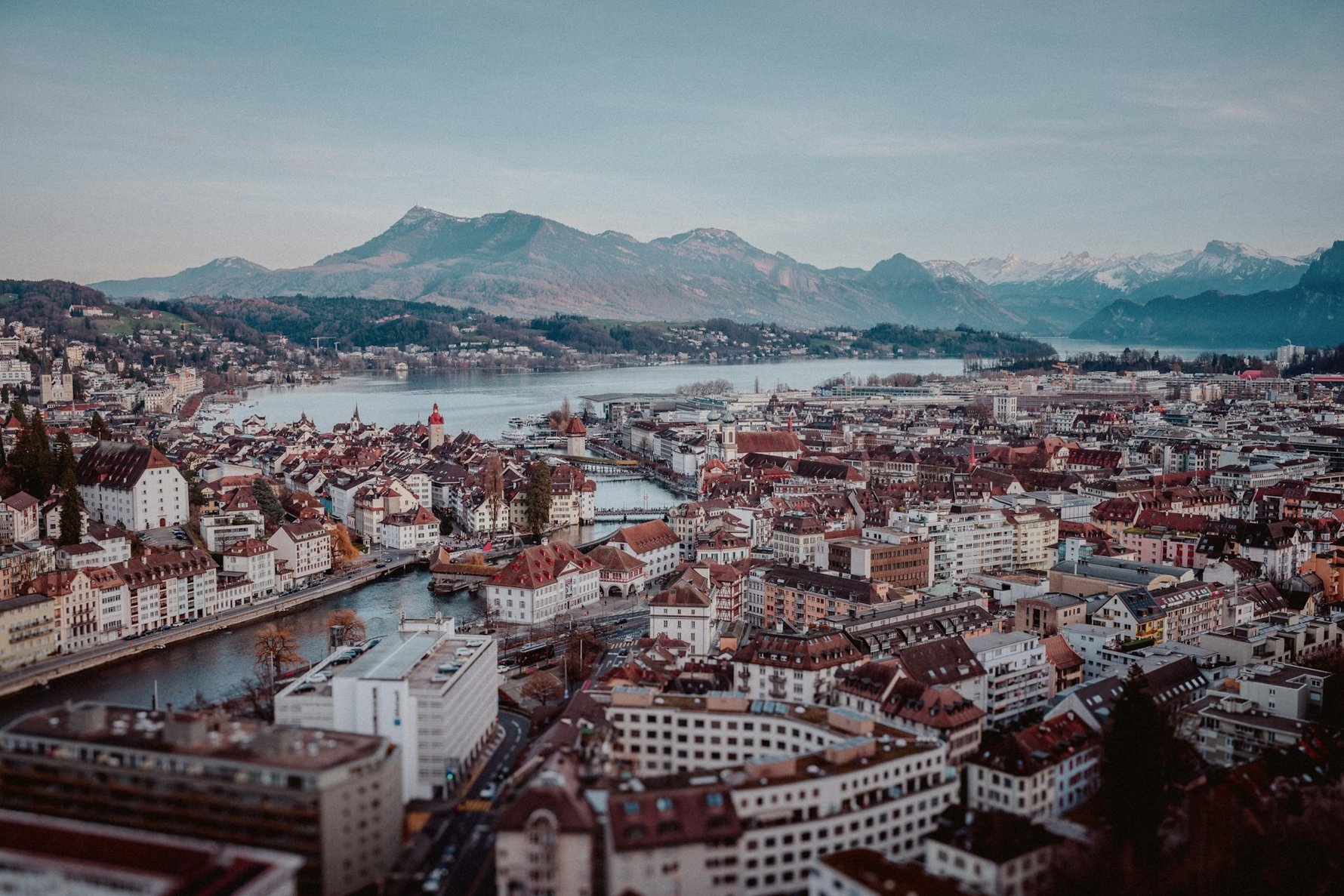
1. Kapellbrücke and the Wasserturm
The Kapellbrücke is the cover image of every brochure Lucerne has ever produced, and it has earned the distinction. Built around 1365 as part of the city’s fortifications – its diagonal path across the Reuss and the high parapets on the lake-facing side are not architectural whims but deliberate defensive measures – it is the oldest surviving truss bridge in the world and, at 205 metres, one of the longest covered wooden bridges in Europe. The interior triangular gables were decorated from 1614 with paintings depicting scenes from Lucerne’s history and the lives of its patron saints, St Leger and St Maurice. Local notables sponsored the panels in exchange for having their coats of arms featured; an arrangement that combined civic virtue with vanity in a ratio that will be familiar to anyone who has ever seen a hospital naming wing.A fire broke out on a moored boat beneath the bridge in the early hours of 18 August 1993, and destroyed around two thirds of the structure and most of the paintings before the fire brigade could contain it. The cause was never established to legal satisfaction – a discarded cigarette is the leading theory – and in any case the statute of limitations expired before anyone could be charged. The city council decided the same day to rebuild; construction began in November 1993 and the bridge was reopened in April 1994, eight months later, for CHF 3.4 million. Of the 147 paintings that existed before the fire, only 30 were fully restored. Replacement panels have been installed in the emptied gables, making the difference between old and new reasonably easy to spot if you are looking for it.
The octagonal Wasserturm attached to the bridge actually predates it by at least a century, built after 1262 and used variously as a watchtower, treasury, archive, and prison before becoming the decorative centrepiece it is today. It can be admired from the bridge but not entered.
- Location: Crosses the Reuss between the Altstadt and the right bank. The entrance is near Kapellplatz on the northern bank.
- Best time to visit: Early morning, before the tour groups arrive, or after 18:00 when the crowds thin considerably. The bridge is lit at night and worth seeing after dark.
- Ticket prices: Free. It is a pedestrian bridge, not a museum.
-
Good to know: Around 13,800 people cross the Kapellbrücke every day, meaning you are extremely unlikely to have it to yourself. The Spreuerbücke, 400 metres downstream, is Lucerne’s other historic covered wooden bridge and worth crossing on the way back – its 17th-century paintings depict the Dance of Death, which is considerably more cheerful in context than it sounds.
![]()
That sleepy sleepy lion © Ilia Bronskiy / Unsplash
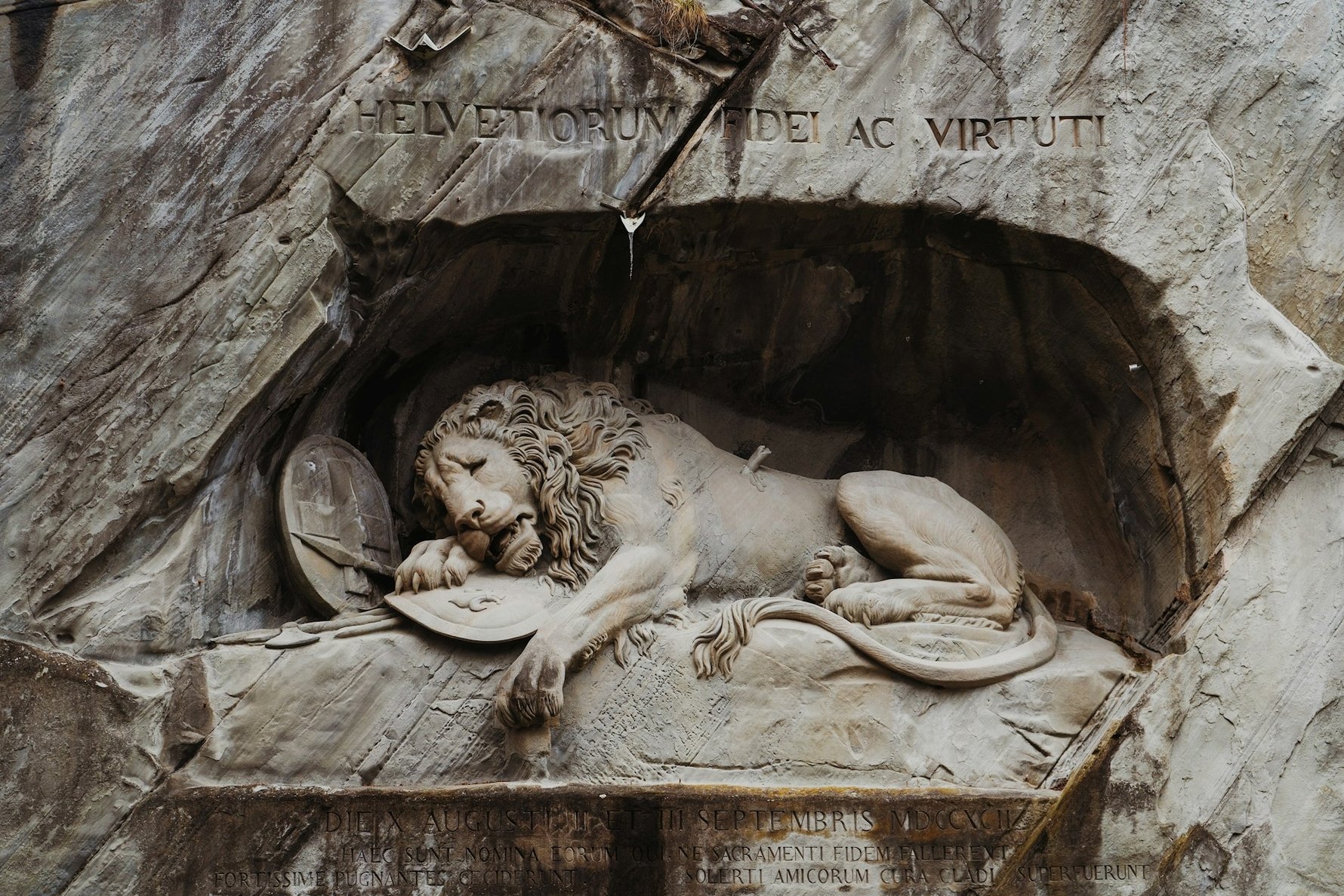
2. The Löwendenkmal (Lion Monument)
The Löwendenkmal is a ten-metre-long dying lion carved directly into a sandstone cliff face, and it is, in the considered opinion of Mark Twain, who visited in 1878, “the most mournful and moving piece of stone in the world.” Twain was not exaggerating, which is notable given his general relationship with restraint. The lion lies mortally wounded, a broken spear in its flank, one paw resting on a shield bearing the fleur-de-lis of the French monarchy. Beside him is a second shield with the Swiss cross. The inscription above reads HELVETIORUM FIDEI AC VIRTUTI – to the loyalty and bravery of the Swiss – and the numbers below record 760 dead and 350 survivors.The monument commemorates the Swiss Guards who died defending the Tuileries Palace in Paris on 10 August 1792, when revolutionary insurgents stormed the building. The survivors of the regiment who had remained at the palace were mostly killed in the fighting or massacred after surrender; an estimated 200 more died in prison or during the September Massacres that followed. A Swiss officer, Karl Pfyffer von Altishofen, happened to be home on leave in Lucerne when his comrades were killed. He spent the next several decades building a memorial campaign, raising funds from European royal houses and commissioning Danish sculptor Bertel Thorvaldsen to design the image. The carving itself was executed between 1820 and 1821 by stonemason Lukas Ahorn – his predecessor on the project had fallen from the scaffold and died, a fact the monument’s promotional literature does not dwell on. It has attracted over a million visitors a year ever since it was inaugurated.
The setting contributes as much as the sculpture: a sheltered park, a small reflecting pond, vines on the cliff, and the kind of ambient quiet that makes the crowd fall silent even on a busy afternoon.
- Location: Denkmalstrasse 4, a ten-minute walk north of the old town. Bus lines 1, 19, 22 or 23 to Löwenplatz.
- Best time to visit: Early morning or late afternoon, when tour groups are elsewhere. Midday in summer is particularly crowded.
- Ticket prices: Free.
- Good to know: The Glacier Garden is directly adjacent and worth adding to the visit – a romantic 19th-century park containing glacial potholes from the last Ice Age, a diorama, and a mirror maze that has been delighting and disorienting visitors since 1896.
3. The Musegg Wall and Towers
The Museggmauer is an 870-metre medieval fortification wall running along the northern edge of the old town, with nine towers at intervals along its length. Built around 1400 in the aftermath of the Battle of Sempach, it is one of the longest and best-preserved city walls in Switzerland and forms what the tourist literature correctly describes as a “crown” over the rooftops of the Altstadt, though crown is doing rather more architectural work here than it does in most sentences. Four of the nine towers are open to the public between April and November; the wall ramparts connecting them can be walked, rewarding those who make the climb with panoramic views over the city, the lake and, on clear days, the Alps as far as Mount Pilatus.The standout tower is the Zytturm, Lucerne’s clock tower, whose clock mechanism dates from 1535 and is the oldest in the city. It has one particular privilege: it strikes the hour one minute before every other clock in Lucerne, a right it has held since the Middle Ages when the oldest clock in town was apparently entitled to go first. The clock face is large enough that, in the 15th century, fishermen could read the time from the lake below. The Zytturm also houses a small exhibition of historical tower clocks maintained by the Lucerne Tower Clocks Association, which is the kind of institution that only Switzerland could produce and that is entirely charming for it.
- Location: The western end of the wall is near the Spreuerbücke on the Reuss; the eastern end is in the Musegg district. The most accessible entry point is via the Schirmerturm from the old town.
- Best time to visit: Any time during the April to November season; go a minute before the hour to hear the Zytturm strike first. The wall is closed from November to March.
- Ticket prices: Free. The towers and ramparts are freely accessible during opening season.
- Good to know: The wall is genuinely narrow in places and involves uneven stone stairs. The Männliturm is the only tower with a roof deck rather than a glass window for views, making it the place to head if you want completely unobstructed photographs. Jackdaws, alpine swifts and various bat species inhabit the wall; the nature enthusiasts in your party may find this more interesting than the history enthusiasts do.
4. The Rosengart Collection
The Sammlung Rosengart is one of those museums that makes no sense in the context of the city it inhabits, and yet here it is. Over 300 works by 23 artists of Classical Modernism and Impressionism, assembled over decades by Lucerne art dealer Siegfried Rosengart (1894–1985) and his daughter Angela, occupying the former premises of the Swiss National Bank – a 1924 Empire-style building that proves the Swiss were capable of architectural understatement when they tried – a seven-minute walk from the train station.The collection has two gravitational centres. Around 125 works by Paul Klee cover all of his creative periods, from the early watercolours through the geometric compositions of the Bauhaus years to the symbol-like logograms of his final period; the Rosengart holding is the largest private Klee collection in the world after the artist’s own family. Some 180 works by Pablo Picasso occupy the upper floors, weighted towards his late period and including 32 paintings, around 100 drawings and prints, and five portraits of Angela Rosengart herself, painted by Picasso from life. Angela and Siegfried were not merely collectors of Picasso but friends of his; the relationship with the artist was personal enough that the works were acquired not as investment but as a living environment. The museum opened in 2002, after Angela established the Rosengart Foundation in 1992 specifically to keep the collection intact and accessible to the public rather than dispersing it at auction.
The remaining floors contain works by Monet, Cézanne, Matisse, Renoir, Chagall, Miró, Kandinsky and others – at any other museum, the supporting cast; here, they are almost incidental to the main event.
- Location: Pilatusstrasse 10, a seven-minute walk from the train station. Website: rosengart.ch
- Best time to visit: Weekday mornings; rainy afternoons when the outdoor sights lose their appeal.
- Ticket prices: CHF 20 adults; reduced rates available. Children under 7 free.
- Good to know: Allow 90 minutes minimum; the Klee rooms in particular reward slow looking. The collection is covered by the Swiss Museum Pass. The building has no cloakroom in the traditional sense but small lockers are available for bags.
5. The KKL (Kultur- und Kongresszentrum Luzern)
The KKL is Lucerne’s answer to a question that most Swiss cities of its size would not have thought to ask: what happens if you commission a Pritzker Prize-winning French architect to build a world-class concert hall on the lakefront? The answer, as it turns out, is Jean Nouvel, who won the design competition in 1989 and spent the next eleven years producing one of the more startling buildings in Central Europe. The structure opened in phases between 1998 and 2000, cost CHF 226.5 million (CHF 32.5 million over budget, a figure the Swiss have presumably made their peace with), and is now widely regarded as one of the finest concert halls in the world.The building’s defining feature is its enormous flat roof, measuring roughly 113 by 107 metres with a 45-metre cantilevered projection over the lake that is entirely unsupported from below. The underside is clad in 2,000 aluminium panels that reflect the surface of the water. Nouvel’s original plan was to build the concert hall directly over the lake; when this was refused, he brought the lake into the building instead, with channels of water running between the three main elements of the complex – the concert hall, the multipurpose Lucerne Hall, and the congress centre. The acoustic specifications for the 1,840-seat concert hall were developed with American acoustician Russell Johnson, and the result is an interior that regularly draws comparisons with the finest halls in Vienna and Amsterdam. The opening concert in August 1998 featured Claudio Abbado and the Berlin Philharmonic, which set a standard subsequent events have had to negotiate.
Even if you are not attending a performance, the KKL is worth walking around and through: the lakeside terrace, the exterior boardwalks and the Europaplatz in front of the building are free to access and provide some of the best views of the water and mountains in the city.
- Location: Europaplatz 1, immediately adjacent to the train station on the lakefront. Website: kkl-luzern.ch
- Best time to visit: The exterior and public spaces are accessible at any time. Concert tickets should be booked in advance, particularly during the annual Lucerne Festival in August and September.
- Ticket prices: Free to enter and walk around. Concert and event tickets vary considerably; check the KKL website for the current programme.
- Good to know: The KKL also contains the Kunstmuseum Luzern (Lucerne Art Museum) on its upper floors, which focuses on contemporary Swiss and international art and is worth a separate visit. The Seebar cocktail bar on the concert hall side has excellent lake views and does not require a concert ticket.
6. The Old Town (Altstadt)
The Altstadt of Lucerne is the thing connecting all the other things on this list, and also a destination in itself. The medieval core on both banks of the Reuss contains painted façades, oriel windows, cobblestone lanes and a succession of squares – Weinmarkt, Hirschenplatz, Kornmarkt – that were once the commercial heart of the city and are now the commercial heart of the city’s tourism, which is a transition that has been managed with more grace than usual. The buildings are genuinely old; the facades in Weinmarkt in particular date from the 15th and 16th centuries and include some of the finest examples of Renaissance fresco painting on secular buildings in Switzerland.The Jesuitenkirche on the southern bank of the Reuss is the first large Baroque church to be built in Switzerland, completed in 1677, with twin onion-domed towers that have been a landmark of the Lucerne skyline ever since. The interior is all pink, white and gold stucco; the exterior is the reason people stop on the bridge and take photographs. The Hofkirche St Leodegar, further east, is the most important Renaissance church in Switzerland and sits in a quiet precinct that feels a world away from the busier parts of the old town. Its twin Gothic spires survived a fire in 1633 that destroyed the original building; everything you see today is a 17th-century rebuild, with the exception of the spires, which predate the disaster and therefore the rest of the church by around 200 years.
- Location: Both banks of the Reuss. The Altstadt is the obvious starting point; cross at the Kapellbrücke and continue into the right-bank quarter for the Hofkirche and Lion Monument.
- Best time to visit: Early morning on weekdays. The old town is at its most bearable before 09:00, when the tour groups are still having breakfast.
- Ticket prices: Free. The Jesuitenkirche and Hofkirche are both free to enter; a small donation is customary.
-
Good to know: The Saturday market on Weinmarkt and the Mühlenplatz is one of the better weekly markets in Central Switzerland. The Rathaus (Town Hall) on the Rathausquai was completed in 1606 in Florentine Renaissance style, which sounds improbable but is not.
![]()
A historic paddle steamer glides across the tranquil turquoise waters of Lake Lucerne © Fabian Kleiser / Unsplash
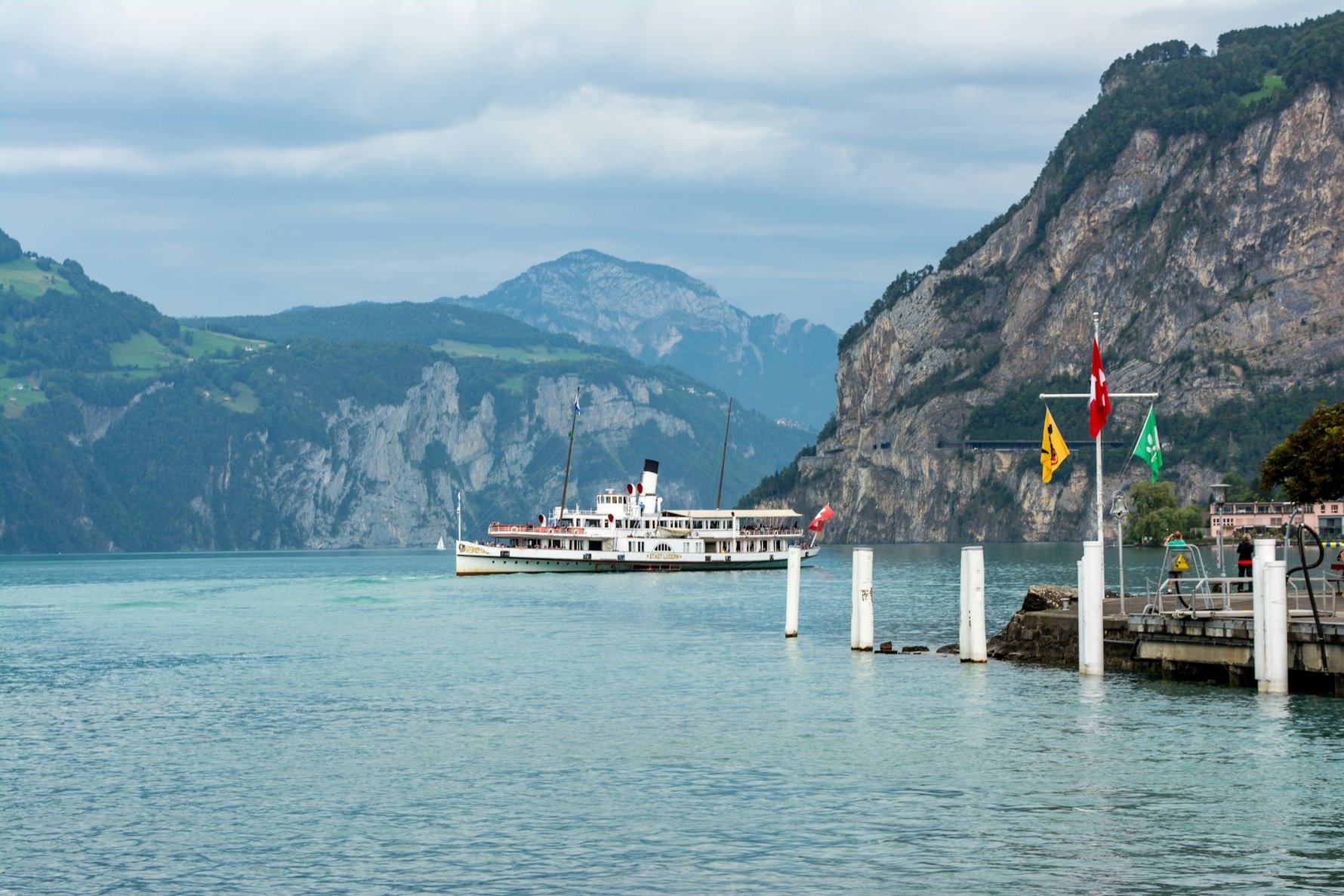
7. Lake Lucerne and the SGV Boats
Lake Lucerne – the Vierwaldstättersee, or Lake of the Four Forest Cantons, for those who prefer geographical accuracy to convenience – is 38 kilometres long, up to 214 metres deep and ringed on almost every side by mountains that become progressively more dramatic as you head south towards the Uri arm of the lake. It is Switzerland’s fourth-largest lake, formed at the end of the last Ice Age and the setting, give or take some poetic licence, for the William Tell legend. The view from the lakeside promenade in Lucerne, with the Alps framing the water on three sides, is one of the canonical Swiss images and remains genuinely impressive even after you have seen it on a hundred postcards.The SGV (Schifffahrtsgesellschaft des Vierwaldstättersees) operates 20 vessels on the lake, including five historic paddle steamers built in the Belle Époque era that remain in service and are not a theme park attraction but functioning scheduled public transport. A trip to Flüelen at the southern end of the lake takes around three hours and fifteen minutes from Lucerne, passing through scenery that narrows into something resembling a Norwegian fjord before opening out into the Uri basin. Shorter trips to Weggis (gateway to Mount Rigi) or Vitznau are practical for half-day excursions. All scheduled SGV services are covered by the Swiss Travel Pass, which means visitors holding one can use the boats as freely as any bus or train.
- Location: Boats depart from the Bahnhofquai piers immediately beside the train station. Pier 1 serves Weggis, Vitznau, Brunnen and Flüelen; other piers serve additional destinations. Timetables at lakelucerne.ch
- Best time to visit: Summer for frequency and the full range of destinations; autumn for empty boats and reflections of the changing vegetation on the water. Winter services run but on a reduced schedule.
- Ticket prices: Vary by route; free with Swiss Travel Pass or GA travelcard; 50% off with Half Fare card. Children under 6 free; 6–15 half price.
- Good to know: The paddle steamers have onboard restaurants, and a long lunch crossing to Flüelen and back is one of the better ways to spend a day in the region. The Gotthard Panorama Express combines the Lucerne–Flüelen boat crossing with a panoramic train ride over the historic Gotthard mountain railway to Lugano – a full day’s journey and one of the more spectacular options in Swiss public transport.
8. Mount Pilatus
Mount Pilatus dominates the skyline to the southwest of Lucerne at 2,128 metres and is, for most visitors, the mountain you go up. The name probably derives from the Latin pileatus (cloud-capped) rather than from Pontius Pilate, whose body was allegedly thrown into the lake by the Romans after his execution and whose restless spirit was said to haunt the mountain for centuries thereafter – a story that added considerably to Pilatus’s medieval reputation for danger. Goats were prohibited from grazing on the slopes until the 16th century for fear of disturbing him. Whether this did anything for the goats is unrecorded.The ascent can be made by two different routes, and the classic approach is to combine them in a round trip. The Pilatus Railway from Alpnachstad on the lake is the steepest cogwheel railway in the world, operating on a rack gradient of up to 48 degrees and covering the 4.6 kilometres to the summit in around 30 minutes. The cable car and gondola from Kriens, on the western edge of Lucerne, provide the alternative route and can be reached by city bus from the station. The summit has two peaks, a hotel, a revolving restaurant, a rope park and views that on a clear day extend to the Bernese Oberland, the Jura and, reportedly, the Black Forest. The standard visit from Lucerne combines the lake boat to Alpnachstad, the cogwheel railway to the top, and the gondola back to Kriens – the “Golden Round Trip” in the tourist literature – and takes most of a day.
- Location: Cogwheel railway from Alpnachstad (reachable by boat or bus from Lucerne); cable car/gondola from Kriens (Bus 1 from the station to Kriens Zentrum). Website: pilatus.ch
- Best time to visit: Spring and autumn for clearer views and fewer visitors; summer for the full range of activities. Check the weather forecast before going – summit cloud is common and turns the trip from spectacular to pointless with minimal warning.
- Ticket prices: The round trip (boat, cogwheel railway, gondola) costs around CHF 115. The Swiss Travel Pass gives 50% off mountain transport; the Lucerne Travel Pass covers Pilatus in full. The cogwheel railway runs from May to November only; in winter, gondola access from Kriens is the only option.
-
Good to know: The cogwheel railway seats are angled to keep passengers level on the steep gradient; if this sounds alarming, the gondola is the gentler alternative. Book the Golden Round Trip online in advance in summer. The rope park at mid-station is one of the better aerial adventure parks in Central Switzerland.
![]()
You don't have to go far from Lucerene to reach the mountains © Jim Tran / Unsplash
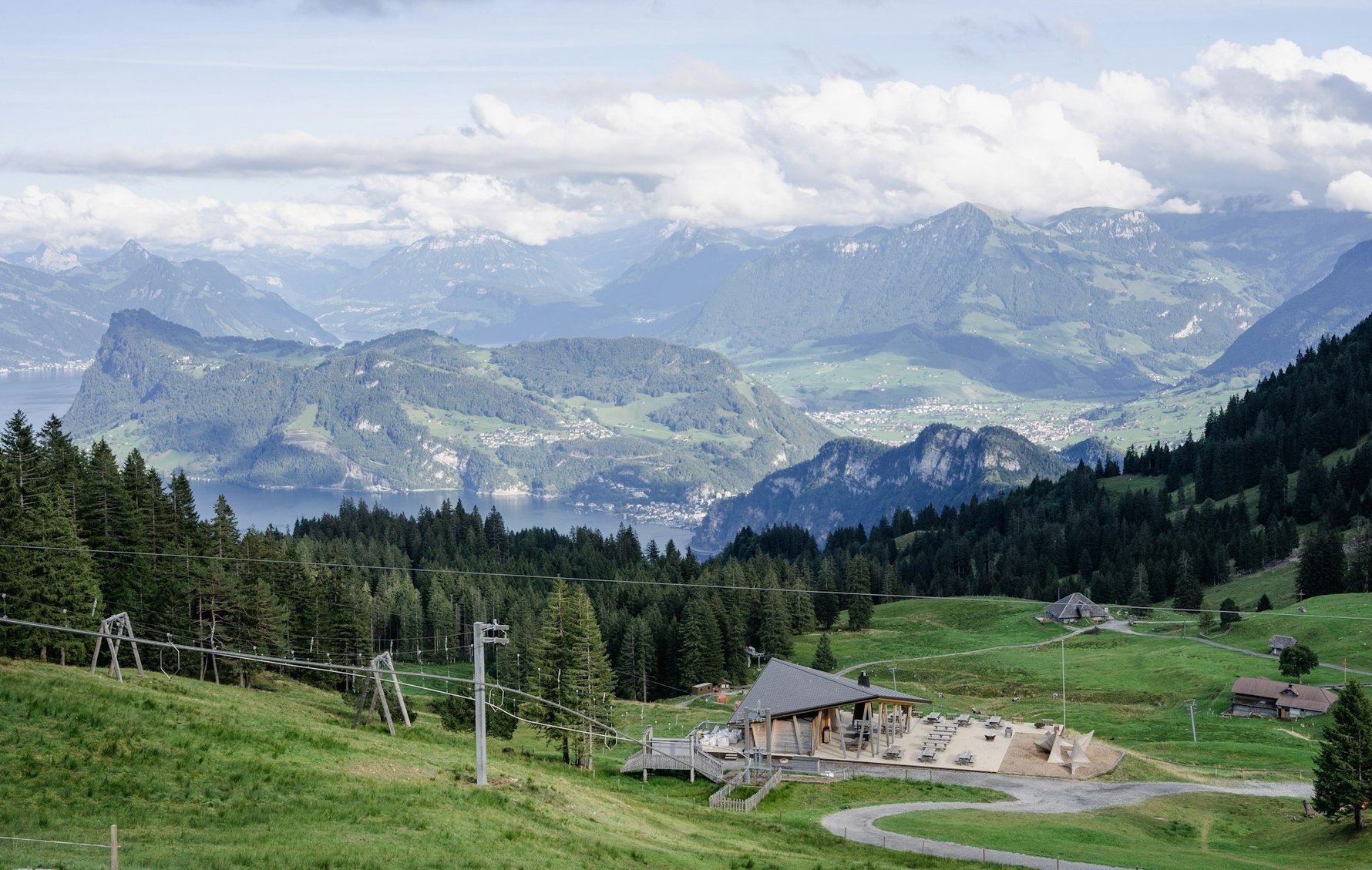
9. Mount Rigi
Mount Rigi is Pilatus’s older, quieter sibling: not as high (1,798 metres), not as dramatic, and considerably less interested in its own mythology. What it offers instead is a 360-degree panorama across Lake Lucerne, Lake Zug and Lake Lauerz, the Bernese Alps to the south, and on a clear day much of Central Switzerland. The Queen of the Mountains, as it has been known since the 19th century, was one of the first Alpine destinations to attract serious tourism, and the infrastructure reflects this: the Rigi Bahn, which ascends from Vitznau on the lake, is the oldest mountain railway in Europe, having opened in 1871, and has been ferrying visitors to the summit ever since with a reliability that the Alps themselves cannot quite match.The round trip by boat and cogwheel train – boat from Lucerne to Vitznau, Rigi Bahn to the summit, descent to Arth-Goldau and train back to Lucerne – is the standard approach and takes most of a day at a comfortable pace. Alternatively, the mountain can be reached from Weggis by cable car and from Arth-Goldau by a second cogwheel railway; multiple ascent and descent combinations are possible, and the SGV timetable is designed to make them flow without much waiting. Hiking trails cover the mountain at all levels of ambition.
- Location: Cogwheel railway from Vitznau (boat from Lucerne) or Arth-Goldau (train from Lucerne); cable car from Weggis (boat from Lucerne). Website: rigi.ch
- Best time to visit: Sunrise from the summit is a long-established Rigi tradition – the mountain has a hotel for those who want to do it properly. Otherwise, any clear morning.
- Ticket prices: The round trip via boat and Rigi Bahn costs around CHF 95–115 depending on routing. The Swiss Travel Pass gives 50% off; the Lucerne Travel Pass covers Rigi in full.
- Good to know: Rigi is considerably more family-friendly than Pilatus – the gradients are gentler, the summit is flat enough to walk around comfortably, and the overall atmosphere is less “extreme sport” and more “19th-century gentleman’s excursion.” The Rigi Kaltbad mid-station has a spa and mineral baths, which adds a further dimension to the day if the views aren’t quite enough.
10. The Swiss Museum of Transport
The Verkehrshaus der Schweiz is, by visitor numbers, the most popular museum in Switzerland, which is a fact that surprises people who expect the most popular museum in Switzerland to be about watches or cheese. It is a large, cheerful and genuinely excellent museum dedicated to the history of transport – road, rail, water, air and space – and has the rare quality of being interesting to adults and entertaining to children simultaneously, which is rarer than it should be.The collection covers Switzerland’s railway history with particular depth, which is appropriate for a country that built some of the most remarkable engineering in the Alps and still operates a public transport network that the rest of Europe periodically weeps over. There are full-size locomotives, historic aircraft, early automobiles, cable cars, and a section on space travel that arrives somewhat unexpectedly but makes a reasonable argument for its inclusion. The Swiss Chocolate Adventure, a separate ticketed experience within the museum, takes visitors through the history of Swiss chocolate via a gentle ride that manages to be both informative and promotional without trying to hide the contradiction. The Planetarium, also on site, runs regular shows and is worth catching if the timing works out.
The museum is located on the eastern lakefront, about fifteen minutes from the old town by foot along the promenade, or a short bus ride from the station.
- Location: Lidostrasse 5, on the eastern lakefront. Bus 6, 8, or 24 from the station to Verkehrshaus. Website: verkehrshaus.ch
- Best time to visit: Open daily, year-round. Weekdays are quieter; summer weekends attract school groups and families in volume. Allow at least half a day; a full day is not unreasonable.
- Ticket prices: Around CHF 32 adults, CHF 16 children (6–16); family tickets available. The Swiss Chocolate Adventure and Planetarium require separate tickets or a combination pass. Covered by the Swiss Travel Pass (free admission for passholders).
- Good to know: The museum is directly on the lake and has its own restaurant and snack facilities. The MediaGlobe cinema on site shows films in a 360-degree dome format that is less gimmicky than it sounds. If you are visiting with children, budget for a full day and recalibrate your expectations for the pace accordingly.


Comments