
Admirer of Croatian history Tocher Mitchell (SME Finance Specialist) takes you on a journey of castle and fortress ruins in the Zagreb County.
Croatia is dotted with hundreds of medieval castles, some intact but most in various stages of ruin. The area surrounding Zagreb is no exception. You don’t have to travel far to find them – some are right in the outskirts of the city. The history behind the castles is captivating. Originally, they were built as redoubts against the Tartars (Mongols). Later most were expanded and refortified to defend against the Ottoman Turks. By the 17th century, advances in military technology had rendered castle fortresses obsolete. Besides, noble ladies by that time were refusing to live in cold, drafty, isolated, stone castles or forts. Those that weren’t destroyed in battle were abandoned and fell into ruin. But exploring these ruins is pleasurable and fascinating. As they usually were built on hill or mountain tops, the views and the architecture can be spectacular. And wandering through them conjures up visions of what might have transpired there over the centuries.
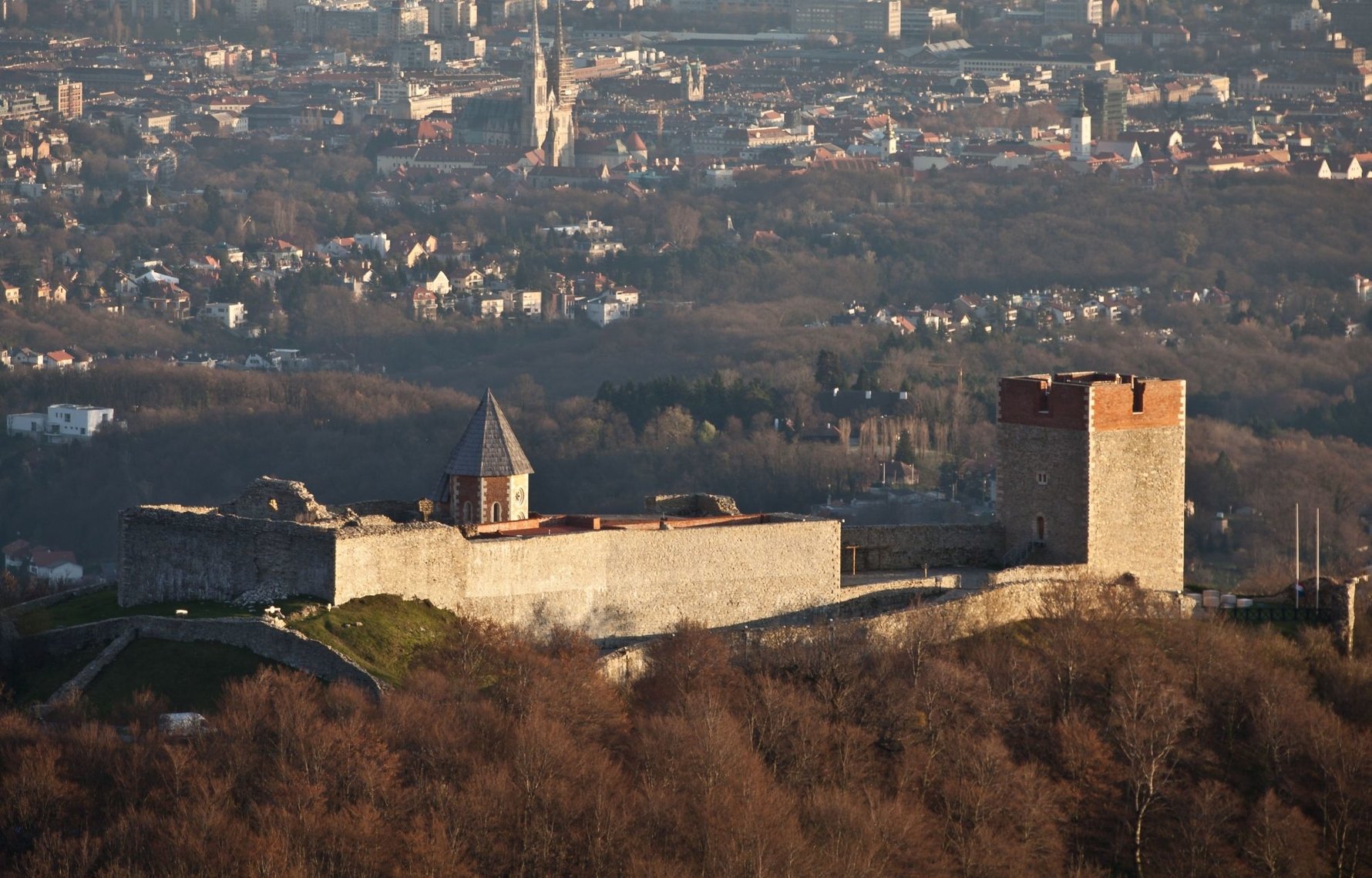
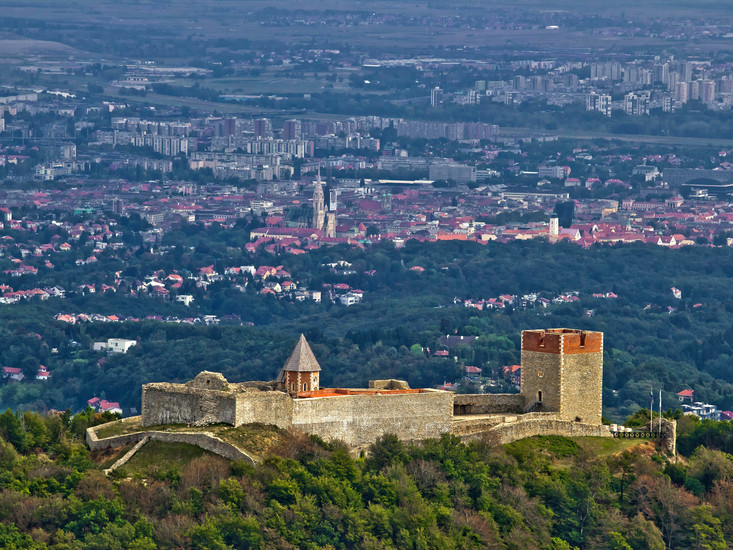
There are three castle ruins on the slopes of the Medvednica mountain range (literally translated, “Bear mountain”) just north of Zagreb. Two of those castles are in the city of Zagreb itself. Medvedgrad is clearly visible from downtown about a third of way up the slopes of Sljeme Mountain. To reach the castle drive or take bus No 102, which runs between Britanski trg and Mihaljevac, and get off at the “Blue Church” in Šestine. Take the paved road that runs up past the church cemetery towards the mountain. After you pass a restaurant on the right hand side of the road if you are walking look for trail No 12 going up into the forest on the left side of the road. The hike up from the bus stop takes 35 – 45 minutes and is moderately steep in places. You can also drive to the castle in about ten minutes on the paved road. There is a café in the restored section of the castle. The view of Zagreb to the south and west is very good. Also, in front of the castle check out the somewhat incongruous modern monument and eternal flame dedicated to fallen Croatian soldiers.
Medvedgrad has a colorful, checkered history. Zagreb’s Bishop Filip built the fortress in the 13th century, after King Béla IV granted him a deed authorising its construction. The fortress had great strategic significance. It could be easily defended during times of war, and it was situated near the western border of the Hungarian-Croatian state. During the seven centuries after its construction, Medvedgrad had many owners. Until the 16th century, it was owned by several distinguished, noble families and individuals, such as Bela IV, Drašković, Gregorijanec, Radić, Zrinski, Andrija III, Zagreb Kaptol and King Matijaš Korvin.
Béla IV was a key figure in Croatian and Hungarian medieval history. He was king from 1235 – 1270, the period during which the Mongols first invaded the area. Aware of the threat they posed, Béla tried to mobilize the troops of other nobles and magnates, and he sent messages asking for help to Pope Gregory IX and the Holy Roman Emperor Frederick II, but to no avail. The Mongols eventually routed Béla's army in the Battle of Mohi on April 11, 1241. It was only a year later that the Mongols withdrew upon the death of their Great Khan, Ogodei, son of Ghengis Khan. Béla reoccupied his kingdom and undertook a massive construction campaign. It was this campaign that produced many of the castle fortresses designed to defend against another, possible Mongol invasion. Many of the ruins we can see in Croatia today are of castles built during this time.
Medvednica Nature Park Archives
Susedgrad is the second castle ruin in the city of Zagreb. It’s situated on the western edge of Zagreb on a low hill, in an area appropriately called “Podsused” (literally translated, “Beneath Sused”). The remains of the castle are visible from the Zagreb – Maribor highway through thick woods, but only in winter, when there is less foliage. Susedgrad is 12 km (7.5 miles) west of the main square, Trg bana Josipa Jelačića. To reach it simply follow Ilica, the main east-west avenue. There are several city buses that go to Podsused from Črnomerec, which is the western terminus of trams 2, 6 and 11. Once you reach Podsused you should turn right off the highway right before a VW dealer. Behind the dealer a marked trail begins. The trail winds up through a wooded park. The ascent only takes around 10 – 15 minutes. There is a good view of the Sava River just below the cliff, close enough that you can hear the noise of the rapids. On a clear day one can see the Samobor Mountains and perhaps even the Slovenian Alps. There is not much left of the ruins, just some walls and what looks like a moat. Nonetheless they are interesting to explore and their proximity to the center of Zagreb makes them an attractive jaunt for a couple of hours.
1/4